


Low-Frequency UPS Engineering Guide: Sizing 10–800kVA Systems for Industrial Plant Loads

Selecting a low-frequency uninterruptible power supply (UPS) across the 10–800kVA range is driven by mechanical physics rather than pure electronic efficiency. While high-frequency transformerless units deliver excellent performance in climate-controlled server rooms with predictable power factor correction, heavy industrial plants subject backup power equipment to direct-on-line motor inrush, inductive back-EMF, harmonic pollution, and dirty generator supply. In these operating environments, the built-in low-frequency galvanic isolation transformer is not a legacy design choice—it is a physical buffer shielding the inverter and critical loads from catastrophic failure.
- 1. What Makes Low-Frequency UPS Systems Essential for Heavy Plants?
- Complete Galvanic Isolation
- True Common-Mode Noise Attenuation
- Robust Neutral Creation
- 2. 10–800kVA Capacity Segmentation and Industrial Applications
- 3. Handling Motor Inrush and Dynamic Overload: The Sizing Math
- The Inrush Thermal Equation
- Sizing Formula for Mixed Motor Loads
- 4. Low-Frequency vs High-Frequency vs Modular: Industrial Plant Sizing Matrix
- 5. Battery Bank Sizing and DC Bus Architecture for 10–800kVA Systems
- The Industrial Autonomy Rule
- 6. Diesel Generator Integration and Weak-Grid Resilience
- Rectifier Soft-Start (Walk-In)
- Wide Frequency Acceptance Window
- Cold Load Pick-up and Slew Rate Management
- 7. Environmental and Installation Requirements for Plant Engineers
- 8. Ten-Line Procurement Specification Sheet for Tenders
- FAQ
1. What Makes Low-Frequency UPS Systems Essential for Heavy Plants?
If your engineering team is evaluating broader facility-wide power architectures, review our baseline overview of industrial UPS systems, applications, and benefits before sizing individual manufacturing lines. For severe electrical installations, this engineering guide establishes practical sizing rules, motor inrush math, and transformer-based topology advantages across the 10–800kVA spectrum.
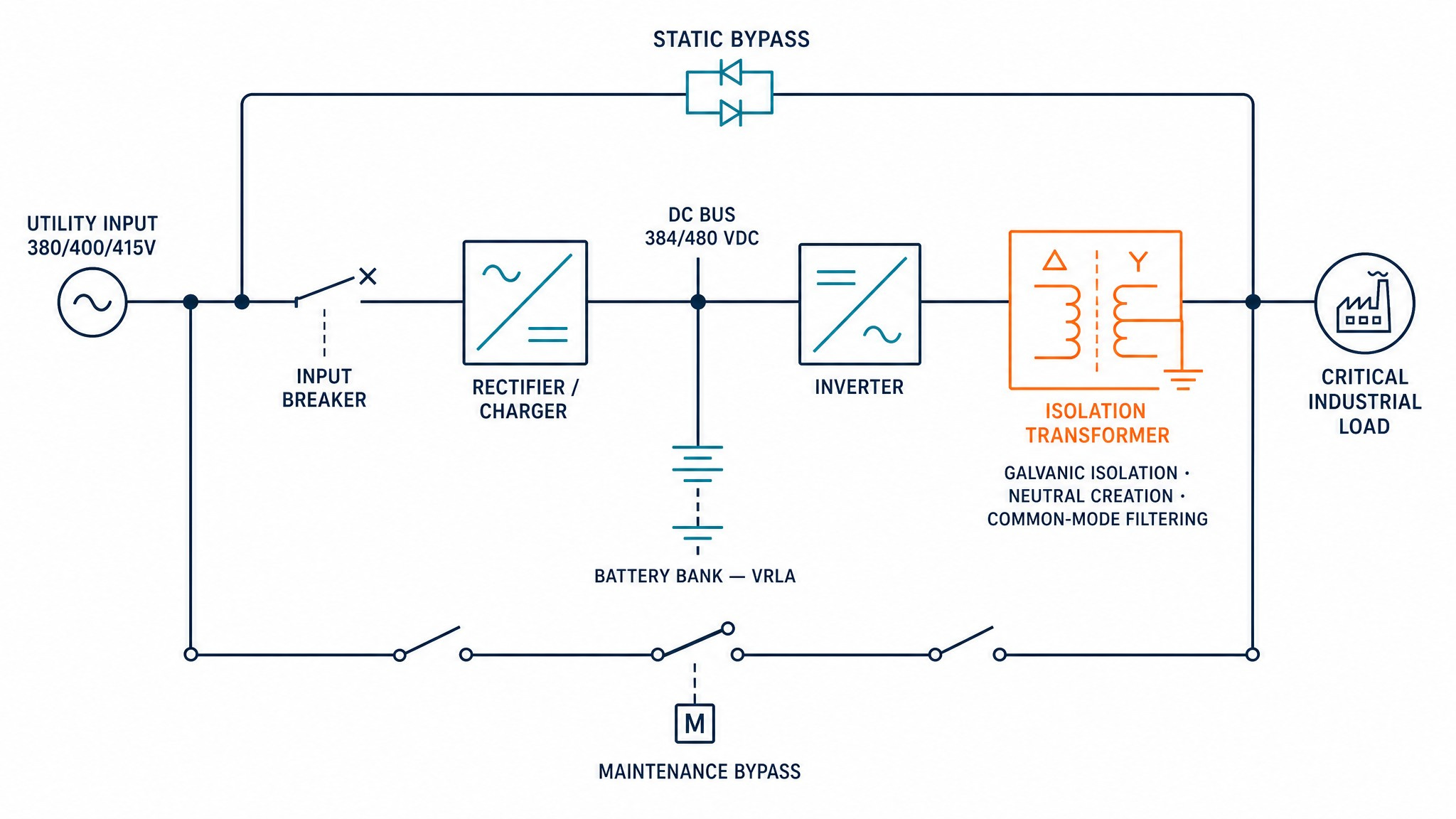
A low-frequency UPS operates on a double-conversion topology where an isolation transformer is physically integrated on the inverter output (and often on the bypass line). Unlike high-frequency UPS units that synthesize AC output directly from a high-voltage DC bus using high-speed IGBT switching and small ferrite inductors, a low-frequency machine employs a copper- or aluminum-wound core transformer operating at line frequency (50 Hz or 60 Hz).
This magnetic design delivers three decisive advantages in demanding industrial and manufacturing applications:
Complete Galvanic Isolation
The primary and secondary windings are physically isolated, preventing DC bus voltage injection into downstream factory loads during catastrophic inverter IGBT failure.
True Common-Mode Noise Attenuation
The magnetic core naturally filters high-frequency electrical spikes, lightning transients, and industrial switching noise without degrading electronic surge arrestors.
Robust Neutral Creation
Industrial facilities often experience phase load imbalance or floating neutral issues. The output star-configured isolation transformer establishes a stable, local neutral reference directly at the machine terminal.
2. 10–800kVA Capacity Segmentation and Industrial Applications
Industrial plants do not size low-frequency UPS units uniformly across production floors. Sizing follows three distinct capacity brackets based on process criticality and motor starting profiles:
When designing plant substations, engineers must avoid grouping disparate load profiles onto a single centralized cabinet unless total connected motor capacity is well understood. While lower capacity blocks (10–40 kVA) often handle localized sensitive controls with minimal thermal overhead, mid-tier and high-tier units (60–800 kVA) serve as critical infrastructure nodes that interface directly with heavy industrial busbars, requiring dedicated spatial clearance for maintenance access and heavy copper cable routing.
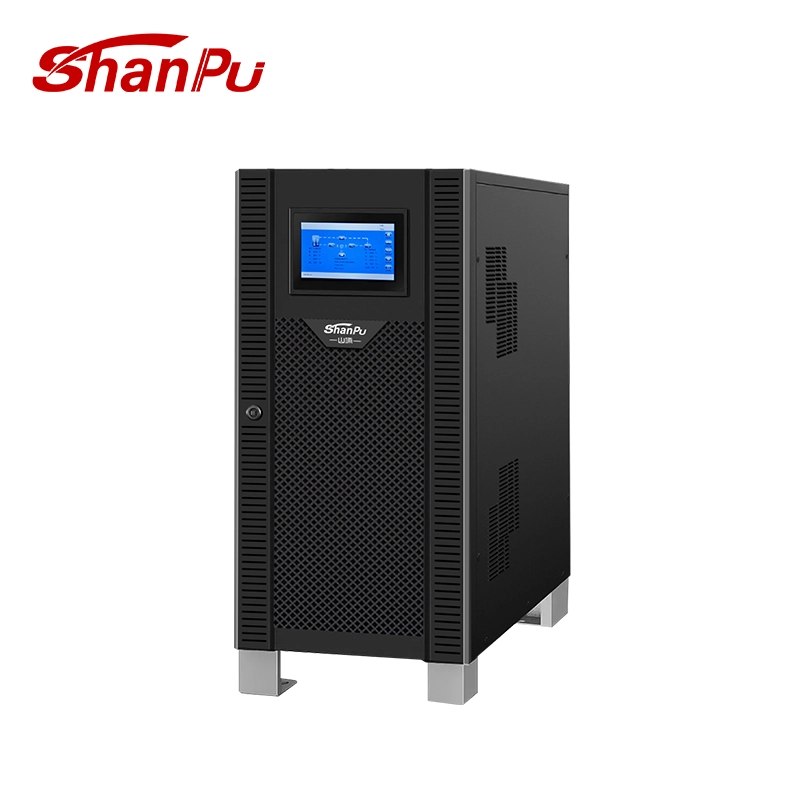
For single-cabinet installations requiring standalone power continuity up to 800 kVA, review the full engineering specifications of the three-phase low-frequency industrial online UPS 10–800kVA.
3. Handling Motor Inrush and Dynamic Overload: The Sizing Math
The most frequent sizing error in industrial procurement is calculating UPS capacity based solely on running kilowatt (kW) ratings. Heavy industrial loads—such as water pumps, air compressors, conveyor belt drives, and vacuum blowers—exhibit extreme starting current surges.
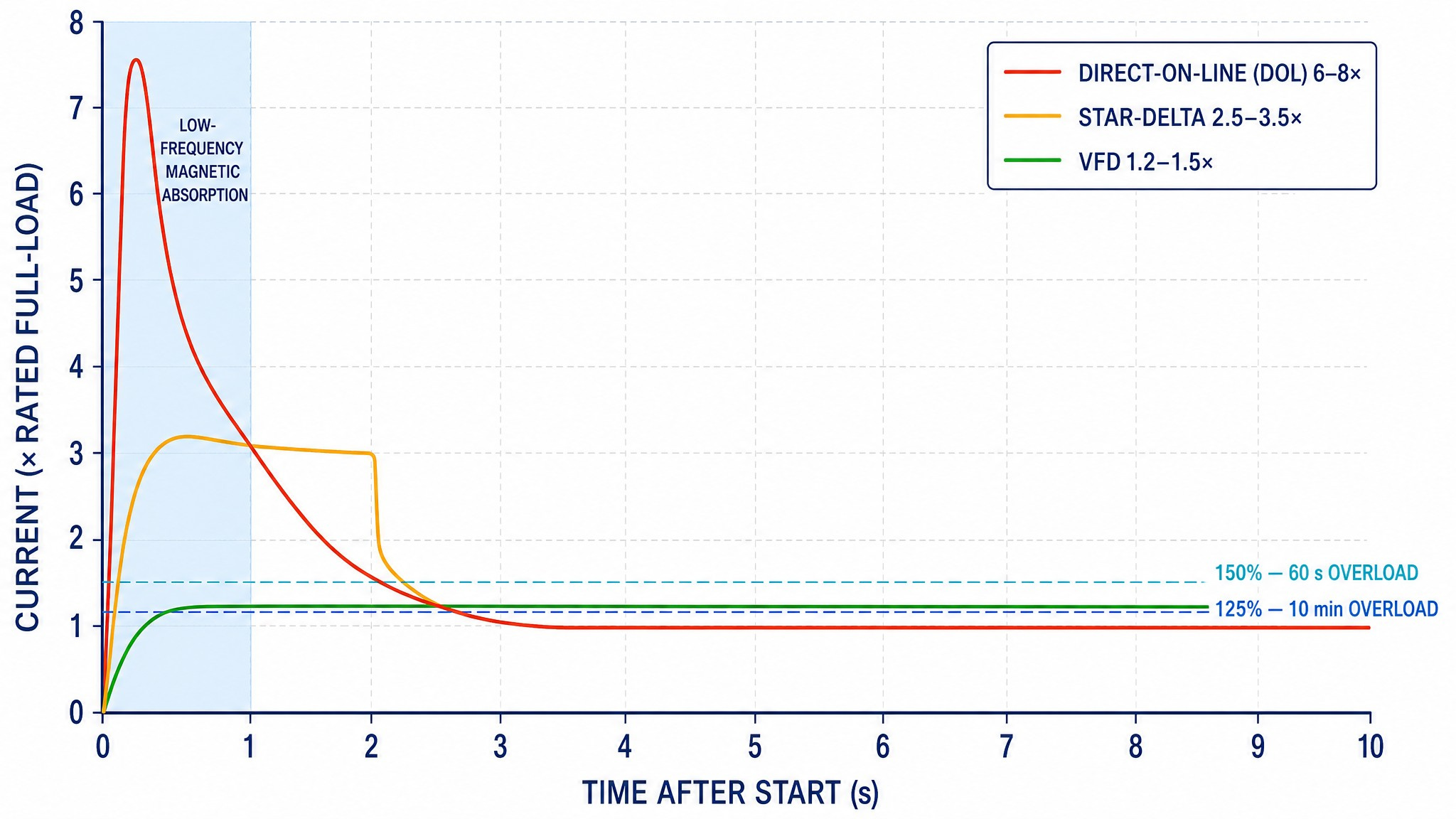
Direct-on-line (DOL) starting draws 6x to 8x rated full-load current for 2 to 5 seconds. Star-delta starting draws 2.5x to 3.5x rated current for 3 to 10 seconds. Variable frequency drives (VFDs) limit current to 1.2x to 1.5x, but input rectifiers generate substantial 5th and 7th harmonic current distortion (THDi).
The Inrush Thermal Equation
High-frequency UPS systems protect internal power semiconductors by transferring to static bypass when instantaneous current exceeds 110% to 125%. If the bypass utility grid experiences a blackout or voltage dip simultaneously, the high-frequency inverter shuts down, dropping the load.
A low-frequency UPS handles inrush magnetically. The massive iron core absorbs short-duration saturation without semiconductor puncture. Typical industrial design ratings provide 110% continuous load tolerance for 60 minutes, 125% overload capacity for 10 minutes, 150% overload capacity for 60 seconds, and inverter short-circuit clearance capability of 300% rated current (3x In) for 200 milliseconds to pop downstream circuit breakers without dropping the common bus.
Sizing Formula for Mixed Motor Loads
To calculate the required continuous rating (S_UPS in kVA), use the following peak-demand formula:
Required UPS kVA = [ Total Running kW + (Peak Starting kW - Running kW of Largest Motor) ] / [ Power Factor x Inverter Overload Factor ]
Where Power Factor is typically 0.8 to 0.85 inductive, and Overload Factor is the inverter's verified 60-second limit (typically 1.5).
Worked Example: A manufacturing line carries a 60 kW base load (PLC, sensors, heaters) plus three 15 kW pumps. If two pumps are running (30 kW) and the third starts direct-on-line (15 kW x 6 = 90 kW peak starting demand):
- Peak Instantaneous Power = 60 + 30 + 90 = 180 kW
- Minimum required UPS continuous rating at 0.8 PF with 150% overload = 180 / (0.8 x 1.5) = 150 kVA
- Recommended model: 160 kVA or 200 kVA low-frequency industrial unit. A commercial 100 kVA unit would trip on the very first motor start.
-
4. Low-Frequency vs High-Frequency vs Modular: Industrial Plant Sizing Matrix
When selecting across architectures, plant managers must evaluate environmental resilience alongside electrical footprint:
For a complete comparative breakdown of total cost of ownership and internal inverter stages, consult our analysis on transformer-based vs transformerless online double-conversion UPS systems, or examine how to choose between modular and transformer-based UPS units.
-
5. Battery Bank Sizing and DC Bus Architecture for 10–800kVA Systems
Industrial processes cannot afford shallow 5-minute autonomy. If a batch chemical reactor or plastic extrusion line freezes midway, restarting takes days of manual cleaning. Industrial plants standardly specify 30 minutes, 60 minutes, or multiple hours of battery backup.
Low-frequency UPS units utilize standardized DC bus configurations. Systems from 10–40 kVA typically operate from 192 VDC to 384 VDC (16 to 32 blocks of 12V VRLA). Units from 60–800 kVA standardize at 384 VDC or 480 VDC nominal (32 to 40 blocks of 12V VRLA, or 192 to 240 cells of 2V industrial VRLA).
The Industrial Autonomy Rule
When calculating Ampere-hour (Ah) capacity for long autonomy, size the end-of-discharge (EOD) cutoff at 1.67V to 1.70V per cell to maximize usable capacity without cell reversal.
Industrial battery rooms without precision air conditioning must derate battery capacity if temperatures drop below 20 °C, or calculate service life degradation above 25 °C.
A standard 800 kVA commercial UPS has a charger sized for 10% of rating (intended for 10-minute batteries). For a 2-hour battery bank, ensure the manufacturer installs an oversized heavy-duty charger capable of supplying 20% to 25% of nominal inverter rating to recharge to 90% within 10 to 12 hours.
-
-
6. Diesel Generator Integration and Weak-Grid Resilience
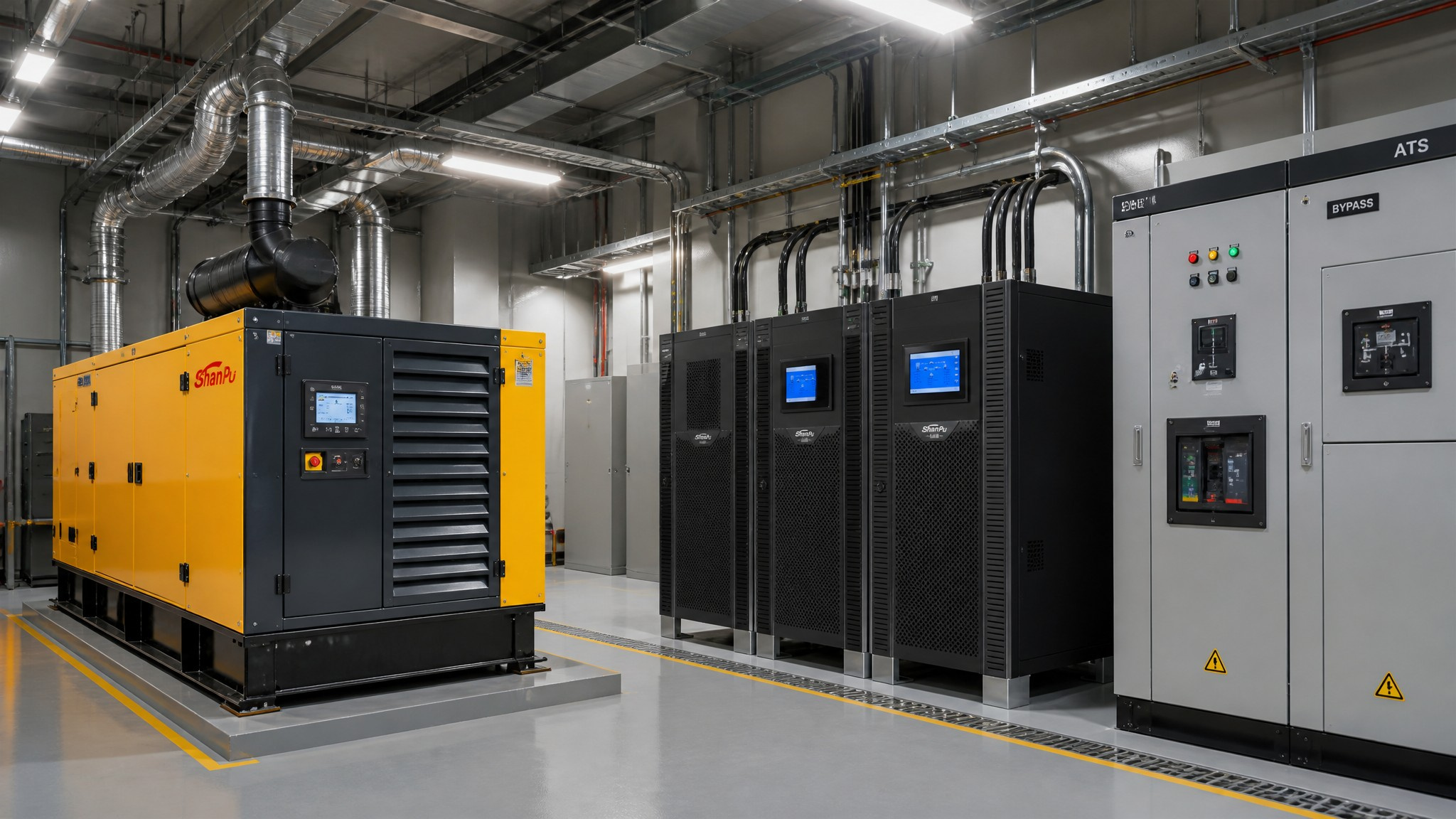
In most industrial facilities, a low-frequency UPS is backed by an onsite diesel genset. Because industrial SCR/IGBT rectifiers can distort the generator's AC alternator waveform, specify the following parameters during procurement:
For a 6-pulse rectifier with passive harmonic filter (THDi < 8%), size the generator at 1.5x to 1.8x the UPS kVA rating. For 12-pulse or IGBT rectifiers (THDi < 3%), a 1.3x to 1.5x ratio is sufficient.
Rectifier Soft-Start (Walk-In)
Ensure the low-frequency UPS firmware incorporates programmable power walk-in (10 to 30 seconds) to prevent generator voltage and frequency collapse during load step acceptance.
Wide Frequency Acceptance Window
Generators hunt under step loads. The UPS must maintain online double-conversion tracking over 40 Hz to 70 Hz before disengaging and resorting to battery power.
Cold Load Pick-up and Slew Rate Management
When the automatic transfer switch (ATS) signals generator supply, the internal inverter frequency synchronization slew rate should be restricted to 1–2 Hz/second. Excessive slew rates cause sensitive plant drives and PLC power supplies to trip on rapid phase displacement, negating the reliability of the emergency generator installation.
-
7. Environmental and Installation Requirements for Plant Engineers
Before dispatching a 10–800kVA low-frequency machine to a factory floor, plant civil and electrical engineers must verify four site conditions:
A 400 kVA low-frequency UPS weighs between 2,200 kg and 2,800 kg due to copper chokes and the main isolation transformer. Concrete slab structural load must be rated for at least 1,000 kg/m².
Operating at 94% efficiency, an 800 kVA unit at full load radiates roughly 48 kW of thermal energy into the room. Forced ventilation or dedicated cooling must be provisioned.
Standard cabinets feature IP20 protection. For facilities with conductive airborne carbon black, cement dust, or splashing liquids, specify factory-fitted IP31, IP42, or conformal-coated PCB boards.
Ensure a wrap-around manual maintenance bypass switch is physically interlocked, allowing technicians to service internal power capacitors and fans while the transformer continues supplying protected load. To consult custom industrial enclosure configurations, plant footprint drawings, or specific voltage customisations, explore the primary low-frequency UPS manufacturing capabilities of ShanPu.
-
8. Ten-Line Procurement Specification Sheet for Tenders
Copy and paste these baseline engineering parameters directly into plant electrical procurement documents:
- Nominal Rating: [10–800] kVA / [9–720] kW at 0.9 lagging output power factor.
- Topology: True Online Double-Conversion with built-in output galvanic isolation transformer.
- Input Voltage: 380V / 400V / 415V ± 25% (3-Phase + Neutral + Ground).
- Output Regulation: ±1% steady-state voltage balance across 0–100% unbalanced loads.
- Overload Performance: 125% for 10 minutes, 150% for 60 seconds, 300% short-circuit clearance for 200 ms.
- Harmonic Distortion (THDv): ≤2% linear load, ≤4% non-linear industrial load.
- Galvanic Isolation: Heavy-duty internal line-frequency inverter transformer with grounded copper electrostatic screen.
- Inverter Bridge Protection: Peak inverse voltage ratings ≥1200V, high-grade thermal heatsinks with individual thyristor/IGBT protection fuses.
- Generator Compatibility: Programmable rectifier walk-in (5–30 seconds) with frequency tracking from 45 Hz to 65 Hz.
- Environmental Rating: 0°C to 40°C continuous operating temperature, conformal-coated electronics, minimum IP21 cabinet enclosure.
FAQ
Why choose a low-frequency UPS over a transformerless model for motor loads?
Motor starting creates extreme inrush current and inductive voltage spikes. Low-frequency UPS units feature an output isolation transformer whose magnetic core absorbs dynamic energy surges, preventing inverter semiconductor damage and nuisance trips to bypass.
What is the typical lifespan of a 10–800kVA low-frequency industrial UPS?
Low-frequency industrial UPS systems are engineered for a 15 to 20-year operational life. Heavy-duty magnetic transformers, robust busbars, and industrial-grade components outlast lightweight high-frequency server room UPS models, which typically require replacement after 8 to 10 years.
Does a low-frequency UPS require an external isolation transformer?
No. A low-frequency UPS incorporates a built-in line-frequency isolation transformer directly on the inverter output. Transformerless UPS designs require an expensive, bulky external transformer cabinet to achieve equivalent galvanic protection and neutral reference.
How does galvanic isolation protect industrial PLCs and CNC machines?
Galvanic isolation breaks the direct electrical connection between input utility power and sensitive equipment. It eliminates ground loops, blocks DC fault current migration during catastrophic inverter failures, and isolates sensitive CNC controls from common-mode electrical noise.
What battery voltage is standard for 100kVA to 800kVA low-frequency systems?
Capacities from 60kVA to 800kVA typically operate on a 384VDC or 480VDC nominal bus, utilizing 32 to 40 blocks of 12V VRLA batteries (or 192 to 240 cells of 2V deep-cycle industrial cells) for extended runtime.
Can a low-frequency UPS run smoothly on a diesel backup generator?
Yes. With programmable rectifier walk-in features (5–30 seconds), broad frequency acceptance (40–70 Hz), and input harmonic filtering, low-frequency systems prevent generator excitation hunting and ensure seamless utility-to-generator transfer.
What is the difference between 6-pulse and 12-pulse low-frequency rectifiers?
A 6-pulse rectifier uses six thyristors and generates roughly 28%–32% input current harmonics. A 12-pulse rectifier pairs two phase-shifted bridge circuits, reducing THDi below 10%, cutting generator sizing requirements and upstream electrical heating.
How much floor load capacity is required for a 400kVA low-frequency unit?
A 400kVA low-frequency industrial UPS weighs roughly 2,200kg to 2,800kg due to the internal magnetic transformer and chokes. Plant engineering must verify concrete slab structural capacity to support at least 1,000 kg/m².
Low-Frequency UPS Engineering Guide: Sizing 10–800kVA Systems for Industrial Plant Loads
Voltage Sag Case Study: How a 1200kVA Modular UPS Project Was Rescued by Bus Distribution Box Selection
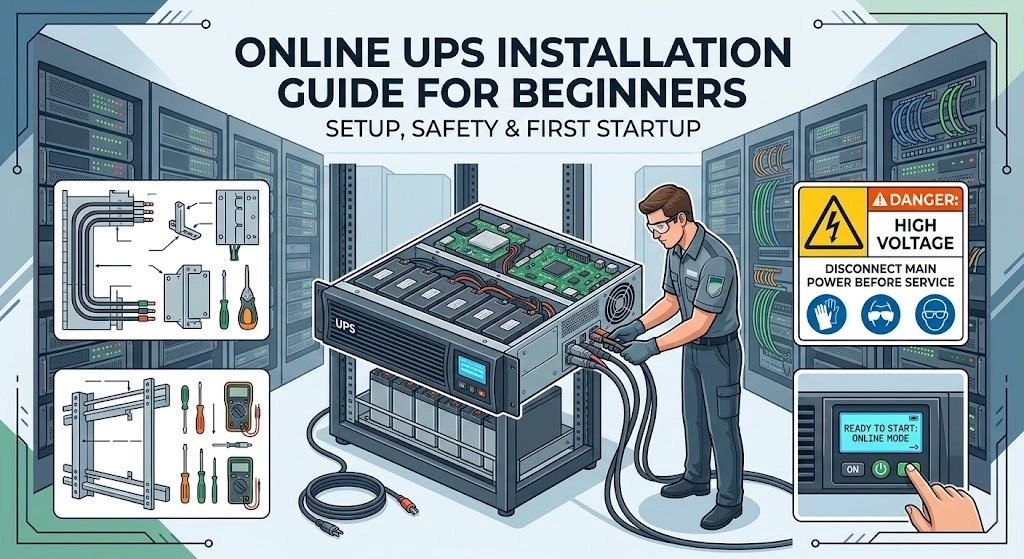
Online UPS Installation Guide for Beginners: Setup, Safety & First Startup
Best Practices for Installing Rack UPS Systems in Data Centers
Get in touch with us
If you have any comments or good suggestions, please leave us a message; later our professional staff will contact you as soon as possible.
© 2026 ShanPu. All Rights Reserved.
YouTube
SHANPU UPS
Shanpu