


can suppliers add private labels to rack mount ups units? | Insights by ShanPu

Quick Answer
Yes, many manufacturers can add private labels to rack mount UPS units, but the scope varies by supplier and project. Typical support covers logos, nameplates, packaging, and manuals. Key factors to confirm: label location and size, safety certification marks, firmware or display branding, MOQ, and lead time. Final solutions depend on the specific project.
How Our Team Supports Private Label Rack UPS Projects
Our team works with buyers on OEM-style branding requests for rack mount UPS products, including front panel logo placement, rear nameplate content, carton and packaging artwork, and user manual covers. Each request is reviewed against the base model's enclosure, available labeling area, and applicable compliance documents before any artwork is approved.
Core buyer parameters usually include power rating (VA or kW), form factor (1U, 2U, or 3U), input and output voltage, topology (line-interactive or online double-conversion), battery configuration, and communication ports. MOQ, lead time, and quotation must be confirmed for each project, because they depend on the model, the depth of customization, and the order volume.
Discuss Your Private Label Rack UPS Requirements
Please send your target power rating (VA or kW), rack height, input and output voltage, required battery runtime, destination market with required certifications, branding scope (logo, packaging, manual, firmware), and estimated order quantity. We can discuss label feasibility, artwork requirements, packaging options, and sample planning. Email your project details to SPU@gdshanpu.com for a project-based review.
FAQ
Which parts of a rack mount UPS can carry a private label?
Branding generally falls into five zones: the front bezel or panel logo, the LCD or LED overlay, the rear rating nameplate, the carton and cushioning artwork, and the printed documentation. Surface methods such as silkscreen, pad printing, laser etching, and adhesive labels usually do not require new tooling. Changing the bezel shape or any injection-molded part is a different category, because it requires new molds and a longer development cycle.
The rating nameplate is a regulated item. IEC 62040-1 expects markings such as rated voltage, frequency, and power, so the brand and model name can be adapted, but the technical data must match the tested configuration. The 19-inch width defined by EIA-310 also fixes the usable front panel area, which limits logo size.
Does private labeling a rack mount UPS affect safety certification marks?
It can, depending on how the approvals are structured. Safety and EMC reports are issued to a named manufacturer and model. Under the EU framework described in the Blue Guide, a company that places a product on the market under its own name or trademark is generally treated as the manufacturer. In practice, this means the EU Declaration of Conformity, CE marking responsibility, and technical file access must be reviewed and updated.
For North America and other regions, certification bodies commonly offer procedures to add a private label name or an additional model designation to an existing listing, usually through a formal application. Before printing any labels, request current certificates and test reports (for example, under IEC/EN 62040-1 and 62040-2) and obtain written confirmation of how your brand and model number will be reflected in them.
What MOQ should buyers expect for custom branded rack UPS?
No single MOQ applies across suppliers, and any figure should be confirmed in a written quotation. The main drivers are the customization method and the packaging. Adhesive labels or printed nameplates on an existing model typically sit at the lower end of commitment. Custom-printed cartons, color changes, and new manuals add setup costs and often raise the order quantity. Tooling-based changes, such as a new bezel, usually require the highest volume to justify the mold investment.
Battery sourcing and pallet configuration also matter, because heavy 1U to 3U units are normally packed in fixed carton quantities. Ask whether the supplier quotes MOQ per model, per brand, or per packaging variant, and how lead time changes between a first order and a repeat bulk order.
How do I submit artwork for UPS front panel logos?
Prepare vector files (AI, EPS, SVG, or vector PDF) with text converted to outlines, along with Pantone references for brand colors. Specify the logo's exact position, maximum dimensions, and clearance from vents, switches, and display windows. Thin lines and very small text may not reproduce well on textured plastic or brushed metal, so a minimum line weight should be agreed with the factory.
The print method influences the result: silkscreen suits flat solid colors, pad printing handles curved or recessed areas, and laser etching produces a durable single-tone mark. Request a digital proof first, then a physical sample for approval, and check color and adhesion before mass production. Record the approved version number so later orders use the identical artwork.
Can firmware, LCD display, and monitoring software show my brand?
Sometimes, and the answer depends on the controller platform. Branding of web interfaces, SNMP card pages, and monitoring software logos is often easier than changing the embedded firmware on the main board. Startup screens or custom display text may require firmware modification by the original designer, and the supplier may not have access to the source code.
Any firmware change should be treated as a controlled revision. Ask whether the modified build requires repeat functional and EMC verification, how version numbers will be tracked, and how future updates will be delivered. Also clarify communication options such as USB, RS-232, and SNMP, because the monitoring software must support the protocols your customers use.
Who handles warranty and service when the UPS carries my brand?
This must be defined contractually before the first order. In most private label arrangements, the brand owner is the customer-facing warrantor, while the manufacturer supports the brand owner under a back-to-back agreement. The contract should cover the warranty period, the RMA process, failure analysis turnaround, spare parts supply, and whether replacements ship from the factory or from a local stock.
Treat batteries separately. Valve-regulated lead-acid batteries have a limited service life, and a commonly cited rule of thumb is that life roughly halves for every 10°C above 25°C, so batteries are often subject to different warranty terms from the electronics. Also agree on documentation, including serial number traceability and labeling of production dates, so claims can be assessed accurately.
Low-Frequency UPS Engineering Guide: Sizing 10–800kVA Systems for Industrial Plant Loads

Voltage Sag Case Study: How a 1200kVA Modular UPS Project Was Rescued by Bus Distribution Box Selection
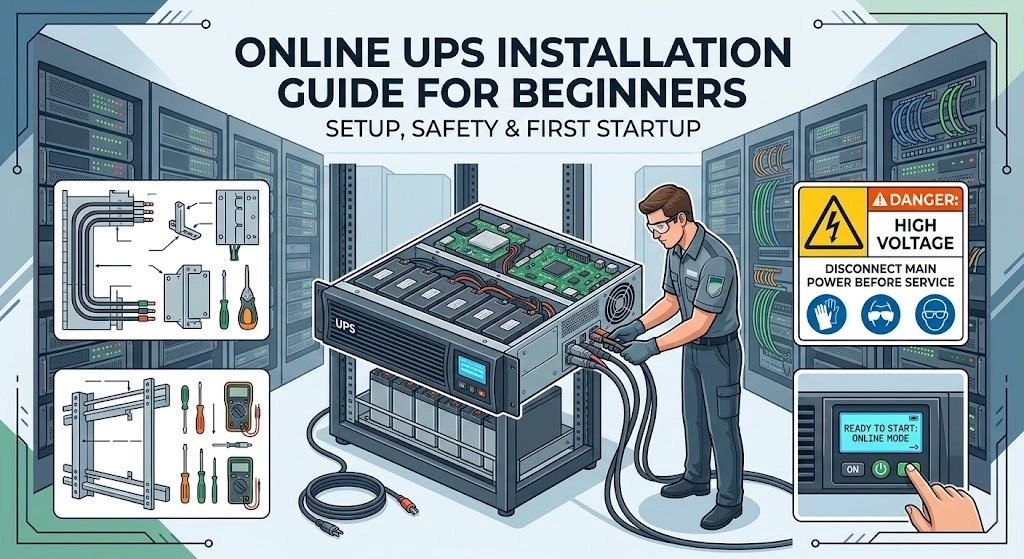
Online UPS Installation Guide for Beginners: Setup, Safety & First Startup

Best Practices for Installing Rack UPS Systems in Data Centers


Get in touch with us
If you have any comments or good suggestions, please leave us a message; later our professional staff will contact you as soon as possible.
© 2026 ShanPu. All Rights Reserved.
YouTube
SHANPU UPS
Shanpu