


UPS System for Hospital Procurement: Key Specs to Compare

When a hospital's power fails for even a fraction of a second, the consequences can be catastrophic. Ventilators stop. Surgical lights go dark. Patient monitoring systems lose data. I have spent 15 years working alongside inverter manufacturers and hospital facility managers, and I can tell you without hesitation: selecting the right UPS system for hospital environments is one of the most consequential procurement decisions a healthcare institution will ever make. This article breaks down every specification that matters, explains why each one is non-negotiable in a clinical setting, and gives you a practical framework for comparing vendors side by side.
Why Hospital Power Protection Demands a Different Standard
The Life-Safety Electricity Classification
Hospitals are not ordinary commercial buildings. Under standards published by the National Fire Protection Association (NFPA 99), healthcare facilities must maintain a life-safety branch of their electrical system that is capable of restoring power within 10 seconds of a utility failure. A standard commercial uninterruptible power supply is simply not designed with this regulatory context in mind. When I walk a procurement team through their requirements, the first thing I establish is that they are not buying office-grade backup power — they are buying a medical-grade power continuity system that must comply with local electrical codes, international standards such as IEC 62040, and potentially hospital accreditation requirements. This distinction immediately narrows the field of acceptable products and forces a more disciplined specification process.
The Real Cost of a Millisecond
I often ask procurement managers: what is the transfer time your most sensitive equipment can tolerate? Most assume the answer is a few seconds. In reality, many modern medical devices — MRI machines, robotic surgery platforms, CT scanners — have internal power supplies that will reset or fault if they experience a voltage interruption longer than 4 milliseconds. This is why online double-conversion topology is the only architecture I recommend for critical hospital loads. In a double-conversion system, the load is always running from the inverter output; the utility power never directly feeds the load. There is zero transfer time. The IEEE Standard 446 (Recommended Practice for Emergency and Standby Power Systems) provides detailed guidance on power quality requirements for sensitive equipment, and I strongly encourage every hospital procurement team to review it before finalizing specifications.
Regulatory and Certification Baseline
Before comparing any technical specification, I always verify that a candidate UPS carries the certifications required for the target market. At minimum, I look for CE marking for European deployments, UL 1778 or equivalent for North American markets, and ISO 9001 quality management certification from the manufacturer. Products lacking these credentials should be disqualified immediately, regardless of price. Cutting corners on certification in a hospital environment is not a procurement strategy — it is a liability.
Critical Technical Specifications to Evaluate and Compare
Power Capacity, Scalability, and Load Planning
Sizing a UPS for a hospital is not a simple watts-times-safety-factor calculation. Hospital loads are dynamic. An operating theater may draw 20 kVA during a routine procedure and spike to 60 kVA when multiple imaging systems activate simultaneously. My standard recommendation is to conduct a detailed load audit that categorizes every connected device by its criticality tier, its steady-state consumption, and its inrush current demand. From that audit, I build a capacity model that sizes the UPS at no more than 80% of its rated load under normal conditions, preserving headroom for growth and inrush events. Modular UPS architecture is particularly valuable in hospital settings because it allows the facility to add power modules as the load grows without replacing the entire system. This approach also enables N+1 redundancy within a single cabinet, meaning one module can fail while the remaining modules continue to carry the full load without interruption.
Battery Technology, Runtime, and Maintenance Strategy
The battery subsystem is where most hospital UPS procurement decisions go wrong. Procurement teams focus on the upfront cost of lead acid battery strings and underestimate the total cost of ownership over a 10-year lifecycle. A sealed valve-regulated lead acid battery in a hospital environment typically needs replacement every 3 to 5 years. Lithium iron phosphate (LiFePO4) batteries, by contrast, can deliver 10 or more years of service life with a significantly smaller footprint and no risk of acid leakage in a clinical environment. I have seen hospitals save more than 40% on their 10-year battery replacement costs by specifying lithium chemistry upfront, even though the initial capital cost was higher. Runtime requirements vary by application: a hospital's critical care ICU may need 30 minutes of battery backup to allow a generator to start and stabilize, while a data center supporting the hospital's electronic health records system may need 4 hours. Always specify runtime at full load, not at a derated percentage, to ensure honest vendor comparisons.
Input/Output Power Quality and Harmonic Distortion
Hospitals operate large numbers of non-linear loads — variable frequency drives on HVAC systems, LED lighting arrays, medical imaging equipment — that inject harmonic distortion back into the electrical distribution system. A high-quality online UPS with active input power factor correction (PFC) will present a near-unity power factor to the utility feed and deliver a clean, regulated sine wave output to connected loads. I specify a maximum total harmonic distortion (THD) of less than 3% on the output voltage waveform for any hospital UPS application. Some lower-cost units deliver THD figures of 5% or higher, which can cause sensitive medical electronics to malfunction or generate erroneous readings. This is a specification that vendors sometimes bury in footnotes, so I always request independent test data rather than relying solely on datasheet claims.
Comparing UPS Topologies for Hospital Applications
The table below summarizes the three primary UPS topologies and their suitability for different hospital load categories. I use this framework in every procurement engagement to help facility teams quickly eliminate options that do not meet their clinical requirements.
<table border=1 cellpadding=8 cellspacing=0 style=width:100%; border-collapse:collapse;>
How ShanPu Addresses Hospital-Grade Power Requirements
A Manufacturer Built for Mission-Critical Environments
After evaluating dozens of vendors over my career, I have come to appreciate manufacturers who treat certification and quality management as a foundation rather than a marketing checkbox. Shanpu Technology (Guangdong) Co., Ltd. is one of those manufacturers. Their product portfolio covers the full spectrum of hospital power protection needs: standby UPS for administrative zones, online double-conversion uninterruptible power supply systems for critical clinical areas, rack-mounted UPS for server rooms supporting electronic health records, and modular UPS platforms for large hospital campuses that need scalable, redundant power architecture. What distinguishes ShanPu in my experience is the depth of their certification stack — ISO 9001 for quality management, ISO 14001 for environmental management, OHSMS 18001 for occupational health and safety, CE, and RoHS compliance. For hospital procurement officers who must satisfy accreditation auditors and risk management committees, this level of documented compliance is not a luxury; it is a prerequisite.
Energy Storage and Renewable Integration for Modern Hospitals
The most forward-thinking hospital systems I work with are no longer thinking about UPS in isolation. They are building integrated energy resilience strategies that combine grid power, on-site generation, battery energy storage systems, and in some cases solar generation. ShanPu's product range extends well beyond the traditional uninterruptible power supply into solar inverters, Energy Storage Inverter platforms, Solar Energy Storage Systems, and complete energy storage systems that can be configured to support a hospital's microgrid strategy. Their inverter energy storage solutions allow a hospital to store energy during off-peak utility periods and deploy it during peak demand or grid outages, reducing both operational cost and carbon footprint. For hospitals in regions with unreliable grid infrastructure, ShanPu's outdoor uninterruptible power supply and outdoor power supply products provide weatherproof, ruggedized power continuity for external facilities, mobile medical units, and remote clinic deployments. The company's commitment to sustainability — developing products that save resources and reduce environmental impact — aligns directly with the ESG mandates that many hospital systems are now required to report against.
Service Model and Long-Term Partnership
In hospital environments, the relationship with a UPS vendor does not end at delivery. Preventive maintenance, firmware updates, battery health monitoring, and rapid emergency response are all part of the total value equation. ShanPu's 1+3 service model — covering pre-sales consultation, in-sales technical support, after-sales maintenance, and ongoing training — is structured specifically to support the kind of long-term partnership that hospital facility teams need. I have seen too many hospitals purchase equipment from vendors who disappear after commissioning, leaving the in-house team to manage a system they were never trained on. ShanPu's integrated training approach ensures that hospital engineering staff understand the system they are operating, which directly reduces the risk of human error during a power event. Their lead acid battery management guidance and lithium battery integration support are particularly valuable for facilities managing mixed battery fleets across multiple buildings.
Frequently Asked Questions
What type of UPS is required for hospital critical care areas?
Online double-conversion UPS is the only topology I recommend for hospital critical care areas such as ICUs, operating theaters, and life support systems. This topology provides zero transfer time, meaning the load is always powered from the inverter output and never experiences a voltage interruption. It also delivers a fully regenerated output waveform with less than 3% total harmonic distortion, which is essential for sensitive medical electronics.
How long should a hospital UPS battery runtime be?
Runtime requirements vary by application. For loads connected to a hospital's emergency generator system, 10 to 30 minutes of battery backup is typically sufficient to allow the generator to start and reach stable output. For IT systems supporting electronic health records or critical communications infrastructure, 2 to 4 hours of runtime may be required. Always specify runtime at full rated load when comparing vendors to ensure accurate comparisons.
What certifications should a hospital UPS manufacturer hold?
At minimum, a hospital UPS manufacturer should hold ISO 9001 quality management certification, CE marking for European markets, and UL 1778 or equivalent for North American deployments. Additional certifications such as ISO 14001 environmental management and OHSMS 18001 occupational health and safety demonstrate a higher level of organizational discipline. Products lacking these credentials should be disqualified from hospital procurement consideration regardless of price.
Is modular UPS better than traditional UPS for hospitals?
In most hospital applications, modular UPS architecture offers significant advantages over traditional monolithic systems. Modular designs allow the facility to scale power capacity incrementally as the load grows, enable N+1 redundancy within a single cabinet, and allow individual modules to be replaced without taking the entire system offline. This hot-swap capability is particularly valuable in hospitals where planned maintenance windows are extremely limited.
Can hospitals integrate solar and energy storage with their UPS systems?
Yes, and this is an increasingly common strategy among forward-thinking hospital systems. By combining an online UPS with a solar inverter, Energy Storage Inverter, and a Solar Energy Storage System, hospitals can build a resilient microgrid that reduces dependence on the utility grid, lowers peak demand charges, and provides extended backup autonomy during prolonged grid outages. Manufacturers like ShanPu offer integrated product lines that cover the full spectrum from traditional uninterruptible power supply systems to complete inverter energy storage platforms.
What is the difference between a standby UPS and an online UPS for hospital use?
A standby UPS normally passes utility power directly to the load and only switches to battery inverter output when it detects a power failure, resulting in a transfer time of 4 to 12 milliseconds. An online double-conversion UPS continuously powers the load from its inverter output, providing zero transfer time and complete isolation from utility power quality issues. For hospital critical loads, the standby topology is not acceptable because the transfer time is long enough to cause sensitive medical equipment to reset or fault.
-
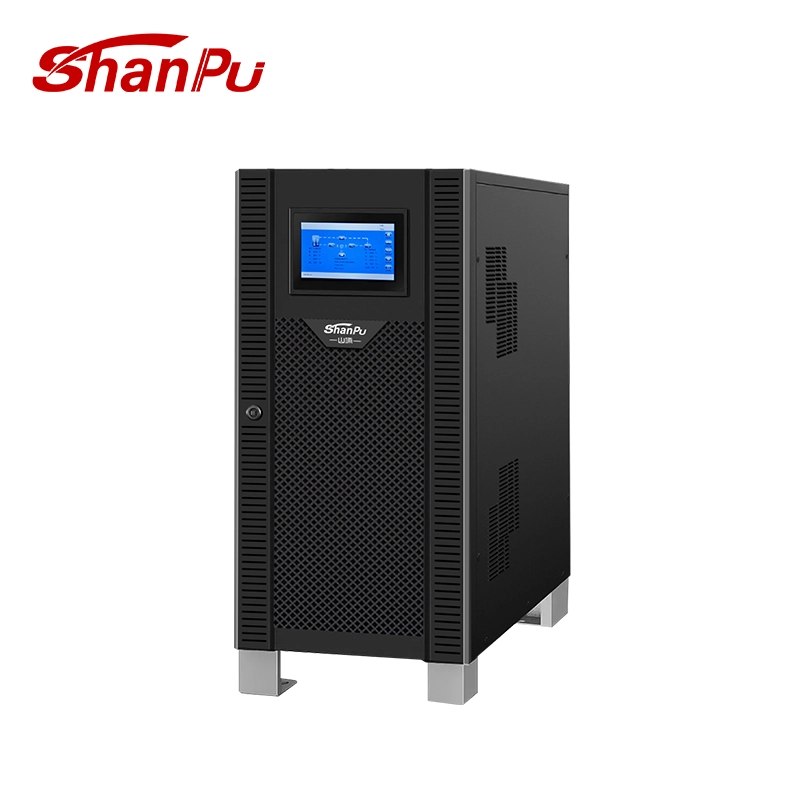
ShanPu 3C33 10-800kVA three-phase industrial UPS is a low-frequency UPS with transformer-based online double conversion for factories and plants. Equipment, automation and control loads stay online through grid disturbance and outage with 0ms transfer.
- Rated 10-800kVA with three-phase input and output at 380/400/415Vac, the 3C33 scales from single machines to full production lines. A low-frequency isolation transformer blocks surge, harmonic and common-mode disturbance before reaching PLCs and drives; microprocessor control keeps output within ±1% across a 304-456Vac input window. External VRLA banks size backup time to the process.
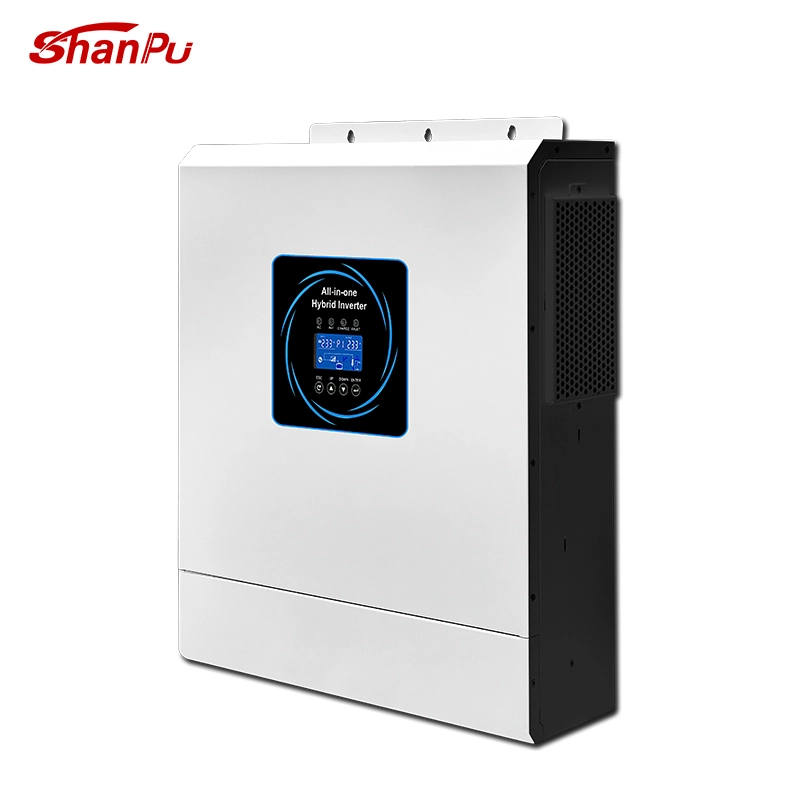
ShanPu SP-12KW/48V is an all-in-one hybrid inverter that integrates dual MPPT solar charging, 48V battery management and dual-output DC-to-AC inversion in one unit for large residential, commercial and light industrial storage systems. Two independent MPPT channels harvest power from separate PV arrays and convert it into regulated 48V DC, charging the battery bank at up to 160A while feeding the inverter stage; the controller automatically selects between solar, utility and battery based on the configured priority mode (SUB / SBU / SUF).The dual AC output design separates critical loads from non-critical circuits, while the 160A MPPT charging current and up to 160A AC charging rapidly recharge 48V battery banks after prolonged cloudy periods or heavy discharge. The 48V architecture reduces line losses and supports higher power delivery, and the Pro model adds parallel expansion plus optional WiFi monitoring for larger projects.
ShanPu SP-3.6KW/24V is an all-in-one hybrid inverter that combines a 100A MPPT solar charger, 24V battery management and DC-to-AC inversion in one compact unit. Built for residential and small commercial systems, it delivers reliable power management with efficient energy conversion and straightforward installation.The inverter supports up to 5000W PV array power with a 60-500Vdc MPPT tracking range and up to 96% peak conversion efficiency from PV to AC. It can also run directly from solar PV or utility without a battery connected, and RS485 communication with automatic lithium battery activation makes LiFePO4 integration straightforward.
ShanPu SP-6.2KW/48V is an all-in-one hybrid inverter that integrates MPPT solar charging, 48V battery management and DC-to-AC inversion into a single unit for medium residential and small commercial storage systems. Solar PV power is processed by the MPPT charger and converted into regulated 48V DC, which simultaneously charges the battery bank and supplies the inverter stage, while the built-in controller automatically selects the energy source - solar, utility or battery - based on the configured operating mode.
© 2026 ShanPu. All Rights Reserved.
YouTube
SHANPU UPS
Shanpu