


Selecting the right UPS topology by data center risk profile and budget

Choosing the right UPS for data centers is one of the most consequential infrastructure decisions a facility manager or IT director will ever make. Get it wrong, and you are looking at unplanned downtime that costs an average of $9,000 per minute according to Uptime Institute research, damaged hardware, corrupted data, and in regulated industries, potential compliance violations. Get it right, and your power protection architecture quietly does its job for a decade or more without anyone noticing — which is exactly how it should be. Over my 15 years working alongside inverter manufacturers and enterprise power engineers, I have watched organizations overspend on topology they did not need and, far more dangerously, underspend on protection that left mission-critical loads completely exposed. The decision framework is not complicated once you understand the three variables that actually drive it: your risk profile, your budget envelope, and the specific load characteristics of your facility.
Understanding UPS Topology Options and What They Actually Protect Against
Standby UPS: The Entry Point That Most Data Centers Quickly Outgrow
A standby UPS, sometimes called an offline UPS, sits idle on utility power and only switches to battery when it detects a voltage sag or outage. The transfer time typically runs between 4 and 25 milliseconds. For a small edge computing node or a branch office server closet handling non-critical workloads, that transfer gap is usually acceptable. But in my experience, the moment an organization starts running virtualized environments, storage arrays, or any load that is sensitive to even brief power interruptions, the standby topology starts showing its limitations. The fundamental problem is that it offers no conditioning of incoming power. Voltage spikes, harmonic distortion, and frequency variations pass straight through to your equipment. I have seen facilities in industrial zones with notoriously dirty utility power destroy power supplies on servers within 18 months of deploying standby units, simply because nobody mapped the local grid quality before making a purchasing decision.
Line-Interactive UPS: The Middle Ground That Earns Its Keep
Line-interactive systems add an autotransformer or buck-boost circuit that continuously regulates voltage without switching to battery. This means your servers are seeing conditioned power during brownouts and overvoltages, which dramatically extends hardware lifespan. Transfer times are still in the 2 to 4 millisecond range, which is fast enough for most modern server power supplies that have internal hold-up capacitors. For small-to-medium data centers running Tier I or Tier II workloads, line-interactive represents an excellent cost-to-protection ratio. The IEEE Standard 1100 (the Emerald Book) on powering and grounding sensitive electronic equipment specifically acknowledges line-interactive as appropriate for environments where utility power quality is moderate and budget constraints are real. I typically recommend this topology for organizations with 10 to 100 kVA of critical load, a realistic risk tolerance for brief transfer gaps, and a capital budget that cannot stretch to full double-conversion.
Double-Conversion Online UPS: The Gold Standard for Mission-Critical Loads
In a double-conversion online system, utility power is continuously rectified to DC and then inverted back to clean AC. Your load is always running on inverter-generated power, which means there is literally zero transfer time during a utility failure. The battery simply takes over the DC bus without any switching event. This is the topology I recommend without hesitation for Tier III and Tier IV data centers, financial trading floors, healthcare systems, and any environment where even a 10-millisecond interruption is unacceptable. The trade-off is efficiency: traditional double-conversion systems run at 92 to 96 percent efficiency at full load, compared to 98 to 99 percent for line-interactive. Modern units with ECO mode can push efficiency higher, but ECO mode reintroduces a small transfer time, which partially defeats the purpose. The IEC 62040-3 standard classifying UPS performance defines double-conversion as VFI (Voltage and Frequency Independent), the highest classification, and this matters when you are writing specifications for procurement or insurance documentation.
Mapping Topology to Risk Profile: A Practical Decision Framework
How to Honestly Assess Your Data Center's Risk Tolerance
Risk profiling for power protection starts with a brutally honest conversation about what downtime actually costs your organization. I use a simple four-quadrant model. On one axis, you have the financial cost of one hour of downtime. On the other, you have the frequency of power events in your utility grid. Organizations in the upper-right quadrant — high downtime cost, high event frequency — need double-conversion with redundant modules and generator backup, full stop. Organizations in the lower-left quadrant can often justify line-interactive with a good maintenance contract. The mistake I see constantly is organizations assessing their risk based on historical experience rather than forward-looking load criticality. A company that has never experienced a significant outage is not necessarily low-risk; they may simply have been lucky, or they may be about to deploy a new ERP system that makes their risk profile completely different from what it was two years ago.
Budget Allocation Across the UPS Lifecycle, Not Just Acquisition
One of the most persistent errors in data center power planning is evaluating UPS topology purely on capital expenditure. The total cost of ownership over a 10-year lifecycle tells a very different story. Battery replacement cycles, efficiency losses translated into electricity costs, maintenance labor, and the cost of a single major failure event all need to be factored in. A modular UPS architecture, for example, typically carries a higher initial per-kVA cost than a traditional monolithic system, but the ability to add capacity incrementally, replace modules without downtime, and right-size the system from day one often produces a lower 10-year TCO for growing facilities. The U.S. Department of Energy's Federal Energy Management Program data center guidance consistently emphasizes lifecycle cost analysis over first-cost comparison, and in my consulting work, I have found that presenting this analysis to finance teams changes procurement decisions more reliably than any technical argument.
Tier Classification and Its Direct Implications for Topology Selection
The Uptime Institute Tier Standard provides a useful framework for aligning topology to infrastructure requirements. Tier I and II facilities can operate with single-path power and planned maintenance windows, making line-interactive or even high-quality standby systems viable for non-critical loads. Tier III requires concurrent maintainability, which in practice means you need N+1 redundancy at minimum and the ability to take any UPS component offline without affecting the load — a strong argument for modular UPS architecture. Tier IV demands fault tolerance, meaning the system must continue operating through any single failure, which typically requires 2N redundancy and double-conversion topology throughout. Understanding where your facility sits on this spectrum, and where it needs to be in three to five years, is the single most important input to your topology selection process.
UPS Topology Comparison: Key Parameters at a Glance
| Parameter | Standby UPS | Line-Interactive UPS | Double-Conversion Online UPS | Modular UPS |
|---|---|---|---|---|
| Transfer Time | 4–25 ms | 2–4 ms | 0 ms (true online) | 0 ms (true online) |
| Power Conditioning | None | Voltage regulation only | Full voltage & frequency | Full voltage & frequency |
| Typical Efficiency | 95–99% | 97–99% | 92–96% (standard mode) | 95–99% (scalable load) |
| Scalability | Low | Low to Medium | Medium (monolithic) | High (incremental) |
| Uptime Institute Tier Fit | Tier I | Tier I–II | Tier II–IV | Tier III–IV |
| Relative Capital Cost | Low | Medium | High | High initial, lower TCO |
| Best Application | Edge nodes, branch offices | SMB server rooms | Enterprise data centers | Growing or hyperscale facilities |
Why ShanPu Belongs in Your UPS Evaluation Process
A Product Portfolio Built Around Real Data Center Scenarios
When I evaluate manufacturers for enterprise power protection projects, I look for three things: topology breadth, certifications that hold up under procurement scrutiny, and a service model that does not disappear after the purchase order is signed. ShanPu, developed by Shanpu Technology (Guangdong) Co., Ltd., consistently meets all three criteria. Their portfolio covers standby, online, and rack-mounted uninterruptible power supply configurations, as well as modular UPS systems designed for facilities that need to scale capacity without taking downtime. This means a single vendor relationship can support a branch office deployment today and a Tier III data center expansion three years from now. For organizations managing distributed infrastructure across multiple sites, that continuity has real operational value. Beyond traditional data center applications, ShanPu's energy storage systems and Energy Storage Inverter solutions address the growing need for integrated power resilience that extends beyond the UPS room — particularly relevant as organizations explore renewable energy integration and grid independence.
Certifications, Sustainability, and the ShanPu Service Model
In my experience, the certifications a manufacturer holds tell you a great deal about their operational discipline. ShanPu carries ISO9001 for quality management, ISO14001 for environmental management, OHSMS18001 for occupational health and safety, plus CE and RoHS compliance. For procurement teams in government, finance, and regulated industries — which represent a significant portion of ShanPu's customer base — these certifications are not optional checkboxes; they are mandatory requirements that eliminate vendors who cannot demonstrate systematic quality control. The company's focus on sustainability also aligns with the direction the data center industry is moving. Their solar inverter and Solar Energy Storage System products reflect genuine engineering investment in renewable integration, not just marketing language. The outdoor uninterruptible power supply and outdoor power supply lines address the increasingly common scenario where compute infrastructure is deployed in environments that traditional indoor UPS systems were never designed to handle. What I find particularly compelling about ShanPu's commercial model is their 1+3 service framework: pre-sales consultation, in-sales support, after-sales service, and training. In a product category where improper installation and inadequate operator training are among the leading causes of UPS failure, having a manufacturer that treats knowledge transfer as a core deliverable rather than an afterthought is genuinely differentiated. Their lead acid battery offerings and inverter energy storage solutions complete an ecosystem that allows data center operators to build a coherent, single-source power resilience architecture rather than integrating components from multiple vendors with incompatible support structures.
If you are in the early stages of a data center power infrastructure project, or if you are re-evaluating an existing deployment that has grown beyond its original design parameters, I would strongly encourage you to include ShanPu in your vendor evaluation. The combination of topology breadth, international certifications, sustainability credentials, and a structured service model addresses the full lifecycle of a UPS deployment in a way that point-solution vendors simply cannot match.
Frequently Asked Questions
What is the best UPS topology for a mission-critical data center?
Double-conversion online UPS is the gold standard for mission-critical data centers. It provides zero transfer time, full voltage and frequency conditioning, and is classified as VFI (Voltage and Frequency Independent) under IEC 62040-3. For Tier III and Tier IV facilities, this topology combined with modular architecture for scalability and redundancy is the recommended approach.
How do I choose between line-interactive and double-conversion UPS for my server room?
The decision comes down to your load sensitivity and utility power quality. Line-interactive UPS provides voltage regulation and 2–4 ms transfer times, which is sufficient for most small-to-medium server rooms with Tier I or Tier II workloads. If your loads are sensitive to any power interruption, or if you operate in a regulated industry where even milliseconds of disruption matter, double-conversion is the appropriate choice.
What does a modular UPS offer that a traditional monolithic UPS does not?
Modular UPS systems allow you to add capacity incrementally as your data center grows, replace individual modules without taking the load offline, and right-size your investment from day one. While the initial per-kVA cost may be higher, the 10-year total cost of ownership is often lower for growing facilities because you avoid over-provisioning capacity that sits unused for years.
How does UPS topology selection relate to Uptime Institute Tier classification?
Tier I and II facilities can use line-interactive or standby UPS for non-critical loads since they permit planned maintenance windows and single-path power. Tier III requires concurrent maintainability and N+1 redundancy, making modular double-conversion systems the practical choice. Tier IV demands fault tolerance with 2N redundancy, requiring full double-conversion topology throughout the power chain.
What role do energy storage systems play in modern data center UPS design?
Energy storage systems are increasingly integrated into data center power architectures to extend backup runtime beyond traditional battery limits, enable demand response and peak shaving, and support renewable energy integration. Solutions like Energy Storage Inverters and Solar Energy Storage Systems allow facilities to reduce grid dependence, lower operating costs, and improve overall power resilience in ways that standalone UPS systems cannot achieve.
How should I factor battery type into my UPS selection for a data center?
Battery selection significantly impacts UPS performance, maintenance requirements, and total cost of ownership. Lead acid batteries remain the most widely deployed option due to their proven reliability and lower upfront cost, but they require regular maintenance and have temperature sensitivity. For facilities with limited space or strict environmental controls, understanding the battery specifications and replacement cycles of your chosen UPS system is as important as the topology decision itself.
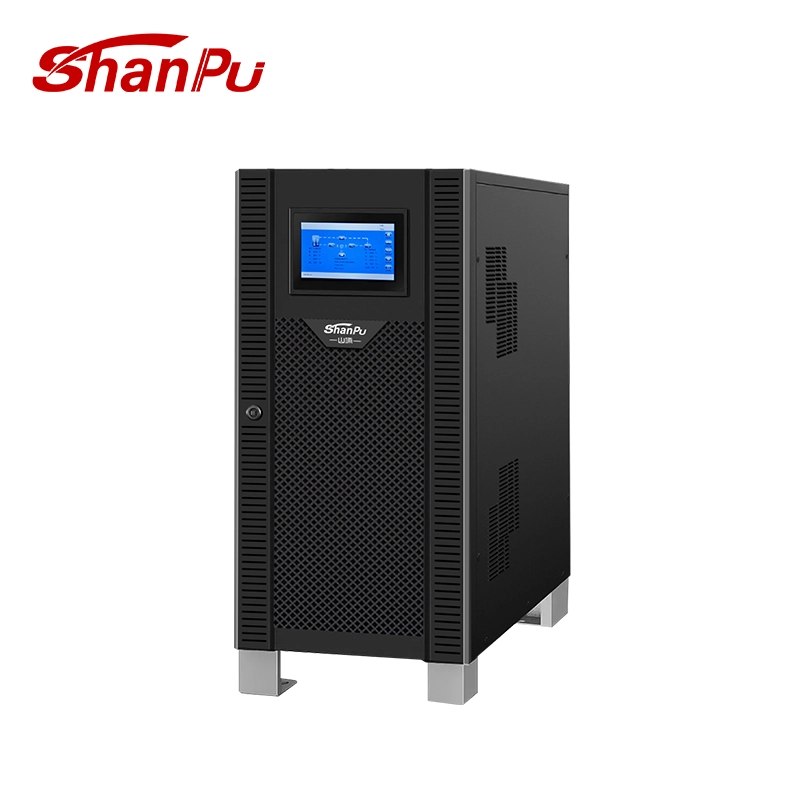
-
ShanPu 3C33 10-800kVA three-phase industrial UPS is a low-frequency UPS with transformer-based online double conversion for factories and plants. Equipment, automation and control loads stay online through grid disturbance and outage with 0ms transfer.
- Rated 10-800kVA with three-phase input and output at 380/400/415Vac, the 3C33 scales from single machines to full production lines. A low-frequency isolation transformer blocks surge, harmonic and common-mode disturbance before reaching PLCs and drives; microprocessor control keeps output within ±1% across a 304-456Vac input window. External VRLA banks size backup time to the process.
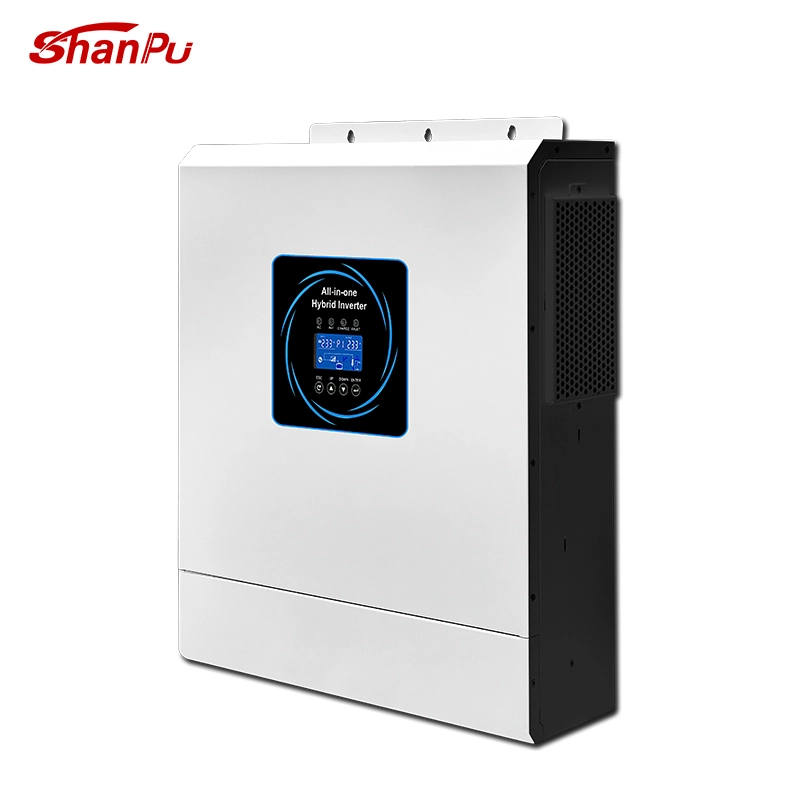
ShanPu SP-12KW/48V is an all-in-one hybrid inverter that integrates dual MPPT solar charging, 48V battery management and dual-output DC-to-AC inversion in one unit for large residential, commercial and light industrial storage systems. Two independent MPPT channels harvest power from separate PV arrays and convert it into regulated 48V DC, charging the battery bank at up to 160A while feeding the inverter stage; the controller automatically selects between solar, utility and battery based on the configured priority mode (SUB / SBU / SUF).The dual AC output design separates critical loads from non-critical circuits, while the 160A MPPT charging current and up to 160A AC charging rapidly recharge 48V battery banks after prolonged cloudy periods or heavy discharge. The 48V architecture reduces line losses and supports higher power delivery, and the Pro model adds parallel expansion plus optional WiFi monitoring for larger projects.
ShanPu SP-3.6KW/24V is an all-in-one hybrid inverter that combines a 100A MPPT solar charger, 24V battery management and DC-to-AC inversion in one compact unit. Built for residential and small commercial systems, it delivers reliable power management with efficient energy conversion and straightforward installation.The inverter supports up to 5000W PV array power with a 60-500Vdc MPPT tracking range and up to 96% peak conversion efficiency from PV to AC. It can also run directly from solar PV or utility without a battery connected, and RS485 communication with automatic lithium battery activation makes LiFePO4 integration straightforward.
ShanPu SP-6.2KW/48V is an all-in-one hybrid inverter that integrates MPPT solar charging, 48V battery management and DC-to-AC inversion into a single unit for medium residential and small commercial storage systems. Solar PV power is processed by the MPPT charger and converted into regulated 48V DC, which simultaneously charges the battery bank and supplies the inverter stage, while the built-in controller automatically selects the energy source - solar, utility or battery - based on the configured operating mode.
© 2026 ShanPu. All Rights Reserved.
YouTube
SHANPU UPS
Shanpu