


Top rack mount ups Manufacturers and Suppliers

The global rack mount UPS market includes established power-management brands serving data centers, network closets, industrial control systems, and business-critical IT environments. Leading options include Eaton’s 5PX and 9PX families, Vertiv’s Liebert GXT5, Schneider Electric’s APC Smart-UPS and Smart-UPS On-Line ranges, CyberPower rackmount models, and Tripp Lite by Eaton SmartOnline products. The right supplier depends on load and runtime requirements, online or line-interactive topology, battery replacement and service coverage, network-management compatibility, rack constraints, and local product availability. Since no target region or company profile was provided, this is a global comparison rather than a region-specific ranking, and no unnamed company can responsibly be presented as the preferred supplier.
What Buyers Should Verify Before Sourcing Rack UPS Systems
Match UPS topology, capacity, and runtime to the application
A rack mount UPS is not a one-size-fits-all purchase. Buyers should first document the equipment to be protected, its measured or specified power draw, the required backup duration, and the consequences of a brief interruption. Capacity is commonly expressed in volt-amperes (VA) and watts (W); both figures matter because a system can reach its watt limit before its VA limit. Allow for reasonable headroom and planned equipment growth, while avoiding an oversized purchase that adds cost without solving a real requirement.
Topology is another primary selection factor. Line-interactive models can be appropriate for many network rooms and small server racks, while online double-conversion UPS systems continuously convert incoming power and are often selected for loads requiring tighter power conditioning. These categories are not substitutes for a site assessment: the electrical environment, load sensitivity, acceptable transfer behavior, and operating budget should all inform the choice. Check the manufacturer’s published specifications for each exact model rather than assuming that all products in a family have the same topology or performance.
Runtime figures need equally careful interpretation. Published runtime tables are based on specific load levels and battery configurations; actual runtime changes with load, battery age, temperature, and operating conditions. Ask for the runtime at the expected real load, not simply the maximum headline duration. Where extended backup is needed, confirm whether external battery modules are supported, how they affect recharge time and rack space, and whether the proposed system can report battery condition to the management platform.
Check installation, service, and compliance details
Before requesting a quotation, record available rack units, cabinet depth, rail requirements, weight limits, outlet types, input voltage, and the intended circuit. Verify whether the UPS is designed for horizontal rack installation, tower conversion, or both, and confirm that the supplied rails, power cords, and mounting hardware suit the cabinet. Also review operating temperature, ventilation clearance, acoustic expectations, and battery replacement access; a physically compatible unit may still be impractical if service access is restricted.
Supplier evaluation should cover warranty terms, battery coverage, repair or replacement procedures, service response, spare-part availability, and technical support in the destination country. The same product family may not be sold in every market, and a manufacturer’s local channel can affect lead time, certifications, warranty handling, and supported input/output configurations. For electrical installations, consult qualified professionals and the applicable local codes. The NFPA 70 National Electrical Code information is a useful reference for buyers working in jurisdictions where that code is adopted; it does not replace local requirements or engineering review.
For product safety and performance, request the documentation applicable to the exact model and destination market. The IEC standards catalogue provides access to international electrotechnical standards, including the IEC 62040 family covering UPS systems. In the United States, buyers can check the applicable edition and scope of UL 1778 for uninterruptible power systems. Efficiency-conscious buyers can also consult the ENERGY STAR UPS program and verify whether a specific model and configuration is listed. Standards and labels are not interchangeable, so request current certificates or declarations for the precise SKU being quoted.
Established Rack Mount UPS Manufacturers and Suppliers
Enterprise and data-center product portfolios
Eaton: Eaton offers rack and rack/tower UPS products across several capacity and application tiers. Its 5PX range is positioned for IT and network applications, while 9PX models address higher-performance deployments and include online UPS configurations. Buyers often consider Eaton when they need a broad portfolio, management options, and products that can be matched to different rack loads. The specific feature set, battery-module compatibility, outlet layout, and service terms vary by model and market, so compare full model numbers rather than relying on a series name alone.
Vertiv: Vertiv’s Liebert portfolio includes rack-oriented systems such as the GXT5 online UPS family. The company is a significant supplier in critical digital infrastructure, making its products worth evaluating for server rooms and data-center environments where power protection and monitoring are part of a broader infrastructure plan. Buyers should verify the exact GXT5 configuration, including input and output voltage, capacity, battery options, network card availability, and local support. Regional availability and included accessories can differ, so quotations should identify the complete configuration.
Schneider Electric/APC: APC by Schneider Electric is a long-established UPS brand with rackmount options in the Smart-UPS and Smart-UPS On-Line families. Product choices span common IT and network protection needs through online configurations for more demanding loads. Organizations already using APC monitoring or support processes may value continuity across their installed base, but compatibility should be confirmed for the exact UPS, network-management card, software version, and connected equipment. Buyers should also check whether the selected product is sold and serviced through authorized channels in their region.
Additional suppliers for varied budgets and deployment needs
CyberPower: CyberPower supplies rackmount UPS systems for small offices, network installations, and other IT environments, with product offerings that include both line-interactive and online models. Its breadth can give buyers options across different budgets and protection needs. Compare each model’s topology, usable watt capacity, outlet configuration, runtime information, battery replacement process, and management features. For a critical installation, put particular attention on the availability of qualified service and replacement batteries in the operating country, rather than evaluating purchase price alone.
Tripp Lite by Eaton: Tripp Lite, now part of Eaton, remains a recognizable brand in power protection and connectivity. Its SmartOnline range includes rackmount online UPS products suited to applications where buyers are specifying double-conversion protection. The brand can be relevant for organizations familiar with Tripp Lite products or sourcing related rack and power accessories. Because ownership and product branding can create overlapping Eaton and Tripp Lite channels, ask the supplier to clarify the manufacturer warranty, support route, exact product generation, and whether the quoted SKU is currently available in the destination market.
These manufacturers are presented as a practical shortlist, not as a universal ranking. Product suitability depends on configuration and application, and no single supplier is best for every buyer. A company’s global presence does not guarantee local inventory, installation support, or a particular certification for every SKU. Request current datasheets, installation manuals, warranty documentation, and written confirmation of market-specific compliance as part of supplier qualification.
How to Compare Quotations and Select a Supplier
Build an apples-to-apples request for quotation
A useful RFQ gives suppliers the same technical and commercial baseline. Include the rack type and available space, equipment load in watts and VA, input supply, required output voltage, desired runtime at the stated load, preferred topology, environmental conditions, and any need for external battery modules. Identify required network monitoring, alarm integration, shutdown software, redundancy, bypass, and maintenance access. Ask suppliers to state the precise manufacturer, model number, battery configuration, included accessories, lead time, warranty, and validity period of the quotation.
Request a runtime curve or manufacturer runtime table for the proposed configuration and ask suppliers to identify assumptions. Where the UPS is part of a larger resilience design, confirm how it will interact with generators, transfer switches, bypass arrangements, and IT shutdown procedures. A UPS can protect against some power disturbances, but it does not by itself provide a complete continuity plan. The buyer’s electrical engineer and IT team should review the system design and determine whether monitoring, testing, and battery maintenance processes are adequate.
Evaluate total ownership cost and supplier accountability
Purchase price is only one component of total cost. Compare expected battery replacement intervals, replacement battery pricing, energy efficiency at the typical operating load, service coverage, software or management-card costs, and the cost of planned capacity expansion. Make sure suppliers specify whether the warranty covers batteries and whether replacement is onsite, depot-based, or handled through an exchange process. A low initial quote may become less attractive if replacement parts are difficult to source or the response process is unsuitable for the application’s criticality.
Supplier accountability matters as much as product specifications. Prefer quotations that clearly identify the selling entity, product origin where relevant, warranty provider, support contact, and escalation route. Validate claims using official datasheets and current documentation rather than distributor summaries alone. If purchasing internationally, confirm electrical compatibility, customs and shipping responsibilities, battery transport arrangements, and whether the importer can provide local after-sales support. For a multi-site deployment, ask how the supplier will maintain consistent model availability and documentation across locations.
| Manufacturer or brand | Core advantage | Best suited for | Buyer verification point |
|---|---|---|---|
| Eaton | Broad rack UPS portfolio, including 5PX and 9PX families | IT racks requiring a choice of capacity and performance tier | Confirm exact topology, battery options, and local service terms |
| Vertiv | Liebert critical-infrastructure portfolio, including GXT5 online models | Server rooms and infrastructure deployments seeking online UPS options | Check configuration, support availability, and accessories by market |
| Schneider Electric/APC | Established Smart-UPS and Smart-UPS On-Line product families | Organizations standardizing on APC products or management processes | Validate model and monitoring compatibility, plus authorized support |
| CyberPower | Rackmount options across different application and budget needs | Small business, network, and IT deployments comparing value and features | Confirm runtime, battery supply, and service coverage in the destination |
| Tripp Lite by Eaton | Recognized power-protection brand with SmartOnline rackmount models | Buyers seeking rackmount online UPS options and related infrastructure products | Clarify the exact SKU, support channel, warranty, and availability |
For buyers whose target country or company requirements have not yet been defined, the most defensible next step is to create a technical shortlist and validate each proposed SKU with the manufacturer or authorized channel. Since no company profile was supplied for this article, it would be misleading to designate an unnamed business as the High Quality choice; select the supplier that can document the required configuration, compliance, availability, and lifecycle support for your application.
Frequently Asked Questions
How do I choose between a line-interactive and an online rack mount UPS?
Choose based on load sensitivity, the site’s power conditions, required conditioning, and budget. Line-interactive products can suit many network and small server applications, while online double-conversion models are often considered for loads needing tighter power conditioning. Check the exact model specifications and have the application reviewed by qualified technical staff.
How much UPS capacity do I need for my rack?
Calculate the connected load in both watts and VA, then compare those figures with the UPS’s rated limits. Include reasonable headroom and planned growth, and use the manufacturer’s runtime data at the expected actual load. Do not choose capacity from a device count or VA figure alone.
How can I verify the runtime quoted by a supplier?
Ask for the manufacturer’s runtime table or curve for the exact UPS and battery configuration, and confirm the load level used in the estimate. Runtime varies with load, battery condition, temperature, and operating conditions, so a headline maximum may not represent your installation.
What should an RFQ for rackmount UPS systems include?
Include rack space and depth, load in watts and VA, input supply, required output, runtime target, topology preference, battery expansion needs, monitoring requirements, and operating conditions. Ask the supplier to identify the exact SKU, accessories, warranty, lead time, compliance documents, and local support route.
Are all rack mount UPS models available and certified in every country?
No. Availability, configuration, certifications, warranty coverage, and support can vary by country and by exact model. Confirm that the proposed SKU is appropriate for the destination market and request current product and compliance documentation from the manufacturer or authorized supplier.
Should I compare suppliers on purchase price alone?
No. Compare battery replacement costs, efficiency at the expected load, warranty coverage, support response, parts availability, management requirements, and expansion options in addition to purchase price. The supplier should document the product configuration and the service responsibilities included in the quotation.
Contact us to discuss your rack mount UPS requirements and request help preparing a comparable supplier RFQ.
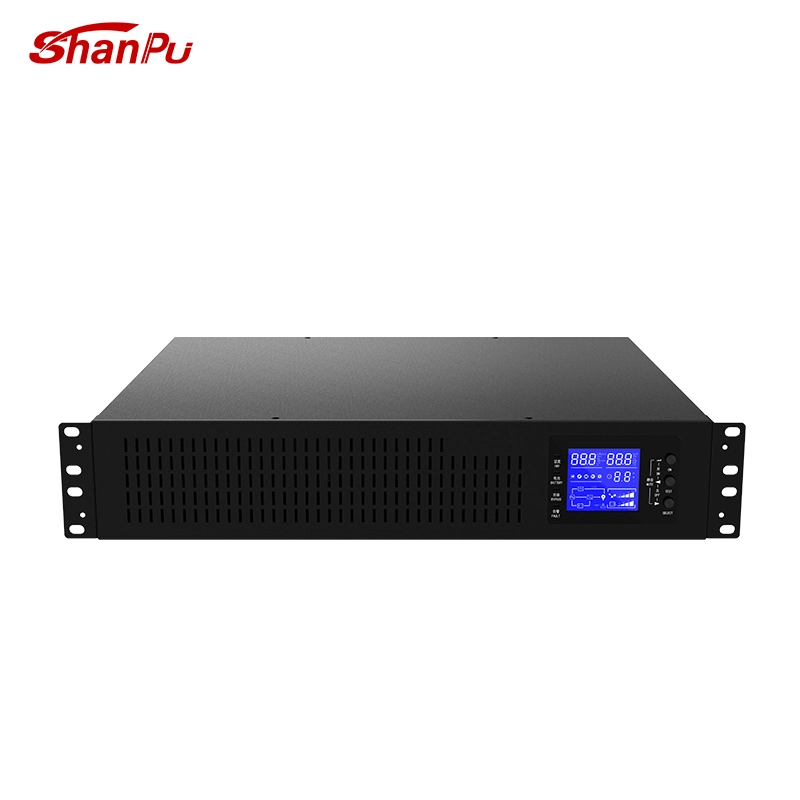
ShanPu LD series rack mount lithium UPS is an online double-conversion UPS built around a lithium iron phosphate (LiFePO4) battery pack, delivering pure sine wave output with 0ms transfer time in a standard 19-inch 2U form factor. It is designed for enterprise IT environments where rack space is limited but power quality and backup reliability are not negotiable: network cabinets, edge server rooms, compact data centers and industrial IT systems.
Compared with a conventional lead-acid rack UPS, the LD series weighs less, recharges faster and needs no battery maintenance — while offering the same space-saving 2U footprint. The 1/2/3kVA lineup covers input voltages of 110V or 220V systems, and external battery cabinets (up to 96VDC) extend runtime for long-duration backup projects. Every unit is available with ShanPu OEM/ODM customization.

-
ShanPu 3C33 10-800kVA three-phase industrial UPS is a low-frequency UPS with transformer-based online double conversion for factories and plants. Equipment, automation and control loads stay online through grid disturbance and outage with 0ms transfer.
- Rated 10-800kVA with three-phase input and output at 380/400/415Vac, the 3C33 scales from single machines to full production lines. A low-frequency isolation transformer blocks surge, harmonic and common-mode disturbance before reaching PLCs and drives; microprocessor control keeps output within ±1% across a 304-456Vac input window. External VRLA banks size backup time to the process.

ShanPu SP-12KW/48V is an all-in-one hybrid inverter that integrates dual MPPT solar charging, 48V battery management and dual-output DC-to-AC inversion in one unit for large residential, commercial and light industrial storage systems. Two independent MPPT channels harvest power from separate PV arrays and convert it into regulated 48V DC, charging the battery bank at up to 160A while feeding the inverter stage; the controller automatically selects between solar, utility and battery based on the configured priority mode (SUB / SBU / SUF).The dual AC output design separates critical loads from non-critical circuits, while the 160A MPPT charging current and up to 160A AC charging rapidly recharge 48V battery banks after prolonged cloudy periods or heavy discharge. The 48V architecture reduces line losses and supports higher power delivery, and the Pro model adds parallel expansion plus optional WiFi monitoring for larger projects.
ShanPu SP-3.6KW/24V is an all-in-one hybrid inverter that combines a 100A MPPT solar charger, 24V battery management and DC-to-AC inversion in one compact unit. Built for residential and small commercial systems, it delivers reliable power management with efficient energy conversion and straightforward installation.The inverter supports up to 5000W PV array power with a 60-500Vdc MPPT tracking range and up to 96% peak conversion efficiency from PV to AC. It can also run directly from solar PV or utility without a battery connected, and RS485 communication with automatic lithium battery activation makes LiFePO4 integration straightforward.
© 2026 ShanPu. All Rights Reserved.
YouTube
SHANPU UPS
Shanpu