


Emerging Opportunities for Online UPS Distributors in Healthcare, Renewable Energy, and Infrastructure Projects

The global market for online double conversion uninterruptible power supply systems is undergoing a structural shift. Healthcare facilities, renewable energy installations, and large-scale infrastructure projects are no longer treating power protection as an afterthought — they are embedding it into their core operational blueprints. As someone who has spent 15 years working alongside inverter manufacturers, distributors, and end-user procurement teams, I can tell you with confidence: the window of opportunity for UPS distributors who understand these verticals is wider right now than at any point in the past decade. The question is not whether demand exists. The question is whether your distribution strategy is positioned to capture it.
Why Power-Critical Sectors Are Driving Unprecedented UPS Demand
Healthcare: Zero Tolerance for Power Interruption
I have walked through hospital data centers, surgical suites, and diagnostic imaging wings where a single millisecond of power disruption can compromise patient outcomes or corrupt irreplaceable diagnostic data. The healthcare sector operates under a zero-tolerance policy for power failure, and that reality is reshaping procurement decisions at every level. According to the World Health Organization's guidelines on health systems infrastructure, reliable power is classified as a foundational requirement for safe clinical environments. This is not regulatory language — it is operational reality.
What I consistently observe in healthcare procurement cycles is a decisive shift away from standby or line-interactive UPS architectures toward true online double conversion topology. The reason is straightforward: online double conversion systems regenerate output power entirely from the inverter, meaning the connected load never sees raw utility power. Voltage fluctuations, harmonic distortions, frequency instability — all of it is filtered out before it reaches an MRI machine, a ventilator, or a hospital-grade server. For distributors, this means the conversation with healthcare buyers is no longer about price per unit. It is about total cost of downtime, regulatory compliance, and lifecycle reliability.
Renewable Energy Integration: The Hidden Power Quality Challenge
The renewable energy sector presents a different but equally compelling opportunity. Solar and wind generation are inherently intermittent, and as grid operators push toward higher renewable penetration rates, the power quality challenges at the point of consumption become more acute. I have worked with facility managers at solar farms and hybrid microgrid installations who discovered — often the hard way — that their sensitive monitoring and control equipment was being damaged by the very clean-energy systems they were operating.
This is where the intersection of energy storage systems and online UPS technology becomes commercially significant. The International Energy Agency's World Energy Outlook projects that global renewable capacity additions will accelerate through 2030, with distributed energy resources requiring increasingly sophisticated power conditioning at the edge. Distributors who can bundle an online double conversion uninterruptible power supply with solar inverter and energy storage inverter solutions are positioning themselves as integrated energy resilience partners, not just hardware vendors.
Infrastructure Projects: Scale, Complexity, and Long-Term Contracts
Government-backed infrastructure projects — data centers, transportation hubs, water treatment facilities, telecommunications networks — represent the highest-volume opportunity in the UPS distribution landscape. These projects typically involve multi-year procurement frameworks, and winning a position on an approved vendor list can generate recurring revenue for a decade or more. From my experience navigating these procurement processes, the technical differentiator that consistently wins bids is the ability to demonstrate compliance with international standards such as ISO 9001 quality management certification, which procurement officers treat as a baseline qualification rather than a bonus.
Infrastructure buyers also demand scalability. A modular UPS architecture that can grow from 20 kVA to 200 kVA without replacing the entire system is not a luxury feature in this context — it is a procurement requirement. Distributors who understand this and align their product portfolio accordingly will consistently outperform competitors who sell single-configuration units.
Understanding the Technical Landscape: Online Double Conversion vs. Alternative Topologies
How Double Conversion Technology Actually Works
I want to be precise here because I have seen too many distributor sales teams misrepresent UPS topology to close deals, only to face costly returns and damaged client relationships. In a true online double conversion system, incoming AC power is first rectified to DC, which simultaneously charges the battery and feeds the inverter. The inverter then synthesizes a clean, stable AC output from that DC bus. The load is always powered by the inverter — not by utility power directly. This architecture delivers the highest level of power conditioning available in commercial UPS design.
The IEEE Standard 446 for Emergency and Standby Power Systems provides the technical framework that most large-scale buyers reference when specifying UPS requirements. Understanding this standard — and being able to speak to it fluently — is a genuine competitive advantage for distributors operating in healthcare and infrastructure verticals.
Comparing UPS Topologies for Vertical Market Applications
The table below summarizes the key performance differences between UPS topologies as they apply to the three target verticals. I use this framework regularly when helping distribution partners qualify opportunities and match the right product to the right application.
| UPS Topology | Transfer Time | Power Conditioning | Healthcare Suitability | Renewable Energy Suitability | Infrastructure Suitability | Typical Efficiency |
|---|---|---|---|---|---|---|
| Online Double Conversion | Zero (0 ms) | Complete isolation and regeneration | Excellent | Excellent | Excellent | 92%–96% |
| Line Interactive | 2–4 ms | Voltage regulation only | Moderate | Limited | Moderate | 95%–98% |
| Standby (Offline) | 4–10 ms | Minimal | Poor | Poor | Poor | 98%–99% |
| Modular Online UPS | Zero (0 ms) | Complete isolation and regeneration | Excellent | Excellent | Superior (scalable) | 93%–97% |
Battery Technology and Runtime Considerations
One aspect of UPS specification that distributors frequently underestimate is battery selection. The choice between valve-regulated lead acid battery technology and lithium-ion alternatives has significant implications for total cost of ownership, installation footprint, and maintenance requirements. In outdoor or remote renewable energy deployments, the thermal performance of the battery chemistry becomes critical. I have seen installations in Southeast Asian solar farms where lead acid batteries performed reliably for eight-plus years under proper management, while poorly specified lithium alternatives failed within 18 months due to inadequate battery management system integration.
For distributors, the practical takeaway is this: do not treat battery selection as a secondary specification. It is a primary value-add conversation that differentiates knowledgeable partners from commodity resellers.
Distribution Strategy: How to Win in These Three Verticals
Building Vertical-Specific Sales Competency
The single most common mistake I see among UPS distributors entering healthcare or infrastructure markets is treating these verticals as extensions of their existing commercial IT business. They are not. Healthcare procurement involves clinical engineers, biomedical technicians, and compliance officers who speak a different language than IT managers. Infrastructure projects involve mechanical and electrical engineers who evaluate UPS systems against IEC and IEEE standards, not product brochures.
My recommendation is to invest in vertical-specific technical training for your sales team before pursuing these opportunities. Understand the regulatory environment — Joint Commission standards for healthcare, grid interconnection requirements for renewable energy, and local building codes for infrastructure. This knowledge is not just a sales tool; it is the foundation of credibility that earns you a seat at the specification table.
Leveraging Outdoor and Hybrid Power Solutions
The growth of distributed renewable energy infrastructure has created strong demand for outdoor uninterruptible power supply solutions — systems designed to operate in ambient temperatures ranging from -20°C to +55°C, with IP-rated enclosures that protect against dust, moisture, and UV exposure. This is a product category that many traditional UPS distributors have not yet developed, which means the competitive landscape is less crowded and margin potential is higher.
Pairing an outdoor power supply with a Solar Energy Storage System and an energy storage inverter creates a complete off-grid or hybrid power resilience package that addresses the needs of remote healthcare clinics, telecom towers, and renewable energy monitoring stations simultaneously. Distributors who can offer this integrated solution — rather than forcing buyers to source components from multiple vendors — command High Quality positioning and stronger customer retention.
Why ShanPu Belongs in Your Distribution Portfolio
After evaluating dozens of inverter manufacturers and UPS suppliers over my career, I have developed a clear framework for what makes a manufacturer worth building a long-term distribution relationship with. The criteria are straightforward: product breadth, certifications, after-sales support infrastructure, and the manufacturer's own commitment to continuous innovation. ShanPu — the brand of Shanpu Technology (Guangdong) Co., Ltd. — consistently meets all four criteria in ways that matter for distributors targeting healthcare, renewable energy, and infrastructure markets.
ShanPu's product portfolio covers the full spectrum of power protection and energy management: standby, online, and rack-mounted uninterruptible power supply systems, solar inverter solutions, modular UPS architectures, energy storage systems, and inverter energy storage configurations. This breadth means that as a distributor, you can serve a hospital's critical care wing, a solar microgrid project, and a government data center from a single supplier relationship — simplifying your supply chain and strengthening your negotiating position.
What I find particularly compelling about ShanPu from a distributor's perspective is the certification stack. ISO9001 quality management, ISO14001 environmental management, OHSMS18001 occupational health and safety, CE marking, and RoHS compliance — these are not marketing checkboxes. They are the specific certifications that procurement officers in healthcare and infrastructure projects require before a product can even be considered. Having these certifications in place eliminates a significant qualification barrier that many competing manufacturers cannot clear.
ShanPu's 1+3 service model — encompassing pre-sales consultation, in-sales technical support, after-sales service, and ongoing training — is structured specifically to support distributor success rather than just product delivery. In my experience, the manufacturers who invest in distributor training and post-sale support generate dramatically higher sell-through rates and lower return rates than those who treat distributors as order-takers. ShanPu's integration of training into daily operations reflects a genuine understanding of how distribution partnerships actually work in the field.
For distributors entering the renewable energy space specifically, ShanPu's Solar Energy Storage System and Energy Storage Inverter products are engineered for the real-world conditions of distributed energy deployments — variable input from solar arrays, battery management across lead acid battery banks, and seamless grid interaction. These are not repurposed commercial UPS systems with a solar label attached. They are purpose-built solutions that reflect genuine engineering investment in the renewable energy vertical.
The outdoor power supply and outdoor uninterruptible power supply offerings extend ShanPu's relevance into the edge computing, remote infrastructure, and off-grid healthcare segments that are growing fastest in emerging markets. For distributors building a presence in Southeast Asia, Africa, or Latin America — regions where grid reliability is inconsistent and outdoor deployments are the norm rather than the exception — this product category is a meaningful differentiator.
Frequently Asked Questions
What makes an online double conversion uninterruptible power supply better than line-interactive UPS for healthcare applications?
An online double conversion UPS provides zero transfer time and complete power regeneration, meaning the connected load never receives raw utility power. In healthcare environments where medical equipment such as MRI machines, ventilators, and surgical systems cannot tolerate even milliseconds of power interruption or voltage disturbance, this topology is the only appropriate choice. Line-interactive systems still expose loads to utility power under normal conditions and only regulate voltage — they do not provide the full isolation that clinical-grade equipment requires.
How can UPS distributors effectively enter the renewable energy market?
The most effective entry point is to develop bundled solutions that combine an online double conversion UPS with solar inverter and energy storage inverter products. Renewable energy installations face unique power quality challenges from intermittent generation sources, and facility operators need integrated power conditioning and backup solutions. Distributors who can offer a complete Solar Energy Storage System package — rather than individual components — position themselves as energy resilience partners and command stronger margins and longer-term contracts.
What certifications should I look for when selecting a UPS manufacturer for infrastructure projects?
For large-scale infrastructure procurement, the baseline certifications to verify are ISO9001 for quality management, CE marking for European market compliance, and RoHS compliance for environmental standards. Many government and healthcare infrastructure projects also require ISO14001 environmental management certification. Manufacturers who hold all of these certifications simultaneously — such as ShanPu — eliminate significant qualification barriers in competitive bid processes.
What is the difference between a modular UPS and a standard online UPS for scalable infrastructure deployments?
A modular UPS uses a hot-swappable, scalable architecture where power modules can be added or replaced without shutting down the system. This means a facility can start with a smaller capacity and expand as power demands grow, without replacing the entire UPS infrastructure. For large infrastructure projects with phased buildouts — such as data centers or transportation hubs — modular online UPS systems offer significant capital expenditure advantages over fixed-capacity standard online UPS units.
Are outdoor uninterruptible power supply systems suitable for remote renewable energy monitoring stations?
Yes, purpose-built outdoor uninterruptible power supply systems are specifically engineered for the temperature extremes, humidity, dust, and UV exposure conditions common in remote renewable energy deployments. When paired with a Solar Energy Storage System and appropriate lead acid battery or lithium battery banks, these systems can provide reliable power protection for monitoring equipment, communications hardware, and control systems at locations where grid power is unavailable or unreliable. It is important to verify that the outdoor UPS carries IP-rated enclosure certification appropriate for the specific installation environment.
How does the '1+3' service model from ShanPu benefit UPS distributors specifically?
ShanPu's '1+3' service model provides pre-sales consultation, in-sales technical support, after-sales service, and ongoing training. For distributors, the training component is particularly valuable because it builds the vertical-specific technical competency needed to win in healthcare and infrastructure markets. The pre-sales consultation support helps distributors correctly specify products for complex applications, reducing the risk of mismatched solutions and costly returns. This level of manufacturer support directly improves distributor sell-through rates and customer retention.
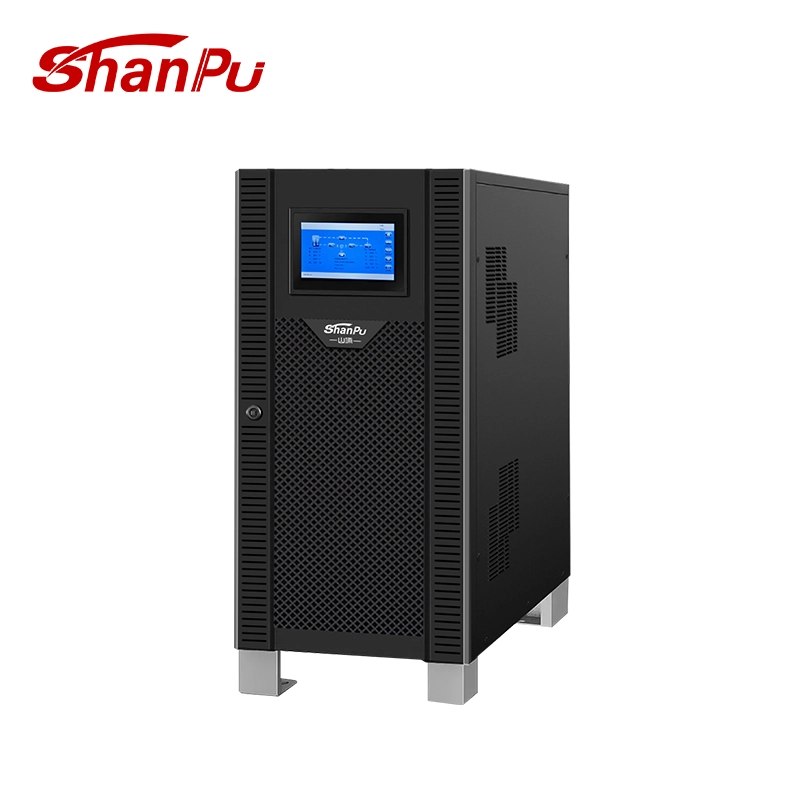
-
ShanPu 3C33 10-800kVA three-phase industrial UPS is a low-frequency UPS with transformer-based online double conversion for factories and plants. Equipment, automation and control loads stay online through grid disturbance and outage with 0ms transfer.
- Rated 10-800kVA with three-phase input and output at 380/400/415Vac, the 3C33 scales from single machines to full production lines. A low-frequency isolation transformer blocks surge, harmonic and common-mode disturbance before reaching PLCs and drives; microprocessor control keeps output within ±1% across a 304-456Vac input window. External VRLA banks size backup time to the process.
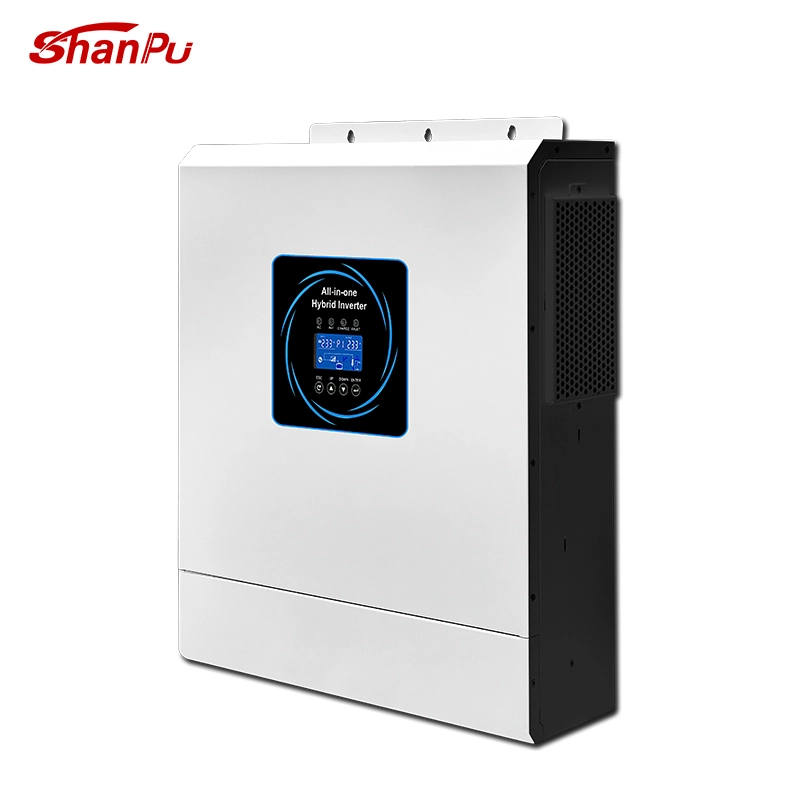
ShanPu SP-12KW/48V is an all-in-one hybrid inverter that integrates dual MPPT solar charging, 48V battery management and dual-output DC-to-AC inversion in one unit for large residential, commercial and light industrial storage systems. Two independent MPPT channels harvest power from separate PV arrays and convert it into regulated 48V DC, charging the battery bank at up to 160A while feeding the inverter stage; the controller automatically selects between solar, utility and battery based on the configured priority mode (SUB / SBU / SUF).The dual AC output design separates critical loads from non-critical circuits, while the 160A MPPT charging current and up to 160A AC charging rapidly recharge 48V battery banks after prolonged cloudy periods or heavy discharge. The 48V architecture reduces line losses and supports higher power delivery, and the Pro model adds parallel expansion plus optional WiFi monitoring for larger projects.
ShanPu SP-3.6KW/24V is an all-in-one hybrid inverter that combines a 100A MPPT solar charger, 24V battery management and DC-to-AC inversion in one compact unit. Built for residential and small commercial systems, it delivers reliable power management with efficient energy conversion and straightforward installation.The inverter supports up to 5000W PV array power with a 60-500Vdc MPPT tracking range and up to 96% peak conversion efficiency from PV to AC. It can also run directly from solar PV or utility without a battery connected, and RS485 communication with automatic lithium battery activation makes LiFePO4 integration straightforward.
ShanPu SP-6.2KW/48V is an all-in-one hybrid inverter that integrates MPPT solar charging, 48V battery management and DC-to-AC inversion into a single unit for medium residential and small commercial storage systems. Solar PV power is processed by the MPPT charger and converted into regulated 48V DC, which simultaneously charges the battery bank and supplies the inverter stage, while the built-in controller automatically selects the energy source - solar, utility or battery - based on the configured operating mode.
© 2026 ShanPu. All Rights Reserved.
YouTube
SHANPU UPS
Shanpu