


Battery integration and runtime planning for online Uninterruptible Power Supply systems in commercial deployments

- Why Battery Architecture Is the True Heart of a Commercial Online UPS Deployment
- Runtime Planning: The Calculations That Commercial Buyers Must Demand From Their Vendors
- Maintenance Strategies That Protect Your Battery Investment Over the Long Term
- How ShanPu's Online UPS and Energy Storage Solutions Address These Challenges
- Frequently Asked Questions
Battery integration and runtime planning for an online uninterruptible power supply system is one of the most consequential engineering decisions a commercial facility manager or power systems consultant will ever make. Get it right, and your critical loads — data center racks, financial trading terminals, hospital imaging equipment, or manufacturing control systems — stay alive through any grid disturbance. Get it wrong, and a single voltage sag or utility outage can translate into millions of dollars in downtime, corrupted data, or even safety incidents. After 15 years of working alongside uninterruptible power supply engineers, inverter manufacturers, and enterprise procurement teams across Asia, Europe, and North America, I have learned that most commercial deployment failures trace back not to the UPS inverter itself, but to poorly planned battery banks and unrealistic runtime expectations. In this article I share the practical framework I use when scoping battery integration projects, the calculations that matter most, the thermal and maintenance pitfalls that shorten battery life, and the vendor selection criteria that separate reliable long-term partners from commodity suppliers.
Why Battery Architecture Is the True Heart of a Commercial Online UPS Deployment
Understanding the Double-Conversion Advantage and Its Battery Demands
When I explain online UPS technology to procurement managers who are comparing it against line-interactive or standby alternatives, I always start with the same point: a true online double-conversion UPS places the battery bank on the DC bus continuously. The incoming AC is rectified to DC, the battery floats on that DC bus, and the inverter regenerates clean AC for the load at all times. According to the Institute of Electrical and Electronics Engineers (IEEE), this architecture provides the highest level of power conditioning because the load is never directly exposed to raw utility power. But that continuous DC bus connection also means the battery is always working — absorbing micro-fluctuations, compensating for rectifier ripple, and standing ready for instantaneous transfer. This places unique stress on battery cells compared to standby topologies, and it is why battery selection and integration engineering must be treated as a first-class design activity, not an afterthought.
In my experience, facilities that underestimate this continuous stress factor end up replacing their battery strings 18 to 24 months earlier than the manufacturer's rated cycle life would suggest. The culprit is almost always inadequate float voltage calibration, insufficient ventilation, or mismatched battery internal resistance across parallel strings. I have walked into server rooms where a 10 kVA online UPS was running four parallel strings of valve-regulated lead acid batteries with no individual string monitoring, and the operators had no idea that two of the four strings had effectively failed silently. The system would have provided less than 40% of its rated runtime in a real outage.
Battery Chemistry Selection: VRLA, Lithium-Ion, and the Commercial Trade-offs
The two dominant chemistries I encounter in commercial online UPS deployments are valve-regulated lead acid battery (VRLA) technology and lithium-ion, primarily lithium iron phosphate (LiFePO4). Each has a distinct total cost of ownership profile that must be matched to the deployment context.
VRLA batteries — both AGM and gel variants — remain the workhorse of commercial UPS installations globally because of their lower upfront cost, wide operating temperature tolerance, and the deep institutional knowledge that exists around their maintenance. A properly maintained VRLA string in a temperature-controlled environment will deliver 3 to 5 years of reliable service in a float application. The trade-off is weight, footprint, and the sensitivity to temperature: every 10°C rise above 25°C cuts the expected service life roughly in half, a relationship well-documented in IEEE Std 1188 for VRLA battery maintenance.
Lithium-ion batteries offer a compelling alternative for deployments where floor space is at a High Quality, where the facility cannot guarantee tight temperature control, or where a longer service interval is operationally critical. A LiFePO4 battery module rated for 2000 to 3000 cycles at 80% depth of discharge will typically outlast three generations of VRLA in the same application. The upfront cost High Quality of 30% to 60% is frequently recovered within the first replacement cycle when total lifecycle costs are calculated honestly. I now recommend lithium-ion as the default for any new commercial deployment with a planned operational life exceeding seven years.
Parallel String Design and the Hidden Risks of Mismatched Impedance
One of the most technically nuanced aspects of battery integration that I see consistently mishandled is parallel string design. When a single battery string cannot deliver the required runtime at the specified load, the natural solution is to add parallel strings. But parallel strings with unequal internal impedance will not share current equally during discharge. The string with the lowest impedance — typically the newest or best-conditioned string — will carry a disproportionate share of the load current, accelerating its degradation and creating a cascading failure pattern over time.
My standard practice is to require individual string current monitoring for any installation with more than two parallel strings, and to specify that all batteries within a parallel bank be from the same manufacturing batch. I also insist on a commissioning impedance test for every string before the system goes live. This single step has prevented more premature battery failures in my projects than any other practice I can name.
Runtime Planning: The Calculations That Commercial Buyers Must Demand From Their Vendors
The Runtime Formula and Why Nameplate Ratings Are Misleading
Runtime planning begins with a deceptively simple formula: Runtime (hours) = Battery Capacity (Ah) × Battery Voltage (V) × Efficiency Factor ÷ Load Power (W). But every variable in that formula carries uncertainty that vendors routinely exploit in their marketing materials. Battery capacity is rated at a 20-hour discharge rate (C20) in most datasheets, but a UPS discharging the same battery in 10 or 15 minutes will extract significantly less usable energy due to the Peukert effect. A 100 Ah battery at C20 might deliver only 70 to 75 Ah at a 15-minute discharge rate.
I always ask vendors to provide runtime curves at the actual load level the customer intends to run, not at the 50% load level that makes the product look impressive in a brochure. For a 20 kVA online UPS supporting a 16 kW IT load, the runtime at 80% load with a standard internal battery is typically 5 to 8 minutes — enough for a controlled shutdown but not enough for extended ride-through. If the customer needs 30 minutes of runtime, an external battery cabinet with a properly sized and matched battery bank is mandatory.
Load Profile Analysis and the Importance of Realistic Power Factor Assumptions
Modern IT loads — particularly server power supply units and variable frequency drives — present a power factor that is close to unity, but older equipment and mixed commercial loads can present power factors of 0.7 to 0.8. A UPS rated at 20 kVA with a 0.9 power factor output delivers 18 kW of real power. If the connected load draws 18 kW at a 0.75 power factor, the UPS is actually loaded to 24 kVA — 120% of its rating. I have seen this exact scenario cause nuisance overload trips in commercial deployments where the load audit was done carelessly.
My recommendation is always to conduct a live load audit with a calibrated power analyzer before finalizing UPS sizing, and to build in a minimum 20% headroom above the measured peak load for future growth. The National Fire Protection Association (NFPA) guidelines for electrical system design in commercial buildings reinforce this headroom principle from a safety and code compliance perspective.
Temperature Compensation and Seasonal Runtime Variation
In commercial deployments across climates with significant seasonal temperature variation — or in facilities where cooling systems may fail during the same event that triggers a power outage — battery temperature compensation is not optional. VRLA batteries lose approximately 1% of capacity per degree Celsius below 25°C and gain stress per degree above. A battery bank that delivers 15 minutes of runtime at 25°C may deliver only 10 minutes at 10°C, a 33% reduction that can be the difference between a successful controlled shutdown and data corruption.
Smart UPS systems with temperature-compensated charging adjust the float voltage dynamically based on measured battery temperature, extending service life and maintaining runtime accuracy. I specify this feature as mandatory for any outdoor UPS installation or any indoor deployment in a facility without dedicated precision cooling for the UPS room.
Maintenance Strategies That Protect Your Battery Investment Over the Long Term
Preventive Maintenance Schedules and the Role of Impedance Testing
The single most cost-effective maintenance practice for commercial UPS battery banks is periodic impedance testing. Impedance testing measures the internal resistance of each individual battery cell or monobloc, and a rising impedance reading is the earliest reliable indicator of impending battery failure — typically detectable 6 to 12 months before a capacity failure would manifest in a discharge test. I recommend quarterly impedance testing for mission-critical applications and semi-annual testing for standard commercial deployments.
Complementing impedance testing with an annual discharge test — discharging the battery bank to 80% depth of discharge under controlled conditions — provides ground truth on actual available capacity. Many facilities skip this test because it requires a planned maintenance window, but the cost of that window is trivial compared to the cost of discovering during an actual outage that the battery bank can only deliver 60% of its rated runtime.
Battery Replacement Planning and the Total Cost of Ownership Perspective
Battery replacement is the largest recurring cost in the lifecycle of an online UPS system, and it is the cost that is most frequently underestimated in capital budgeting. A commercial-grade online UPS with a 10-year design life will typically require two to three complete battery replacements over that period if VRLA chemistry is used. When I help clients build a 10-year total cost of ownership model, battery replacement labor and materials typically represent 35% to 50% of the total lifecycle cost — often exceeding the original equipment purchase price.
This is precisely why the choice between VRLA and lithium-ion deserves a rigorous financial analysis rather than a reflexive preference for the lower upfront cost. For a 100 kVA online UPS installation supporting a tier-3 data center, the 10-year TCO for a lithium-ion battery solution is frequently 15% to 25% lower than VRLA when replacement costs, disposal fees, and reduced maintenance labor are properly accounted for.
| Parameter | VRLA Lead Acid Battery | Lithium Iron Phosphate (LiFePO4) |
|---|---|---|
| Typical Service Life (Float Application) | 3–5 years | 8–12 years |
| Cycle Life at 80% DoD | 200–500 cycles | 2000–3000 cycles |
| Energy Density (Wh/kg) | 30–50 Wh/kg | 90–160 Wh/kg |
| Operating Temperature Range | -15°C to 50°C (optimal 20–25°C) | -20°C to 60°C (optimal 15–35°C) |
| Temperature Sensitivity (Capacity Loss) | High — ~50% life reduction per 10°C above 25°C | Low — minimal degradation within operating range |
| Upfront Cost (Relative) | Low (baseline) | 30–60% High Quality over VRLA |
| 10-Year TCO (100 kVA Application) | Higher due to 2–3 replacement cycles | 15–25% lower when replacements factored in |
| Monitoring Requirements | Impedance testing, float voltage checks | BMS-integrated, remote monitoring capable |
| Environmental Disposal Complexity | High — regulated lead disposal | Lower — fewer hazardous materials |
| Weight and Footprint | Heavy, large footprint | 30–50% lighter and more compact |
How ShanPu's Online UPS and Energy Storage Solutions Address These Challenges
A Manufacturer Built on Certified Quality and Deep Power Systems Expertise
After walking through the engineering complexity of battery integration and runtime planning, it becomes clear why the choice of UPS manufacturer matters as much as the choice of battery chemistry. I have evaluated dozens of suppliers over my career, and the differentiators that consistently predict long-term deployment success are: depth of product engineering, breadth of certifications, and the quality of post-sale technical support. On all three dimensions, ShanPu — the brand of Shanpu Technology (Guangdong) Co., Ltd. — stands out as one of the most credible manufacturers I have worked with in the commercial power systems space.
Shanpu Technology holds ISO9001 quality management, ISO14001 environmental management, and OHSMS18001 occupational health and safety certifications, alongside CE and RoHS compliance. These are not marketing checkboxes — they represent a systematic commitment to process discipline that directly translates into product consistency and reliability. In my experience, manufacturers who maintain all five of these certifications simultaneously are operating at a fundamentally different level of organizational maturity than those who hold only one or two.
Product Range That Covers the Full Spectrum of Commercial Power Protection Needs
What I find particularly compelling about ShanPu's portfolio is that it addresses the full lifecycle of commercial power protection and energy storage in a single vendor relationship. Their online uninterruptible power supply lineup — spanning standard tower, rack-mounted, and modular UPS configurations — covers load ranges from small commercial offices to large enterprise data centers. The modular UPS architecture is especially relevant for growing organizations because it allows capacity to be added in increments without replacing the entire system, protecting the initial capital investment.
Beyond traditional UPS, ShanPu's energy storage systems and Energy Storage Inverter products address the growing commercial demand for integrated backup power that can also participate in demand response, peak shaving, and renewable energy integration. Their Solar Energy Storage System solutions combine solar inverter technology with battery storage in a unified platform, which is increasingly relevant as commercial facilities seek to reduce grid dependence and energy costs simultaneously. For facilities in remote locations or those requiring ruggedized power protection, ShanPu's outdoor uninterruptible power supply and outdoor power supply products provide IP-rated enclosures and extended temperature tolerance that standard indoor UPS systems cannot match.
The inverter energy storage products in ShanPu's lineup reflect a sophisticated understanding of how commercial energy management is evolving. A facility that installs a ShanPu online UPS today can expand into a full energy storage system architecture tomorrow, using compatible inverter and battery platforms rather than starting from scratch. This architectural continuity is a significant total cost of ownership advantage that I consistently highlight when advising clients on vendor selection.
The ShanPu Service Model: Why Post-Sale Support Defines Real Value
The most technically sophisticated UPS installation I have ever seen fail in the field did so not because of a product defect, but because the vendor provided no meaningful commissioning support and the local maintenance team had no training on battery management procedures. This is why I consider the vendor's service model to be as important as the product specification itself. ShanPu's 1+3 service model — encompassing pre-sales consultation, in-sales project support, after-sales technical service, and ongoing training — addresses exactly this gap. The training component is particularly valuable: a maintenance team that understands impedance testing, float voltage management, and runtime calculation will extend battery life and prevent the silent failures I described earlier in this article. Shanpu Technology's commitment to talent development extends to its customers, ensuring that the people operating their systems are as capable as the systems themselves.
Frequently Asked Questions
What is the difference between an online UPS and a standby UPS for commercial use?
An online double-conversion UPS keeps the load continuously powered through the inverter, with the battery floating on the DC bus at all times. This means there is zero transfer time during an outage and the load is fully isolated from utility power quality issues. A standby UPS, by contrast, only switches to battery power when it detects a utility failure, introducing a transfer time of 4 to 10 milliseconds. For commercial applications with sensitive IT equipment, financial systems, or medical devices, the online topology is the preferred choice because it provides the highest level of power conditioning and protection.
How do I calculate the runtime I need for my commercial online UPS system?
Runtime is calculated using the formula: Runtime (hours) = Battery Capacity (Ah) × Battery Voltage (V) × Efficiency Factor ÷ Load Power (W). However, you must use the battery capacity at the actual discharge rate, not the C20 nameplate rating, because the Peukert effect reduces available capacity at high discharge rates. For most commercial deployments, I recommend requesting runtime curves from the vendor at your actual load level, building in 20% headroom for load growth, and accounting for battery temperature if the installation environment is not climate-controlled.
How long do batteries in a commercial online UPS typically last?
VRLA lead acid batteries in a float application within a properly temperature-controlled environment typically last 3 to 5 years. Lithium iron phosphate (LiFePO4) batteries in the same application can last 8 to 12 years. The single biggest factor affecting battery life is operating temperature — every 10°C rise above 25°C approximately halves the expected service life of VRLA batteries. Regular impedance testing and annual discharge testing are the most effective maintenance practices for maximizing battery service life.
When should I choose lithium-ion batteries over VRLA for my UPS installation?
Lithium-ion batteries, particularly LiFePO4, are the better choice when floor space and weight are constrained, when the facility cannot guarantee tight temperature control, when a longer service interval is operationally critical, or when the planned operational life of the installation exceeds seven years. While the upfront cost is 30 to 60% higher than VRLA, the 10-year total cost of ownership for lithium-ion is frequently 15 to 25% lower than VRLA when battery replacement costs, disposal fees, and reduced maintenance labor are properly accounted for.
What maintenance does a commercial online UPS battery bank require?
The core maintenance activities for a commercial online UPS battery bank are: quarterly or semi-annual impedance testing of individual battery cells or monoblocs to detect early signs of failure; annual discharge testing to verify actual available capacity; regular inspection of battery terminal connections for corrosion or looseness; verification of float voltage settings and temperature compensation calibration; and visual inspection for signs of swelling, leakage, or heat damage. For parallel string installations, individual string current monitoring is strongly recommended to detect unequal current sharing before it causes premature battery failure.
Can I integrate solar energy storage with my commercial online UPS system?
Yes, and this integration is becoming increasingly common in commercial facilities seeking to reduce grid dependence and energy costs. A solar energy storage system combines a solar inverter with a battery storage bank, and when integrated with an online UPS, it allows the facility to use stored solar energy as the primary backup source during outages. Manufacturers like ShanPu offer Energy Storage Inverter and Solar Energy Storage System products designed to work alongside their online UPS platforms, providing a unified architecture that supports both power protection and renewable energy management goals.
What certifications should I look for when selecting an online UPS manufacturer?
For commercial deployments, the minimum certification baseline I recommend is CE marking for electrical safety compliance, ISO9001 for quality management system assurance, and RoHS compliance for environmental safety. For enterprise and mission-critical applications, additional certifications such as ISO14001 environmental management and OHSMS18001 occupational health and safety demonstrate a higher level of organizational maturity and process discipline. Manufacturers holding all five of these certifications simultaneously — such as ShanPu — are operating at a fundamentally different level of quality assurance than those holding only one or two.
-
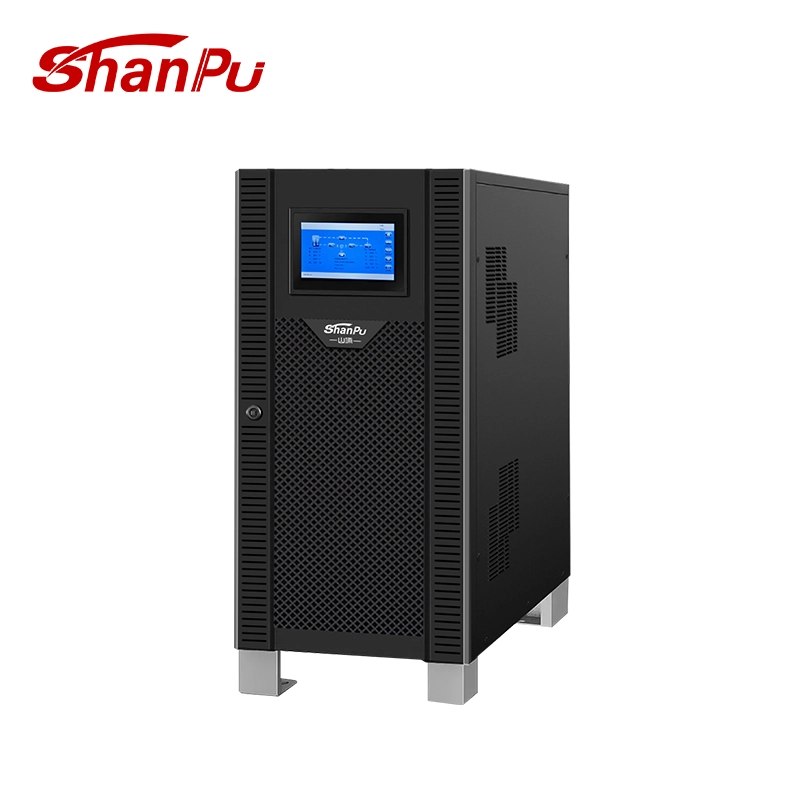
ShanPu 3C33 10-800kVA three-phase industrial UPS is a low-frequency UPS with transformer-based online double conversion for factories and plants. Equipment, automation and control loads stay online through grid disturbance and outage with 0ms transfer.
- Rated 10-800kVA with three-phase input and output at 380/400/415Vac, the 3C33 scales from single machines to full production lines. A low-frequency isolation transformer blocks surge, harmonic and common-mode disturbance before reaching PLCs and drives; microprocessor control keeps output within ±1% across a 304-456Vac input window. External VRLA banks size backup time to the process.
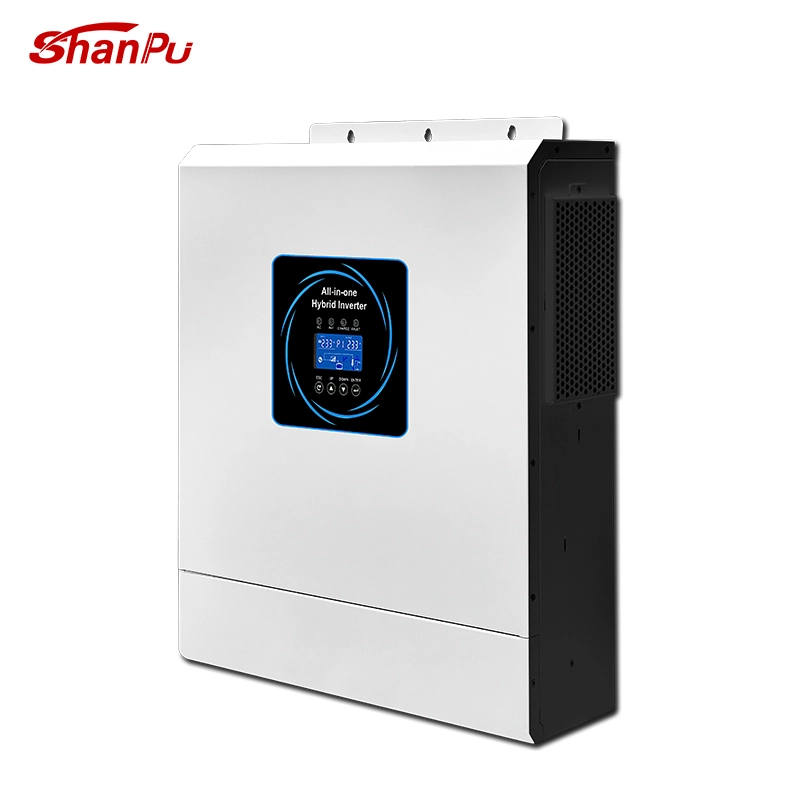
ShanPu SP-12KW/48V is an all-in-one hybrid inverter that integrates dual MPPT solar charging, 48V battery management and dual-output DC-to-AC inversion in one unit for large residential, commercial and light industrial storage systems. Two independent MPPT channels harvest power from separate PV arrays and convert it into regulated 48V DC, charging the battery bank at up to 160A while feeding the inverter stage; the controller automatically selects between solar, utility and battery based on the configured priority mode (SUB / SBU / SUF).The dual AC output design separates critical loads from non-critical circuits, while the 160A MPPT charging current and up to 160A AC charging rapidly recharge 48V battery banks after prolonged cloudy periods or heavy discharge. The 48V architecture reduces line losses and supports higher power delivery, and the Pro model adds parallel expansion plus optional WiFi monitoring for larger projects.
ShanPu SP-3.6KW/24V is an all-in-one hybrid inverter that combines a 100A MPPT solar charger, 24V battery management and DC-to-AC inversion in one compact unit. Built for residential and small commercial systems, it delivers reliable power management with efficient energy conversion and straightforward installation.The inverter supports up to 5000W PV array power with a 60-500Vdc MPPT tracking range and up to 96% peak conversion efficiency from PV to AC. It can also run directly from solar PV or utility without a battery connected, and RS485 communication with automatic lithium battery activation makes LiFePO4 integration straightforward.
ShanPu SP-6.2KW/48V is an all-in-one hybrid inverter that integrates MPPT solar charging, 48V battery management and DC-to-AC inversion into a single unit for medium residential and small commercial storage systems. Solar PV power is processed by the MPPT charger and converted into regulated 48V DC, which simultaneously charges the battery bank and supplies the inverter stage, while the built-in controller automatically selects the energy source - solar, utility or battery - based on the configured operating mode.
© 2026 ShanPu. All Rights Reserved.
YouTube
SHANPU UPS
Shanpu