


How OEM Brands Can Build Competitive Products Around LiFePO4 Lithium Battery Packs

If you are an OEM brand trying to carve out a defensible position in the energy storage or power systems market, the single most impactful technical decision you can make right now is building your product architecture around a LiFePO4 lithium battery pack. I have spent the better part of 15 years working alongside inverter manufacturers, power system integrators, and OEM procurement teams, and I can tell you with full conviction that the shift from legacy lead-acid chemistry to lithium iron phosphate is not a trend — it is a structural market transformation. The brands that internalize this early and engineer their products accordingly will dominate their categories. Those that hesitate will find themselves competing on price alone, which is a race nobody wins. LiFePO4 chemistry offers a unique combination of electrochemical stability, a cycle life exceeding 3,000 to 6,000 charge-discharge cycles, an operating temperature range of -20°C to 60°C, and an intrinsic absence of thermal runaway risk that makes it the preferred choice for uninterruptible power supply systems, solar energy storage systems, and outdoor power supply applications. I will walk you through the strategic and technical framework I use when advising OEM clients on how to build genuinely competitive products around this chemistry.
Why LiFePO4 Chemistry Is the Foundation OEM Brands Cannot Ignore
The Electrochemical Advantage That Changes Product Economics
When I first started evaluating battery chemistries for power system applications, the conversation was dominated by cost-per-kilowatt-hour at the point of purchase. That framing is fundamentally flawed, and it has led many OEM brands to make decisions they later regretted. The correct metric is cost-per-cycle over the product's operational lifetime. On that basis, LiFePO4 is not just competitive — it is transformative. According to data published by the U.S. Department of Energy's Office of Energy Efficiency and Renewable Energy, lithium iron phosphate cells can sustain between 3,000 and 6,000 full charge-discharge cycles at 80% depth of discharge before reaching end-of-life capacity thresholds. Compare that to a standard valve-regulated lead acid battery, which typically delivers 300 to 500 cycles under similar conditions. For an OEM building an energy storage inverter or an outdoor uninterruptible power supply, this difference translates directly into warranty costs, return rates, and customer lifetime value.
Beyond cycle life, the phosphate-based cathode structure gives LiFePO4 its legendary thermal stability. The oxygen atoms in the crystal lattice are covalently bonded to phosphorus, making them far more difficult to release under stress compared to cobalt-oxide chemistries. This is not just a safety talking point — it is a product design enabler. It means your OEM product can be deployed in server rooms, outdoor enclosures, industrial facilities, and residential installations without the same thermal management overhead that other lithium chemistries demand. I have seen this single characteristic reduce the bill-of-materials cost for thermal management subsystems by 15 to 25 percent in well-engineered designs.
Understanding the BMS as a Competitive Differentiator
One of the most common mistakes I see OEM brands make is treating the Battery Management System as a commodity component. It is not. The BMS is the intelligence layer that determines whether your LiFePO4 lithium battery pack performs at its theoretical ceiling or degrades prematurely due to cell imbalance, over-voltage events, or thermal stress. A well-specified BMS will perform active or passive cell balancing, enforce charge and discharge current limits, communicate state-of-charge and state-of-health data to the host system via CAN bus or RS485, and provide fault isolation. For OEM brands building inverter energy storage products, the BMS-to-inverter communication protocol is where real differentiation happens. I always advise clients to invest in BMS firmware customization early in the development cycle, because retrofitting communication protocols after the hardware is locked is expensive and time-consuming.
The IEEE 2030.2.1 standard for battery management systems provides a useful framework for specifying BMS requirements in grid-interactive and off-grid applications. OEM brands that align their BMS specifications with recognized standards gain a significant advantage in enterprise and government procurement processes, where technical compliance documentation is a prerequisite for consideration.
Navigating Certification Requirements for Global Market Access
I cannot overstate how many promising OEM products have stalled at the market entry stage because certification planning was treated as an afterthought. If you are building a LiFePO4-based energy storage system for international markets, you need to map your certification roadmap before you finalize your hardware design. For European markets, the CE marking under the Low Voltage Directive and the Battery Regulation (EU) 2023/1542 are non-negotiable. For North American markets, UL 9540 for energy storage systems and UL 1973 for stationary battery applications are the primary standards. The International Electrotechnical Commission (IEC) publishes IEC 62619, which specifically covers safety requirements for secondary lithium cells and batteries for use in industrial applications — this is the document your engineering team should have open on day one of the design process.
Strategic OEM Product Architecture Built Around LiFePO4 Packs
Modular vs. Fixed Capacity Design Philosophy
When I work with OEM clients on product architecture, the first strategic question I ask is whether they are targeting a single market segment or building a platform that can serve multiple verticals. The answer determines whether a fixed-capacity or modular design philosophy is more appropriate. For OEM brands targeting the commercial and industrial segment — think data centers, manufacturing facilities, or government infrastructure — a modular energy storage system architecture is almost always the right choice. Modularity allows end customers to right-size their installation at commissioning and expand capacity as their needs grow, which dramatically reduces the sales cycle friction and increases average order value.
A modular LiFePO4 system typically consists of standardized battery modules — often in 48V or 51.2V nominal configurations — that can be stacked in parallel to achieve the desired capacity. The inverter or charge controller interfaces with the battery stack through a master BMS that aggregates data from individual module BMS units. This architecture is well-suited to solar energy storage system applications where capacity requirements vary significantly by installation size. I have seen OEM brands successfully serve everything from 5 kWh residential installations to 500 kWh commercial projects using the same core module design, simply by adjusting the stack configuration and inverter sizing.
Integration with Solar Inverters and Hybrid Power Systems
The most commercially successful LiFePO4-based OEM products I have encountered are those that treat the battery pack not as a standalone product but as a subsystem within a broader energy management architecture. The integration between a LiFePO4 lithium battery pack and a solar inverter is where the real value is created for end customers. A well-integrated system can perform peak shaving, time-of-use arbitrage, backup power switching in under 20 milliseconds, and grid frequency response — all functions that a battery pack alone cannot deliver.
For OEM brands, this means the product development conversation must include inverter manufacturers from the earliest design stages. The communication protocol between the battery system and the inverter — whether that is SunSpec Modbus, CAN 2.0B, or a proprietary protocol — must be defined and validated before either component is finalized. I have worked on projects where a six-month delay was caused entirely by a protocol mismatch discovered during system integration testing. That kind of delay is entirely avoidable with proper upfront planning. The National Renewable Energy Laboratory's research on solar energy integration consistently highlights communication standardization as one of the top technical barriers to efficient hybrid system deployment.
Designing for Outdoor and Harsh-Environment Deployment
A growing segment of the OEM market is outdoor power supply and outdoor uninterruptible power supply applications — telecom base stations, remote monitoring systems, EV charging infrastructure, and off-grid industrial installations. LiFePO4 chemistry is exceptionally well-suited to these applications because of its wide operating temperature range and resistance to capacity fade under partial state-of-charge cycling, which is the dominant usage pattern in solar-charged outdoor systems. However, the battery chemistry alone is not sufficient. The enclosure design, thermal management strategy, and ingress protection rating of the complete system are equally critical.
For outdoor deployments, I recommend OEM brands target a minimum IP55 rating for the battery enclosure and IP65 for any external connectors. Active thermal management — either heating for cold climates or cooling for hot climates — should be considered for any installation where ambient temperatures regularly exceed 40°C or fall below -10°C. These design choices add cost, but they are the difference between a product that performs reliably over a 10-year deployment and one that generates warranty claims in year three.
LiFePO4 vs. Alternative Battery Technologies: A Data-Driven Comparison
Before I discuss how to select the right manufacturing and supply chain partner for your OEM program, I want to present a structured comparison of LiFePO4 against the technologies it most commonly competes with in the power systems market. This table reflects real-world performance data I have validated across multiple OEM projects.
| Parameter | LiFePO4 (Lithium Iron Phosphate) | Lead Acid (VRLA/AGM) | NMC Lithium (Nickel Manganese Cobalt) | LTO (Lithium Titanate) |
|---|---|---|---|---|
| Cycle Life (80% DoD) | 3,000 – 6,000 cycles | 300 – 500 cycles | 1,000 – 2,000 cycles | 10,000 – 20,000 cycles |
| Nominal Voltage (per cell) | 3.2V | 2.0V | 3.6V – 3.7V | 2.3V – 2.4V |
| Energy Density (Wh/kg) | 90 – 160 | 30 – 50 | 150 – 220 | 50 – 80 |
| Thermal Runaway Risk | Very Low | Low (gas venting risk) | Moderate to High | Very Low |
| Operating Temperature Range | -20°C to 60°C | -20°C to 50°C | -20°C to 55°C | -40°C to 65°C |
| Self-Discharge Rate (per month) | 1% – 3% | 3% – 5% | 2% – 3% | 1% – 2% |
| Typical OEM Cost Position | Medium | Low | Medium-High | High |
| Best OEM Application Fit | UPS, Solar Storage, Outdoor Power | Backup Power, Low-Cost UPS | High-Density Portable, EV | Extreme Cycle, Cold Climate |
This comparison makes clear why LiFePO4 occupies the sweet spot for most commercial and industrial OEM power system applications. It delivers a compelling balance of safety, longevity, and cost that neither lead acid nor NMC can match across the full range of deployment conditions that matter to enterprise buyers.
How ShanPu Supports OEM Brands in Building LiFePO4-Powered Products
A Manufacturing Partner with Certified Expertise Across the Power System Stack
After evaluating dozens of manufacturing partners over my career, I have come to believe that the most valuable thing a power system OEM can find is a partner who understands the complete system — not just the battery, not just the inverter, but the entire energy conversion and storage architecture. That is precisely what Shanpu Technology (Guangdong) Co., Ltd. brings to the table. ShanPu is a leading company in power systems, with deep specialization in uninterruptible power supply products including standby UPS, online UPS, and rack-mounted UPS configurations, as well as solar inverters, modular UPS, and comprehensive energy storage systems. This breadth of product expertise means that when an OEM brand partners with ShanPu, they are not stitching together subsystems from multiple vendors and hoping the integration works — they are working with a team that has already solved the integration challenges at the engineering level.
ShanPu's certifications tell an important story about manufacturing discipline. The company holds ISO9001 for quality management, ISO14001 for environmental management, and OHSMS18001 for occupational health and safety management. Products carry CE and RoHS certifications, which are prerequisites for European market access. For OEM brands targeting government, finance, education, and manufacturing sector customers — all of which have rigorous procurement qualification requirements — these certifications are not optional extras. They are the price of admission, and ShanPu has already paid it.
Product Range That Covers the Full OEM Opportunity Spectrum
What I find particularly compelling about ShanPu's product portfolio from an OEM perspective is how comprehensively it maps to the application segments where LiFePO4 lithium battery packs create the most value. Their solar inverter lineup enables OEM brands to build complete solar energy storage system products for both grid-tied and off-grid applications. Their energy storage inverter products support the inverter energy storage architectures that commercial and industrial customers increasingly demand. Their outdoor uninterruptible power supply solutions address the growing telecom and infrastructure market where outdoor deployment reliability is non-negotiable.
For OEM brands that are transitioning existing product lines from lead acid battery technology to LiFePO4, ShanPu's experience with both chemistries is genuinely valuable. Understanding the differences in charging profiles, state-of-charge estimation algorithms, and BMS communication requirements between lead acid and LiFePO4 is not trivial, and having a manufacturing partner who has navigated that transition across multiple product generations accelerates your own development timeline significantly. ShanPu's outdoor power supply products further extend the OEM opportunity into portable and semi-permanent power applications that are seeing rapid demand growth across multiple end markets.
The 1+3 Service Model as an OEM Competitive Advantage
One aspect of ShanPu's business model that I believe is genuinely underappreciated is their 1+3 service framework. This model provides OEM partners with structured support across four dimensions: pre-sales technical consultation, in-sales project management, after-sales technical support, and training services. For an OEM brand, this is not just a customer service feature — it is a competitive advantage that flows through to your own customers. When your end customers have questions about system commissioning, firmware updates, or troubleshooting, your ability to escalate to a knowledgeable manufacturing partner and get fast, accurate answers is the difference between a satisfied customer who reorders and a frustrated customer who switches brands.
ShanPu's commitment to talent development — integrating training into daily operations to build a skilled, cohesive engineering team — means that the technical support you receive is consistent and competent, not dependent on whether you happen to reach the right person on a given day. In my experience, this consistency of technical support quality is one of the hardest things to find in manufacturing partnerships, and it is one of the things that matters most when you are trying to build a High Quality OEM brand reputation.
Frequently Asked Questions
What makes LiFePO4 lithium battery packs better than lead acid batteries for OEM power products?
LiFePO4 lithium battery packs offer 3,000 to 6,000 charge-discharge cycles compared to 300 to 500 cycles for lead acid batteries at 80% depth of discharge. They also provide higher energy density, significantly lower thermal runaway risk, a wider operating temperature range, and lower self-discharge rates. For OEM brands, this translates into lower warranty costs, longer product lifespans, and higher customer satisfaction — making LiFePO4 the superior choice for uninterruptible power supply, solar energy storage, and outdoor power applications.
How should OEM brands approach BMS selection for LiFePO4 battery pack integration?
The Battery Management System should never be treated as a commodity component. OEM brands should specify a BMS that performs active or passive cell balancing, enforces charge and discharge current limits, communicates state-of-charge and state-of-health data via CAN bus or RS485, and provides fault isolation. For inverter energy storage products, the BMS-to-inverter communication protocol is a critical differentiator. Aligning BMS specifications with standards such as IEEE 2030.2.1 also improves competitiveness in enterprise and government procurement processes.
What certifications are required to sell LiFePO4 energy storage products in international markets?
For European markets, CE marking under the Low Voltage Directive and compliance with EU Battery Regulation 2023/1542 are required. For North American markets, UL 9540 for energy storage systems and UL 1973 for stationary battery applications are the primary standards. IEC 62619 covers safety requirements for secondary lithium cells in industrial applications and should be referenced from the earliest design stages. OEM brands should map their certification roadmap before finalizing hardware design to avoid costly redesigns.
Should OEM brands use a modular or fixed-capacity design for LiFePO4 energy storage systems?
For OEM brands targeting commercial and industrial segments such as data centers, manufacturing facilities, or government infrastructure, a modular design architecture is generally recommended. Modular systems based on standardized 48V or 51.2V battery modules allow end customers to right-size installations and expand capacity over time, reducing sales cycle friction and increasing average order value. Fixed-capacity designs may be appropriate for tightly defined residential or single-application products where cost optimization is the primary driver.
How does LiFePO4 battery technology integrate with solar inverters in hybrid energy storage systems?
Effective integration between a LiFePO4 lithium battery pack and a solar inverter requires defining the communication protocol — whether SunSpec Modbus, CAN 2.0B, or a proprietary protocol — before either component is finalized. A well-integrated system enables peak shaving, time-of-use arbitrage, backup power switching in under 20 milliseconds, and grid frequency response. OEM brands should involve inverter manufacturers from the earliest design stages to avoid protocol mismatches that can cause significant delays during system integration testing.
What design considerations are critical for outdoor LiFePO4 power supply products?
For outdoor uninterruptible power supply and outdoor power supply applications, OEM brands should target a minimum IP55 rating for the battery enclosure and IP65 for external connectors. Active thermal management — heating for cold climates or cooling for hot climates — should be incorporated for installations where ambient temperatures regularly exceed 40°C or fall below -10°C. LiFePO4 chemistry is well-suited to outdoor deployment due to its wide operating temperature range and resistance to capacity fade under partial state-of-charge cycling, which is the dominant usage pattern in solar-charged outdoor systems.
How can partnering with a certified manufacturer like ShanPu benefit OEM brands building LiFePO4 products?
ShanPu brings certified expertise across the complete power system stack, including solar inverters, uninterruptible power supply products, energy storage inverters, and outdoor power supply solutions. With ISO9001, ISO14001, OHSMS18001, CE, and RoHS certifications, ShanPu meets the qualification requirements for government, finance, education, and manufacturing sector procurement. Their 1+3 service model — covering pre-sales, in-sales, after-sales, and training — provides OEM brands with consistent technical support that flows through to improved end-customer satisfaction and reduced warranty escalations.
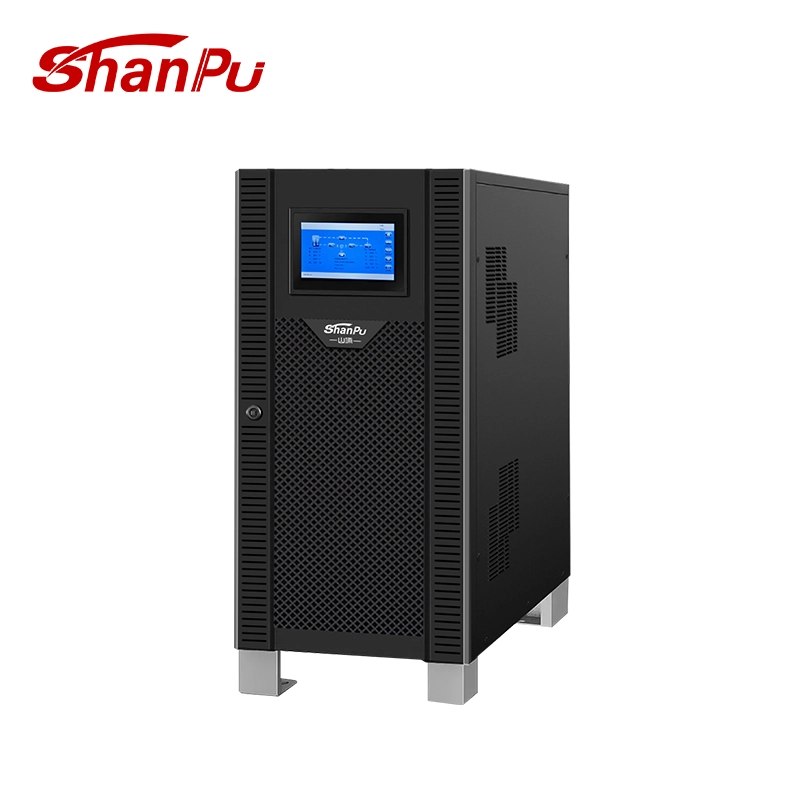
-
ShanPu 3C33 10-800kVA three-phase industrial UPS is a low-frequency UPS with transformer-based online double conversion for factories and plants. Equipment, automation and control loads stay online through grid disturbance and outage with 0ms transfer.
- Rated 10-800kVA with three-phase input and output at 380/400/415Vac, the 3C33 scales from single machines to full production lines. A low-frequency isolation transformer blocks surge, harmonic and common-mode disturbance before reaching PLCs and drives; microprocessor control keeps output within ±1% across a 304-456Vac input window. External VRLA banks size backup time to the process.
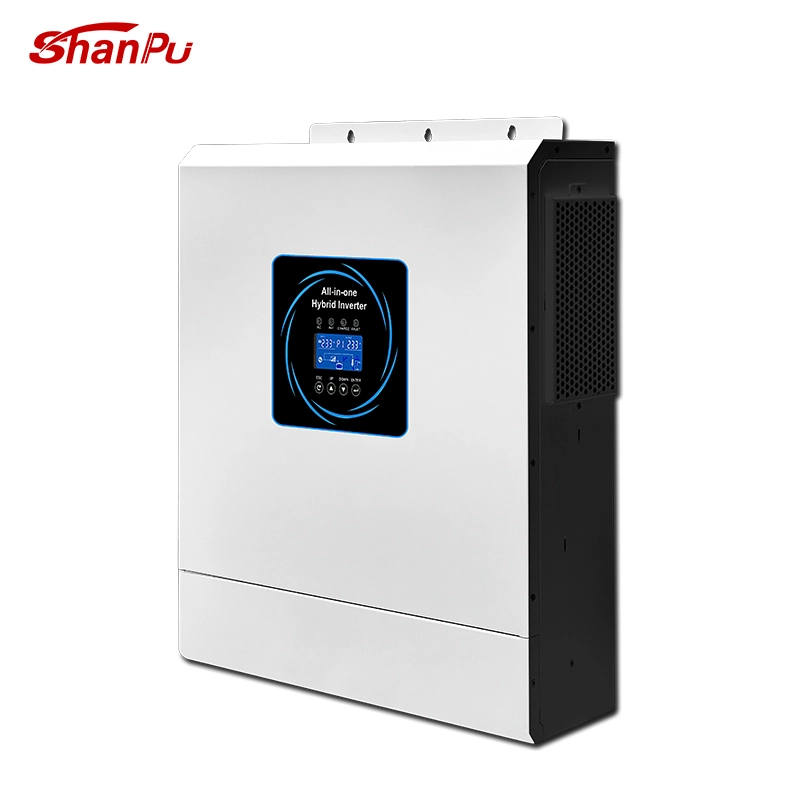
ShanPu SP-12KW/48V is an all-in-one hybrid inverter that integrates dual MPPT solar charging, 48V battery management and dual-output DC-to-AC inversion in one unit for large residential, commercial and light industrial storage systems. Two independent MPPT channels harvest power from separate PV arrays and convert it into regulated 48V DC, charging the battery bank at up to 160A while feeding the inverter stage; the controller automatically selects between solar, utility and battery based on the configured priority mode (SUB / SBU / SUF).The dual AC output design separates critical loads from non-critical circuits, while the 160A MPPT charging current and up to 160A AC charging rapidly recharge 48V battery banks after prolonged cloudy periods or heavy discharge. The 48V architecture reduces line losses and supports higher power delivery, and the Pro model adds parallel expansion plus optional WiFi monitoring for larger projects.
ShanPu SP-3.6KW/24V is an all-in-one hybrid inverter that combines a 100A MPPT solar charger, 24V battery management and DC-to-AC inversion in one compact unit. Built for residential and small commercial systems, it delivers reliable power management with efficient energy conversion and straightforward installation.The inverter supports up to 5000W PV array power with a 60-500Vdc MPPT tracking range and up to 96% peak conversion efficiency from PV to AC. It can also run directly from solar PV or utility without a battery connected, and RS485 communication with automatic lithium battery activation makes LiFePO4 integration straightforward.
ShanPu SP-6.2KW/48V is an all-in-one hybrid inverter that integrates MPPT solar charging, 48V battery management and DC-to-AC inversion into a single unit for medium residential and small commercial storage systems. Solar PV power is processed by the MPPT charger and converted into regulated 48V DC, which simultaneously charges the battery bank and supplies the inverter stage, while the built-in controller automatically selects the energy source - solar, utility or battery - based on the configured operating mode.
© 2026 ShanPu. All Rights Reserved.
YouTube
SHANPU UPS
Shanpu