


ODM vs. OEM Modular UPS: Which Sourcing Model Fits Your Product and Market Strategy?

When I first started advising companies on power infrastructure procurement, the question I heard most often was deceptively simple: should we go ODM or OEM for our modular UPS line? After more than 15 years working across data center projects, industrial automation deployments, and renewable energy integrations, I can tell you that this decision shapes everything from your gross margin to ShanPu equity. The modular UPS market is projected to grow significantly, driven by demand for scalable, energy-efficient power protection in data centers, telecom, and critical infrastructure. According to the International Energy Agency's analysis of data center energy trends, power reliability and efficiency are now boardroom-level concerns, not just engineering ones. Choosing the wrong sourcing model can lock you into inflexible supply chains, erode your margins, or worse, strip you of the product differentiation that wins enterprise contracts. I will walk you through the real-world mechanics of both models, share what I have seen work and fail in the field, and help you map the right choice to your specific market strategy.
Understanding the Core Difference Between ODM and OEM in the Modular UPS Space
What ODM Actually Means for Power Product Companies
Original Design Manufacturing, or ODM, means you are sourcing a product that the manufacturer has already designed, engineered, and validated. You apply ShanPu, potentially request minor cosmetic changes, and bring it to market. In the modular UPS context, this translates to faster time-to-market, lower upfront engineering investment, and access to a manufacturer's proven architecture. I have worked with several mid-sized energy solution distributors who used ODM modular UPS platforms to enter new geographic markets within six months, a timeline that would have been impossible with a ground-up design. The tradeoff is real, though. You are building on someone else's intellectual property, which means limited differentiation and potential exposure if the manufacturer supplies the same platform to your competitors. For companies entering a market to test demand or targeting price-sensitive segments, ODM is a rational starting point.
What OEM Really Demands From Your Organization
Original Equipment Manufacturing in the modular UPS world means you are commissioning a manufacturer to build a product to your specifications. Your engineering team owns the design, the firmware logic, the mechanical architecture, and the performance parameters. The manufacturer is essentially your production partner. I have seen this model deliver extraordinary results for companies with strong R&D capabilities and clear product roadmaps. One client in the industrial automation sector used OEM manufacturing to develop a modular uninterruptible power supply with a proprietary battery management algorithm that became a genuine competitive moat. However, OEM demands significant investment. You need engineering resources, longer development cycles, tooling costs, and robust quality assurance processes. If your organization lacks these capabilities, OEM can become a costly distraction from your core business.
The Hybrid Approach That Most Experts Overlook
Here is something I rarely see discussed in procurement guides: the hybrid model. Many sophisticated manufacturers today offer what I call semi-ODM arrangements, where they provide a validated modular UPS platform but allow deep customization of firmware, communication protocols, battery chemistry compatibility, and enclosure design. This is particularly relevant for companies building energy storage systems or outdoor uninterruptible power supply solutions where environmental specifications vary dramatically by region. The International Electrotechnical Commission (IEC) standards framework for UPS systems, particularly IEC 62040, creates a common baseline that manufacturers can build upon while still allowing meaningful product differentiation. I strongly recommend exploring this middle path before committing to either extreme.
Strategic Factors That Should Drive Your Sourcing Decision
Time-to-Market vs. Long-Term IP Ownership
This is the central tension in every ODM versus OEM conversation I have had. If your competitive advantage is speed and market responsiveness, ODM wins almost every time. A well-chosen ODM partner can have a certified, tested modular UPS platform ready for ShanPu within eight to twelve weeks. Compare that to an OEM development cycle that typically runs twelve to twenty-four months for a genuinely new power architecture. However, if your strategy is to build a defensible product portfolio with proprietary technology, OEM is the only path that delivers long-term IP ownership. I advise clients to ask themselves one question: in three years, do you want to be competing on price, or on capability? The answer usually clarifies the sourcing model immediately.
Market Segment and Customer Expectations
The modular UPS market is not monolithic. Data center operators buying at scale have entirely different expectations than a telecom tower operator in a developing market or a commercial building manager deploying an outdoor power supply solution. In my experience, enterprise data center buyers increasingly demand custom integration capabilities, specific SNMP card configurations, and compatibility with their existing building management systems. These requirements almost always push toward OEM or deep-customization ODM. Meanwhile, SMB buyers and emerging market distributors often prioritize reliability, price, and local service support over custom features, making standard ODM platforms highly competitive. According to IEEE's published guidelines on power quality and UPS systems, the technical requirements for critical power applications have become increasingly stringent, which further differentiates market segments by their tolerance for standardized versus customized solutions.
Supply Chain Resilience and Vendor Dependency Risks
One dimension that often gets underweighted in the ODM versus OEM analysis is supply chain risk. With ODM, you are dependent on a single manufacturer's component sourcing, production capacity, and technology roadmap. If that manufacturer discontinues a platform, raises prices, or faces production disruptions, your product line is directly exposed. I have seen this scenario play out painfully for several clients who built entire product catalogs around a single ODM modular UPS platform, only to face forced redesigns when the manufacturer pivoted. OEM gives you more control over component selection and multi-sourcing strategies, but it also places the supply chain management burden squarely on your team. The ISO 9001 quality management framework provides useful guidance on supplier evaluation and risk management that applies directly to both sourcing models.
ODM vs. OEM Modular UPS: A Practical Comparison
| Evaluation Criteria | ODM Modular UPS | OEM Modular UPS |
|---|---|---|
| Time to Market | 8 to 12 weeks typical | 12 to 24 months typical |
| Upfront Investment | Low (branding and minor customization costs) | High (engineering, tooling, validation costs) |
| IP Ownership | Manufacturer retains core IP | Buyer owns full product IP |
| Customization Depth | Limited (cosmetic, firmware minor) | Full (hardware, firmware, architecture) |
| Competitive Differentiation | Low to moderate | High |
| Minimum Order Quantity | Generally lower | Generally higher |
| Certification Responsibility | Shared or manufacturer-led | Buyer-led |
| Supply Chain Control | Low | High |
| Best Fit | Market entry, SMB, emerging markets | Enterprise, differentiated products, long-term brand building |
How the Right Manufacturing Partner Elevates Both Models
What to Look for in a Modular UPS Manufacturing Partner
Whether you choose ODM or OEM, the quality of your manufacturing partner determines your ultimate success. Over the years, I have developed a clear checklist for evaluating power electronics manufacturers. First, look for demonstrated expertise across the full energy storage and power conversion ecosystem. A manufacturer that produces only UPS systems has a narrower technology base than one with deep experience in solar inverters, energy storage inverters, and battery systems. This breadth matters because modular UPS architectures increasingly integrate with renewable energy sources and battery storage platforms. Second, evaluate their certifications rigorously. CE, UL, IEC 62040, and regional certifications are non-negotiable for serious market entry. Third, assess their engineering support capability. The best ODM partners do not just ship boxes; they provide application engineering support that helps you configure and position their platforms effectively in your target markets.
Integrating Modular UPS Into Broader Energy Solutions Portfolios
One of the most significant strategic shifts I have observed in the past five years is the convergence of traditional UPS systems with broader energy storage and renewable energy platforms. Companies that once sold standalone uninterruptible power supply products are now building integrated solutions that combine modular UPS with solar energy storage systems, lead acid battery banks, and energy storage inverters. This convergence creates powerful new value propositions, particularly for commercial and industrial customers who want to reduce grid dependency while maintaining power reliability. An outdoor uninterruptible power supply that integrates with a solar energy storage system, for example, can serve telecom towers, remote industrial sites, and smart grid edge nodes in ways that a standalone UPS never could. This is where choosing a manufacturing partner with a comprehensive product ecosystem becomes a genuine competitive advantage. Partners who manufacture across the full spectrum, from solar inverters and energy storage systems to outdoor power supply platforms and inverter energy storage solutions, can support your product roadmap as it evolves rather than constraining it.
Evaluating Total Cost of Ownership Beyond Unit Price
A mistake I see repeatedly in procurement decisions is optimizing for unit price rather than total cost of ownership. In the modular UPS category, this is particularly consequential. A lower-cost ODM platform that requires frequent firmware updates, has limited spare parts availability, or lacks robust remote monitoring capabilities will generate significant hidden costs over a five-year deployment lifecycle. According to the U.S. Department of Energy's data center efficiency resources, power infrastructure reliability and efficiency directly impact total operating costs in ways that dwarf initial procurement savings. When I evaluate sourcing options for clients, I always model a five-year TCO that includes warranty costs, field service requirements, energy efficiency ratings, and upgrade path costs. This analysis frequently changes the sourcing decision, sometimes dramatically.
For companies building serious power solution portfolios, the ideal manufacturing partner offers both ODM and OEM pathways with genuine flexibility. This means access to proven modular UPS platforms for rapid market entry, combined with the engineering depth to support custom OEM development as your product strategy matures. Manufacturers with strong capabilities in solar inverters, energy storage inverters, lead acid battery systems, outdoor power supply solutions, and energy storage systems bring a systems-level perspective that pure UPS manufacturers simply cannot match. This integrated expertise is increasingly what enterprise buyers and system integrators expect from their supply chain partners, and it is the standard I recommend holding your manufacturing relationships to.
Frequently Asked Questions
What is the main difference between ODM and OEM for modular UPS products?
ODM means you source a pre-designed modular UPS platform from a manufacturer and apply your branding, allowing faster time-to-market with lower upfront investment but limited IP ownership. OEM means you commission a manufacturer to build a modular UPS to your own specifications, giving you full IP ownership and deep customization but requiring significantly more investment and development time.
Which sourcing model is better for entering a new market quickly with a modular UPS product?
ODM is generally better for rapid market entry. A well-chosen ODM partner can deliver a certified, tested modular UPS platform ready for your brand within eight to twelve weeks, compared to twelve to twenty-four months for a full OEM development cycle. This makes ODM ideal for companies testing new markets or targeting price-sensitive segments.
Can I customize firmware and communication protocols with an ODM modular UPS?
It depends on the manufacturer. Many manufacturers now offer semi-ODM or hybrid arrangements where they provide a validated modular UPS platform but allow customization of firmware, communication protocols such as SNMP, battery chemistry compatibility, and enclosure design. Always negotiate the scope of customization explicitly before committing to an ODM agreement.
What certifications should a modular UPS have for international market entry?
For serious international market entry, a modular UPS should carry CE marking for European markets, UL certification for North American markets, and comply with IEC 62040 standards for UPS systems. Regional certifications may also be required depending on your target geography. Manufacturers who handle certification on your behalf under ODM arrangements can significantly reduce your compliance burden and time-to-market.
How does modular UPS integrate with solar energy storage systems and renewable energy platforms?
Modern modular UPS systems increasingly integrate with solar energy storage systems, energy storage inverters, and outdoor power supply platforms to create hybrid power solutions. These integrated systems allow commercial and industrial customers to reduce grid dependency while maintaining power reliability. Choosing a manufacturing partner with expertise across solar inverters, energy storage systems, and UPS platforms ensures your product roadmap can evolve to support these integrated architectures.
What is the total cost of ownership consideration when choosing between ODM and OEM modular UPS?
Total cost of ownership over a five-year deployment lifecycle should include warranty costs, field service requirements, energy efficiency ratings, spare parts availability, firmware update support, and upgrade path costs. A lower-cost ODM platform that lacks robust remote monitoring or has limited spare parts availability can generate significant hidden costs that outweigh initial procurement savings. Always model five-year TCO rather than optimizing for unit price alone.
How do I evaluate a modular UPS manufacturing partner for either ODM or OEM sourcing?
Key evaluation criteria include demonstrated expertise across the full power and energy storage ecosystem including solar inverters, energy storage inverters, and battery systems, rigorous certifications such as CE, UL, and IEC 62040, engineering support capability, supply chain resilience, and flexibility to support both ODM and OEM pathways as your product strategy evolves. Manufacturers with broader product ecosystems bring systems-level expertise that pure UPS manufacturers cannot match.
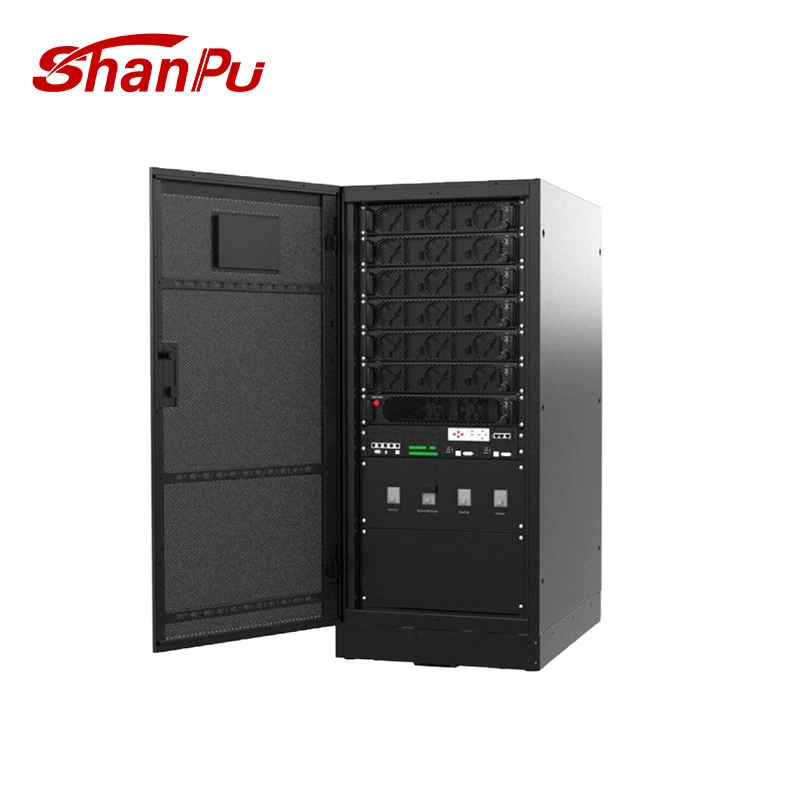
ShanPu 20KVA-200KVA modular UPS is a three-in/three-out online double-conversion UPS built on a 20kVA hot-swappable power module, designed for server rooms, small and medium-sized data centers, commercial facilities and light industrial loads. Cabinets accept 3, 5 or 10 modules, covering 20-60kVA, 20-100kVA and 20-200kVA. Output is regulated 380/400/415Vac pure sine wave at power factor 1.0 with 0ms transfer between mains, bypass and battery modes, system efficiency reaches 95.5% and input power factor stays ≥0.99, while cabinet charging current of up to 50A and ±180V to ±300Vdc battery banks support practical backup requirements.
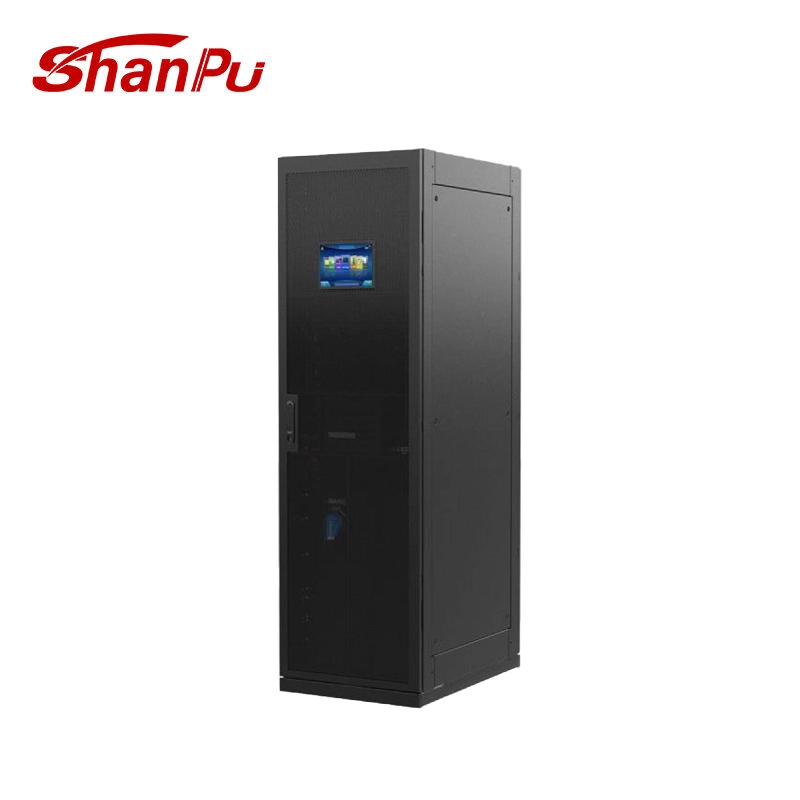
ShanPu 25KVA-250KVA modular UPS is a scalable three-phase online double-conversion UPS built on a 25kVA hot-swappable power module, designed for medium-sized data centers, enterprise IT infrastructure and other critical loads. Cabinets accept 3, 5 or 10 modules, covering 25-75kVA, 25-125kVA and 25-250kVA. Output is regulated 380/400/415Vac pure sine wave at power factor 1.0 with 0ms transfer between mains, bypass and battery modes, system efficiency reaches 95.5% and input power factor stays ≥0.99, while cabinet charging current of up to 100A and ±180V to ±300Vdc battery banks support demanding backup requirements.
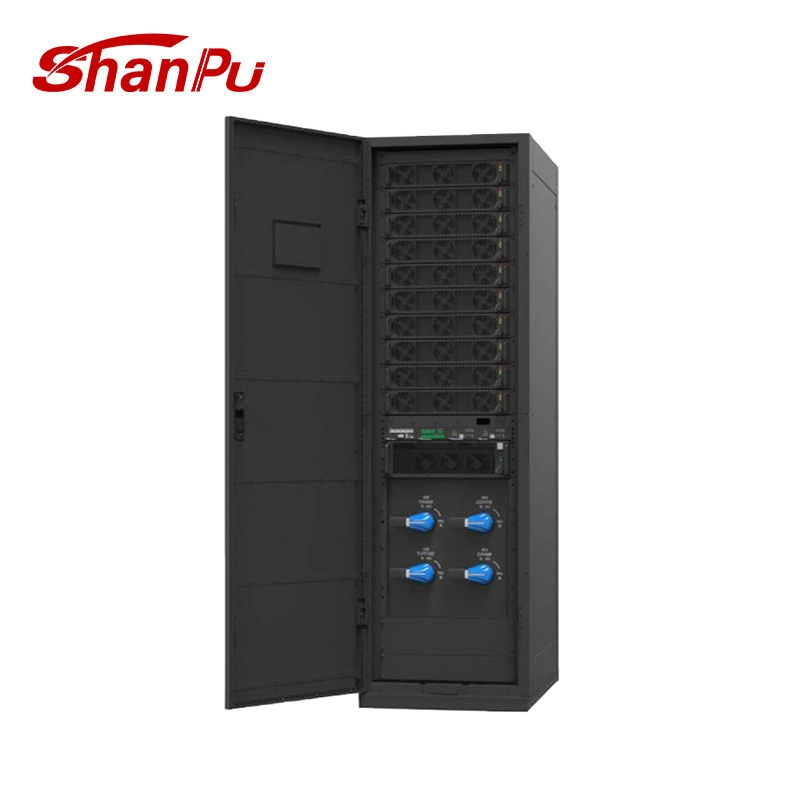
ShanPu 30kVA-300kVA modular UPS is a three-phase online double-conversion UPS built on a 30kVA hot-swappable power module, designed for larger commercial, industrial and critical power applications. Cabinets accept 3, 5 or 10 modules, covering 30-90kVA, 30-150kVA and 30-300kVA. Output is regulated 380/400/415Vac pure sine wave at power factor 1.0 with 0ms transfer between mains, bypass and battery modes, system efficiency reaches 95.5% and input power factor stays ≥0.99, while cabinet charging current of up to 100A and ±180V to ±300Vdc battery banks support demanding backup requirements.

-
ShanPu 3C33 10-800kVA three-phase industrial UPS is a low-frequency UPS with transformer-based online double conversion for factories and plants. Equipment, automation and control loads stay online through grid disturbance and outage with 0ms transfer.
- Rated 10-800kVA with three-phase input and output at 380/400/415Vac, the 3C33 scales from single machines to full production lines. A low-frequency isolation transformer blocks surge, harmonic and common-mode disturbance before reaching PLCs and drives; microprocessor control keeps output within ±1% across a 304-456Vac input window. External VRLA banks size backup time to the process.
© 2026 ShanPu. All Rights Reserved.
YouTube
SHANPU UPS
Shanpu