


Modular UPS vs. Transformer-Based UPS: How to Choose for a Critical Power Project

- Understanding the Core Architecture Differences Between Modular and Transformer-Based UPS Systems
- Total Cost of Ownership: Where the Real Numbers Live
- Application Scenarios: When Each Architecture Wins
- Selecting the Right Power Protection Partner for Your Critical Infrastructure
- Frequently Asked Questions
Choosing between a modular UPS and a transformer-based UPS is one of the most consequential decisions you will make in any critical power project. The wrong choice does not just affect your uptime numbers — it shapes your capital expenditure, your maintenance burden, your floor space allocation, and your ability to scale over the next decade. Having spent fifteen years designing and specifying power protection systems for data centers, hospitals, industrial facilities, and telecom infrastructure, I have watched both architectures succeed brilliantly and fail expensively depending on how well they were matched to the application. In this article I will walk you through the core technical differences, the real-world trade-offs, and the decision framework I use with clients today.
Understanding the Core Architecture Differences Between Modular and Transformer-Based UPS Systems
How a Transformer-Based UPS Is Built
A transformer-based UPS — often called a conventional or monolithic UPS — uses a large low-frequency transformer at its output stage. That transformer provides galvanic isolation between the input and the load, which is genuinely valuable in environments where electrical noise, ground faults, or transient surges are a serious concern. The topology has been the industry backbone for decades, and for good reason: it is robust, it tolerates non-linear loads exceptionally well, and it delivers a very clean output waveform even under severe distortion conditions. When I specify power protection for legacy medical imaging equipment or older industrial motor drives, the transformer-based design still earns its place. The IEEE standards for power quality in healthcare facilities have historically been written with this kind of isolation in mind.
The downside is physical reality. A 200 kVA transformer-based UPS can weigh over 1,000 kg and occupy a footprint that modern facilities simply cannot afford. Efficiency at partial load — which is where most UPS systems actually operate — typically sits between 92% and 95%, meaning you are continuously burning kilowatts just to keep the system running. Redundancy requires purchasing a second full-sized unit, which doubles your capital cost and your floor space requirement simultaneously.
How a Modular UPS Is Built
A modular UPS replaces that single monolithic cabinet with a chassis that accepts individual hot-swappable power modules, each typically rated between 10 kW and 50 kW. You populate the chassis with exactly as many modules as your current load demands, then add modules as your load grows. The architecture is inherently N+1 or N+X redundant at the module level, meaning a single module failure does not interrupt the load — the remaining modules absorb the difference. Efficiency figures for modern modular designs regularly reach 96% to 97% at partial load, and some High Quality units claim up to 99% in eco-mode operation. The U.S. Department of Energy's data center efficiency guidelines consistently highlight modular architectures as a pathway to reducing power usage effectiveness (PUE).
The trade-off I always explain to clients is that most modular UPS systems use transformerless designs with high-frequency switching. This delivers the efficiency and the compact form factor, but it means the galvanic isolation that a transformer provides is absent unless you add an external isolation transformer. For loads that genuinely need that isolation, you must budget for it separately.
The Scalability Equation That Changes Everything
One of the most underappreciated advantages of the modular UPS architecture is what I call the scalability equation. When a client comes to me with a greenfield data center project, they almost never know exactly what their load will be in year three or year five. A transformer-based UPS forces you to buy for peak projected capacity on day one, which means you are paying for — and losing efficiency on — capacity you are not using. A modular system lets you start at 40% of your target capacity and expand incrementally. Over a ten-year project lifecycle, the capital deferral and the efficiency savings compound into a very significant number. The Uptime Institute's annual global data center survey has repeatedly documented that over-provisioning of power infrastructure is one of the leading causes of poor PUE scores in enterprise facilities.
Total Cost of Ownership: Where the Real Numbers Live
Capital Expenditure vs. Operational Expenditure
The sticker price comparison between a modular UPS and a transformer-based UPS is almost always misleading. A transformer-based unit at a given kVA rating will typically have a lower upfront purchase price per kW than a modular chassis fully populated. But that comparison ignores the operational expenditure side of the ledger entirely. At 500 kW of protected load running 8,760 hours per year, a 2% efficiency difference translates to roughly 87,600 kWh of additional energy consumption annually. At an average commercial electricity rate, that is a meaningful recurring cost that accumulates every year for the life of the system. When I build total cost of ownership models for clients, the modular UPS almost always achieves payback within three to five years purely on energy savings, before accounting for reduced maintenance costs.
Maintenance, Serviceability, and Mean Time to Repair
This is where the modular UPS architecture delivers its most operationally compelling argument. In a transformer-based system, a major component failure — an IGBT module, a control board, a capacitor bank — typically requires a service window, often with load transfer to bypass. Mean time to repair can stretch to hours or even days if specialized components need to be shipped. In a modular system, a failed power module is replaced by a trained technician pulling out the faulty module and sliding in a replacement, often in under fifteen minutes, with the load never leaving protected power. For a Tier III or Tier IV data center, that difference in serviceability is not a convenience — it is a core element of the availability architecture. The ANSI/TIA-942 standard for data center infrastructure explicitly addresses concurrent maintainability as a Tier classification criterion, and modular UPS designs are inherently better aligned with that requirement.
Battery Management and Runtime Flexibility
Both architectures connect to external battery strings, but the modular UPS platform typically offers more granular battery management. Individual battery strings can be tested, replaced, or expanded independently. Many modern modular systems also support lithium-ion battery integration natively, which dramatically reduces the physical footprint of the battery room and extends the service life of the energy storage component. I have worked on projects where switching from valve-regulated lead acid battery banks to lithium-ion within a modular UPS platform reduced the battery room footprint by over 60% — a transformation that freed up valuable raised-floor space for revenue-generating IT equipment.
Application Scenarios: When Each Architecture Wins
When Transformer-Based UPS Systems Are the Right Answer
I want to be direct here: the transformer-based UPS is not obsolete. There are specific scenarios where I still recommend it without hesitation. Industrial applications with large variable-frequency drives, arc furnaces, or other highly non-linear loads benefit from the inherent robustness of the low-frequency transformer. Environments with severe electrical noise or where true galvanic isolation is a regulatory requirement — certain medical device manufacturing environments, for example — are natural fits. Legacy facilities where the existing electrical infrastructure was designed around a transformer-based system may also find that a like-for-like replacement is more cost-effective than a full infrastructure redesign. If your load is stable, your facility is mature, and you have no growth plans, the transformer-based UPS can serve you reliably for twenty years or more.
When Modular UPS Systems Are the Clear Choice
For any project where scalability, efficiency, footprint, or availability are primary drivers, the modular UPS wins the comparison decisively. Edge computing deployments, hyperscale data centers, colocation facilities, and any environment where the load profile will evolve over time are natural homes for modular architecture. Telecommunications infrastructure — particularly 5G edge nodes where space is at an absolute High Quality — has become one of the fastest-growing application areas for compact modular UPS designs. Healthcare facilities that are expanding their IT infrastructure while maintaining strict uptime requirements are another strong fit. In my experience, any project above 100 kW that anticipates growth within five years should default to a modular UPS evaluation as the starting point.
Hybrid Approaches and the Role of Broader Energy Systems
Increasingly, the UPS decision does not exist in isolation. Critical power projects today are being designed as integrated energy systems that include solar generation, battery energy storage, and grid interaction capabilities. A modular uninterruptible power supply platform that can interface with an energy storage inverter or a solar energy storage system gives facility managers a level of operational flexibility that was simply not available with previous generations of power protection equipment. I have worked on projects where the UPS backbone, the solar inverter output, and the energy storage systems were all coordinated through a single energy management platform, allowing the facility to optimize for cost, carbon, and resilience simultaneously. This integration capability is increasingly a specification requirement rather than a nice-to-have, and it strongly favors modular, software-defined power architectures.
| Criteria | Modular UPS | Transformer-Based UPS |
|---|---|---|
| Typical Efficiency (Partial Load) | 96% – 99% | 92% – 95% |
| Scalability | High (incremental module addition) | Low (full unit replacement required) |
| Physical Footprint | Compact, high power density | Large, heavy |
| Redundancy Model | N+1 at module level, inherent | Requires second full unit |
| Mean Time to Repair | Minutes (hot-swap module) | Hours to days |
| Galvanic Isolation | Not inherent (external transformer needed) | Inherent |
| Non-Linear Load Tolerance | Good (with modern DSP control) | Excellent |
| Lithium-Ion Battery Compatibility | Native support in most platforms | Limited, often requires adaptation |
| Upfront Capital Cost per kW | Moderate to High | Moderate |
| 10-Year TCO | Lower (energy and maintenance savings) | Higher (energy and service costs) |
| Integration with Solar/Storage Systems | Strong native capability | Limited |
| Best Application | Data centers, edge, telecom, scalable facilities | Industrial, legacy, high-distortion loads |
Selecting the Right Power Protection Partner for Your Critical Infrastructure
What to Look for in a Complete Power Solution Portfolio
After fifteen years in this industry, I have learned that the quality of the power protection platform matters enormously, but so does the breadth of the solution ecosystem around it. A vendor that offers only a standalone uninterruptible power supply without integration pathways to energy storage systems, solar inverter platforms, or outdoor power supply solutions will create integration headaches that cost you time and money during commissioning and throughout the operational life of the facility. The most successful critical power projects I have been involved with have been built around vendors who think in terms of complete energy architectures rather than individual product sales.
When evaluating vendors for a modular UPS project, I look for demonstrated expertise across the full power chain: from the inverter energy storage platform that manages the battery assets, to the solar energy storage system that can offset grid consumption, to the outdoor uninterruptible power supply solutions that protect distributed edge infrastructure. A vendor with deep competency in lead acid battery management as well as lithium-ion integration gives you flexibility as battery technology continues to evolve. The ability to deploy an outdoor power supply solution that is ruggedized for harsh environments — whether that is extreme temperature, humidity, or dust — is increasingly important as critical infrastructure moves to the edge of the network.
The Convergence of UPS and Energy Storage
The boundary between a traditional uninterruptible power supply and a modern energy storage system is dissolving rapidly. The most advanced modular UPS platforms today are essentially bidirectional power conversion systems that can absorb energy from solar arrays, store it in battery banks, deliver it to critical loads, and feed excess back to the grid — all within a single integrated architecture. This convergence means that specifying a modular UPS for a new critical power project is simultaneously a decision about your energy storage strategy, your renewable integration roadmap, and your grid interaction capabilities. Vendors who offer a coherent portfolio spanning energy storage inverters, solar energy storage systems, and modular UPS platforms are positioned to deliver solutions that are genuinely future-proof rather than requiring a full infrastructure replacement every five to seven years.
The International Electrotechnical Commission's standards for energy storage systems are evolving rapidly to address exactly this convergence, and specifying equipment from vendors who actively participate in those standards development processes gives you confidence that your investment will remain compliant as the regulatory landscape matures.
Making the Final Decision: A Practical Framework
When I sit down with a client to make the final architecture decision, I use a straightforward five-question framework. First: will the load grow by more than 20% within five years? If yes, modular wins on scalability alone. Second: is the facility subject to strict uptime requirements where concurrent maintainability is a Tier classification criterion? If yes, modular wins on serviceability. Third: are there severe non-linear loads or a regulatory requirement for galvanic isolation? If yes, transformer-based deserves serious consideration. Fourth: what is the ten-year energy cost projection, and how does a 2-3% efficiency difference affect the business case? In most commercial and enterprise environments, the modular UPS delivers a compelling financial argument. Fifth: is there a roadmap for solar integration, battery storage expansion, or grid interaction? If yes, the modular platform's native integration capabilities with broader energy storage systems make it the only rational choice for a forward-looking infrastructure strategy.
Ready to find the right modular UPS or integrated energy storage solution for your critical power project — contact our expert team today to get a customized architecture recommendation and total cost of ownership analysis.
Frequently Asked Questions
What is the main difference between a modular UPS and a transformer-based UPS?
A modular UPS uses hot-swappable power modules within a scalable chassis, offering high efficiency (96–99%), compact footprint, and inherent N+1 redundancy. A transformer-based UPS uses a large low-frequency output transformer that provides galvanic isolation and excellent non-linear load tolerance but at lower efficiency (92–95%) and with a much larger physical footprint.
Is a modular UPS more expensive than a transformer-based UPS?
The upfront capital cost per kW for a modular UPS can be moderate to high compared to a transformer-based unit. However, over a ten-year total cost of ownership period, the modular UPS typically delivers significant savings through higher energy efficiency and dramatically lower maintenance costs, often achieving payback within three to five years.
Can a modular UPS support lithium-ion batteries?
Yes. Most modern modular UPS platforms natively support lithium-ion battery integration, which reduces battery room footprint by up to 60% compared to traditional valve-regulated lead acid battery banks and extends the service life of the energy storage component significantly.
When should I choose a transformer-based UPS over a modular UPS?
A transformer-based UPS is the better choice for industrial applications with highly non-linear loads such as variable-frequency drives or arc furnaces, environments where true galvanic isolation is a regulatory requirement, and mature facilities with stable loads and no growth plans where a like-for-like replacement is more cost-effective than a full infrastructure redesign.
How does a modular UPS integrate with solar and energy storage systems?
Modern modular UPS platforms are designed as bidirectional power conversion systems that can interface with solar inverters, energy storage inverters, and solar energy storage systems through a unified energy management platform. This allows facilities to optimize for cost, carbon emissions, and resilience simultaneously, making the modular UPS a core component of a complete integrated energy architecture.
What is the mean time to repair for a modular UPS compared to a transformer-based UPS?
For a modular UPS, a failed power module can typically be hot-swapped by a trained technician in under fifteen minutes without interrupting the protected load. For a transformer-based UPS, a major component failure can require a service window with load transfer to bypass, and mean time to repair can stretch to hours or days if specialized parts must be sourced.
Is a modular UPS suitable for outdoor or edge computing deployments?
Yes. Compact modular UPS designs are increasingly used in edge computing, 5G infrastructure, and telecommunications deployments where space is at a premium. When combined with ruggedized outdoor power supply enclosures, modular UPS systems can be deployed in harsh environments with extreme temperature, humidity, or dust conditions.
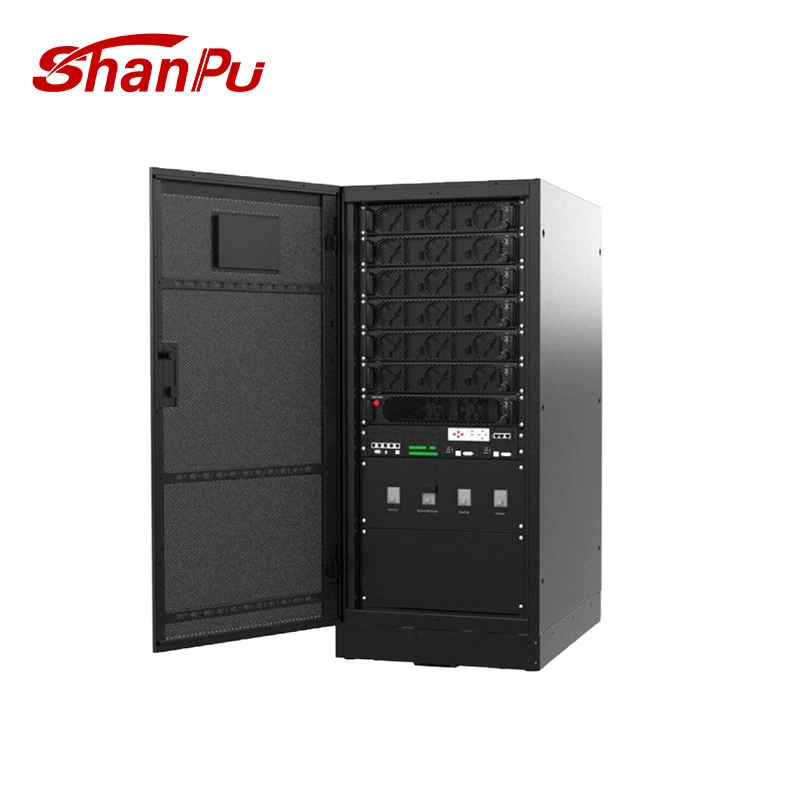
ShanPu 20KVA-200KVA modular UPS is a three-in/three-out online double-conversion UPS built on a 20kVA hot-swappable power module, designed for server rooms, small and medium-sized data centers, commercial facilities and light industrial loads. Cabinets accept 3, 5 or 10 modules, covering 20-60kVA, 20-100kVA and 20-200kVA. Output is regulated 380/400/415Vac pure sine wave at power factor 1.0 with 0ms transfer between mains, bypass and battery modes, system efficiency reaches 95.5% and input power factor stays ≥0.99, while cabinet charging current of up to 50A and ±180V to ±300Vdc battery banks support practical backup requirements.
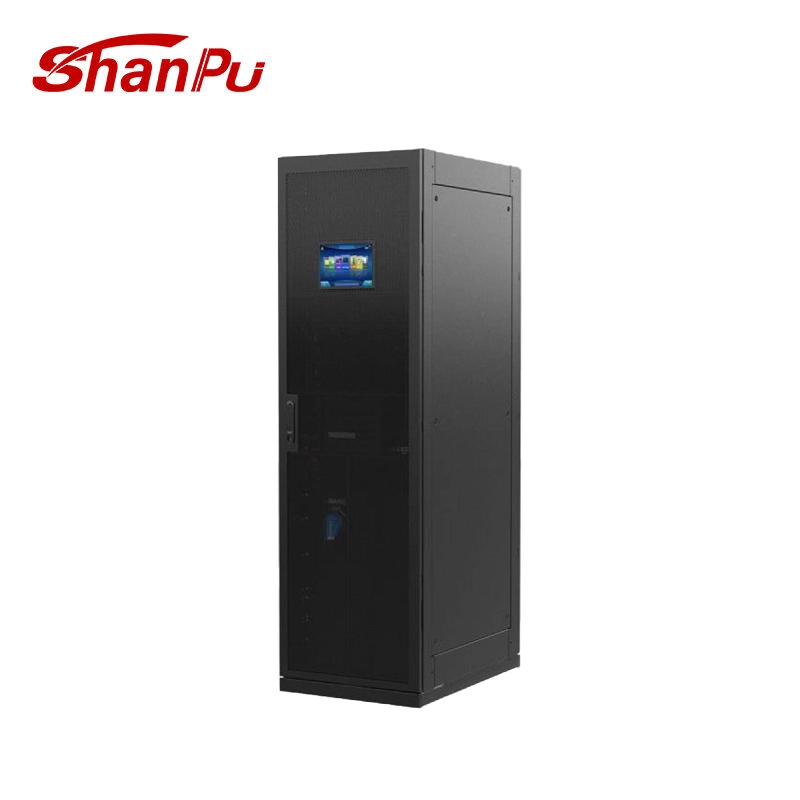
ShanPu 25KVA-250KVA modular UPS is a scalable three-phase online double-conversion UPS built on a 25kVA hot-swappable power module, designed for medium-sized data centers, enterprise IT infrastructure and other critical loads. Cabinets accept 3, 5 or 10 modules, covering 25-75kVA, 25-125kVA and 25-250kVA. Output is regulated 380/400/415Vac pure sine wave at power factor 1.0 with 0ms transfer between mains, bypass and battery modes, system efficiency reaches 95.5% and input power factor stays ≥0.99, while cabinet charging current of up to 100A and ±180V to ±300Vdc battery banks support demanding backup requirements.
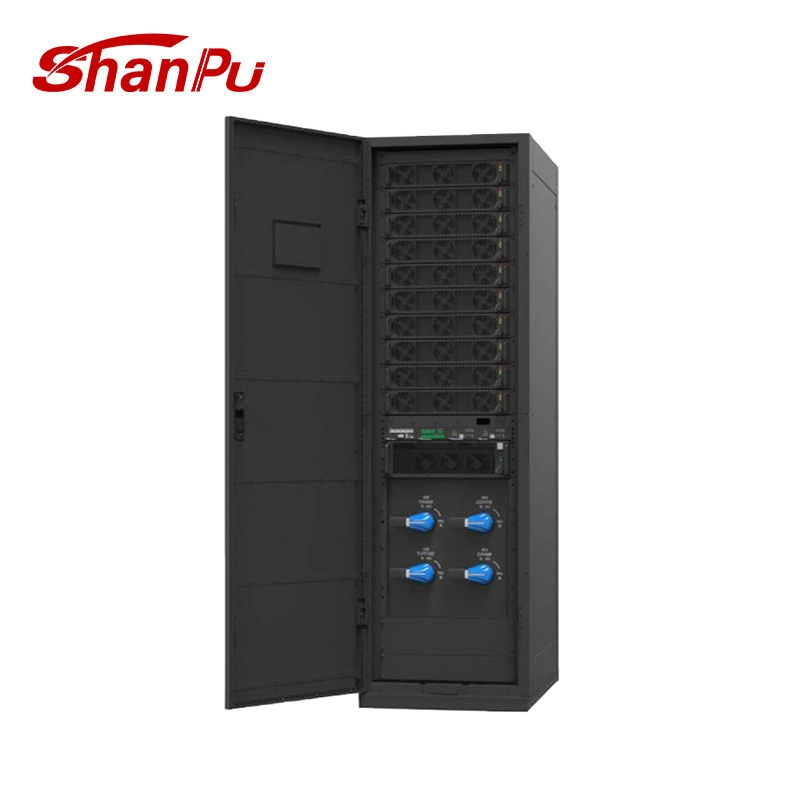
ShanPu 30kVA-300kVA modular UPS is a three-phase online double-conversion UPS built on a 30kVA hot-swappable power module, designed for larger commercial, industrial and critical power applications. Cabinets accept 3, 5 or 10 modules, covering 30-90kVA, 30-150kVA and 30-300kVA. Output is regulated 380/400/415Vac pure sine wave at power factor 1.0 with 0ms transfer between mains, bypass and battery modes, system efficiency reaches 95.5% and input power factor stays ≥0.99, while cabinet charging current of up to 100A and ±180V to ±300Vdc battery banks support demanding backup requirements.

-
ShanPu 3C33 10-800kVA three-phase industrial UPS is a low-frequency UPS with transformer-based online double conversion for factories and plants. Equipment, automation and control loads stay online through grid disturbance and outage with 0ms transfer.
- Rated 10-800kVA with three-phase input and output at 380/400/415Vac, the 3C33 scales from single machines to full production lines. A low-frequency isolation transformer blocks surge, harmonic and common-mode disturbance before reaching PLCs and drives; microprocessor control keeps output within ±1% across a 304-456Vac input window. External VRLA banks size backup time to the process.
© 2026 ShanPu. All Rights Reserved.
YouTube
SHANPU UPS
Shanpu