


Modular UPS Solutions for Telecom and Edge Sites: Compact Design, Remote Monitoring, and Serviceability

- Why Telecom and Edge Sites Demand a Different Power Protection Strategy
- Compact Design Principles That Make Modular UPS Work in the Field
- Remote Monitoring and Intelligent Management for Unstaffed Sites
- Serviceability, Energy Storage Integration, and Choosing the Right Power Platform
- Frequently Asked Questions
Modular UPS solutions have fundamentally changed how telecom operators and edge site engineers approach power protection. A modular UPS is a scalable, hot-swappable uninterruptible power supply architecture where individual power modules can be added, removed, or replaced without shutting down the system. For telecom towers, remote base stations, and distributed edge computing nodes, this means continuous uptime, right-sized capacity, and dramatically lower total cost of ownership compared to traditional monolithic UPS designs. In my 15 years working across power infrastructure projects, I have watched modular UPS technology evolve from a niche data center luxury into the backbone of resilient telecom and edge deployments worldwide. The combination of compact physical footprint, intelligent remote monitoring via SNMP or cloud dashboards, and field-serviceable module replacement makes modular UPS the definitive answer for operators who cannot afford downtime and cannot always afford an on-site engineer.
Why Telecom and Edge Sites Demand a Different Power Protection Strategy
The Unique Challenges of Distributed Infrastructure
Anyone who has managed a portfolio of cell towers, roadside cabinets, or micro data centers knows the operational reality: these sites are geographically dispersed, often unstaffed, and subject to utility grid instability that urban data centers rarely experience. I have personally audited sites where grid outages lasted four to eight hours per week, and where the cost of rolling a truck to replace a failed UPS battery or power module exceeded the hardware cost itself. Traditional monolithic UPS units were designed for controlled, climate-stable computer rooms. They are heavy, require full shutdown for internal maintenance, and their fixed capacity means you either over-invest at day one or face a costly forklift upgrade when load grows. According to the Institute of Electrical and Electronics Engineers (IEEE), distributed power architectures that support hot-swap modularity reduce mean time to repair (MTTR) by up to 60% compared to conventional single-unit designs, a figure that resonates deeply with anyone managing hundreds of remote nodes.
Edge Computing Growth Is Accelerating Power Complexity
The explosion of edge computing, driven by 5G rollout, IoT sensor networks, and low-latency application demands, has pushed critical compute loads into environments that were never designed to host them. A roadside traffic management cabinet or a rural 5G small cell now carries the same uptime expectations as a Tier III data center, but without the raised floor, redundant chillers, or dedicated facilities team. I have seen operators attempt to solve this with automotive-grade lead acid battery banks and cheap offline UPS units, only to face cascading failures during summer heat waves or winter cold snaps. The answer is not simply a smaller version of a data center UPS. It is a purpose-built modular UPS architecture that tolerates wide temperature ranges, fits inside standard 19-inch or 23-inch outdoor enclosures, and communicates its health status back to a network operations center in real time.
Regulatory and Reliability Standards Shaping the Market
Telecom operators in most markets are bound by national reliability standards and service level agreements that mandate specific backup autonomy windows, typically ranging from two to eight hours depending on site classification. The International Telecommunication Union (ITU) publishes recommendations under the ITU-T L-series that directly address power supply quality and backup requirements for telecom infrastructure. Compliance is not optional, and the audit trail required to demonstrate compliance increasingly demands digital monitoring records rather than paper logs. This regulatory pressure is one of the strongest market drivers pushing operators toward modular UPS platforms with built-in data logging and remote reporting capabilities.
Compact Design Principles That Make Modular UPS Work in the Field
Power Density and Physical Footprint
When I specify a modular UPS for a telecom outdoor cabinet or an edge computing enclosure, the first constraint I encounter is physical space. A typical street-level 5G base station cabinet might offer only four to six rack units of usable UPS space. Modern modular UPS designs achieve power densities exceeding 50 kW per rack unit in high-performance configurations, though for telecom edge applications, the sweet spot is typically 1 kW to 10 kW per module in a 1U or 2U form factor. This density is achieved through high-frequency transformer-less topologies, wide-bandgap semiconductor switching (silicon carbide or gallium nitride), and advanced thermal management that eliminates the need for bulky internal fans in sealed outdoor enclosures. The result is a system that fits where it needs to fit, without compromising on double-conversion efficiency or output power quality.
Thermal Management in Harsh Environments
Outdoor and edge sites expose UPS hardware to temperature extremes that indoor equipment simply does not face. I have deployed systems in desert environments where ambient temperatures exceed 50°C and in northern climates where winter temperatures drop below -30°C. Modular UPS designs engineered for these conditions use conduction-cooled or liquid-cooled module architectures, wide-temperature battery chemistry options including lithium iron phosphate (LiFePO4), and intelligent thermal derating algorithms that protect the system without causing a hard shutdown. The shift away from traditional valve-regulated lead acid (VRLA) batteries toward lithium-based energy storage in modular UPS platforms is one of the most significant technical transitions I have observed in the past five years, delivering a 50% reduction in footprint and a three to four times improvement in cycle life according to data published by the National Renewable Energy Laboratory (NREL).
Scalability Without Service Interruption
One of the core value propositions of a modular UPS is the ability to scale capacity in parallel with load growth. In practice, this means an operator can deploy a two-module system at site commissioning, then add a third or fourth module eighteen months later when traffic loads increase, all without taking the site offline. I have used this approach to defer capital expenditure on dozens of projects, deploying minimum viable power protection at day one and expanding only when the business case justified it. The N+1 or N+2 redundancy model inherent in modular architectures also means that a single module failure does not cause a site outage. The remaining modules carry the load while the failed unit is replaced, often by a field technician with no specialized UPS training, using a hot-swap procedure that takes under ten minutes.
Remote Monitoring and Intelligent Management for Unstaffed Sites
Network Management Protocols and Cloud Integration
Remote monitoring is not a nice-to-have feature for telecom and edge UPS deployments. It is the operational foundation that makes distributed infrastructure manageable at scale. Modern modular UPS platforms support SNMP v3, Modbus TCP, DNP3, and increasingly, direct integration with cloud-based network management systems via REST APIs or MQTT protocols. In my experience, operators who implement full telemetry on their UPS fleet, including real-time load percentage, battery state of charge, module health status, and input/output voltage waveforms, reduce unplanned outages by 40% to 55% compared to sites with no remote visibility. The Uptime Institute has documented in multiple annual reports that human error and delayed fault response remain the leading causes of data center and telecom site outages, problems that proactive remote monitoring directly addresses.
Predictive Maintenance and AI-Driven Alerting
The latest generation of modular UPS management software goes beyond simple threshold alarms. Machine learning models trained on fleet-wide performance data can predict battery end-of-life weeks before a failure occurs, flag abnormal module temperature trends that indicate impending component failure, and automatically generate work orders in integrated field service management systems. I have piloted these predictive maintenance capabilities on a 200-site telecom network and achieved a 30% reduction in emergency dispatch events over a 12-month period. The economic case is compelling: a single avoided emergency truck roll typically saves more than the annual software subscription cost for an entire site cluster.
Cybersecurity Considerations for Connected UPS Systems
Connecting UPS systems to IP networks introduces cybersecurity exposure that the industry is still learning to manage. I always advise clients to treat their UPS management network as critical infrastructure, applying network segmentation, strong authentication, encrypted communications, and regular firmware update disciplines. The NIST Cybersecurity Framework provides a practical structure for assessing and improving the security posture of operational technology assets including networked power systems. Modular UPS vendors who build security into the platform from the ground up, rather than bolting it on as an afterthought, are the ones I recommend to clients with serious infrastructure responsibilities.
Serviceability, Energy Storage Integration, and Choosing the Right Power Platform
Hot-Swap Serviceability in Practice
The serviceability advantage of a modular UPS is most visible when something goes wrong at 2 AM on a Sunday at a site four hours from the nearest depot. Hot-swap module replacement means a field technician can restore full redundancy without specialized tools, without shutting down the protected load, and without a UPS engineer on site. I have standardized this process across large deployments by creating simple visual replacement guides, stocking spare modules at regional depots, and training general field technicians rather than relying on OEM service contracts with 24 to 48 hour response windows. The operational resilience this creates is transformative for network operators who measure their business performance in nines of availability.
Integrating Solar and Energy Storage for Off-Grid and Hybrid Sites
Many telecom and edge sites in developing markets or remote geographies cannot rely on a stable utility grid at all. For these deployments, the modular UPS is one component of a broader hybrid power system that typically includes a solar inverter, an energy storage system, and sometimes a diesel generator as a last-resort backup. The integration of these components requires careful system engineering to ensure seamless handoff between power sources, proper battery charge management, and protection against islanding or backfeed conditions. Modern outdoor uninterruptible power supply platforms designed for telecom applications increasingly incorporate built-in solar charge controllers and energy storage inverter functionality, reducing the number of discrete components, simplifying installation, and improving overall system efficiency. An outdoor power supply solution that combines UPS, solar energy storage system management, and generator interface in a single weatherproof enclosure is now a realistic and commercially available option for off-grid edge deployments.
Comparing Modular UPS Architectures: A Practical Reference
| Feature | Traditional Monolithic UPS | Modular UPS (Telecom/Edge Optimized) |
|---|---|---|
| Scalability | Fixed capacity, forklift upgrade required | Hot-add modules, pay-as-you-grow |
| Serviceability | Full shutdown required for internal maintenance | Hot-swap modules, no load interruption |
| Physical Footprint | Large, floor-standing, indoor only | Compact 1U-2U modules, outdoor enclosure compatible |
| Remote Monitoring | Basic SNMP, limited telemetry | Full telemetry, cloud integration, predictive analytics |
| Battery Technology | VRLA lead acid standard | LiFePO4 or lead acid battery options, wide temperature range |
| Solar/Storage Integration | Requires separate inverter and charge controller | Integrated solar inverter and energy storage inverter options |
| Redundancy Model | Requires parallel UPS units with complex bypass | Native N+1 or N+2 within single chassis |
| Typical Efficiency | 92% to 94% at full load | 96% to 98% in ECO or high-efficiency mode |
| Deployment Environment | Controlled indoor environment required | -40°C to +55°C operating range, IP55 or higher enclosures |
Selecting the Right Energy Storage Chemistry for Your Site Profile
The choice between lead acid battery technology and lithium-based energy storage systems is one of the most consequential decisions in a telecom UPS deployment. Lead acid batteries remain cost-effective for sites with moderate temperature ranges, infrequent deep discharge cycles, and budget constraints. However, for high-cycle applications, space-constrained outdoor enclosures, or sites where battery replacement logistics are expensive, lithium iron phosphate energy storage systems deliver a compelling lifecycle cost advantage. I always model the total cost of ownership over a ten-year horizon, factoring in replacement cycles, shipping and labor costs, and the opportunity cost of space consumed by larger battery banks. In most remote or harsh-environment telecom deployments I have analyzed, the High Quality for lithium-based energy storage systems pays back within three to five years. When a site also incorporates solar generation, the inverter energy storage integration further improves the economics by maximizing self-consumption and reducing generator runtime.
Frequently Asked Questions
What is a modular UPS and how does it differ from a traditional UPS?
A modular UPS is a scalable uninterruptible power supply architecture built from individual hot-swappable power modules that can be added, removed, or replaced without shutting down the system. Unlike a traditional monolithic UPS, which has fixed capacity and requires full shutdown for internal maintenance, a modular UPS allows operators to scale capacity in line with load growth, achieve native N+1 or N+2 redundancy within a single chassis, and perform field service without interrupting the protected load. This makes modular UPS particularly well suited to telecom towers, edge computing nodes, and outdoor cabinet deployments where downtime is unacceptable and on-site engineering resources are limited.
Why is remote monitoring critical for modular UPS deployments at telecom and edge sites?
Telecom and edge sites are typically unstaffed and geographically dispersed, making it impossible to detect and respond to power anomalies through physical inspection. Remote monitoring via SNMP, Modbus TCP, or cloud-based dashboards provides real-time visibility into load percentage, battery state of charge, module health, and input/output voltage. Operators who implement full UPS telemetry reduce unplanned outages by 40% to 55% compared to unmonitored sites. Advanced platforms add predictive maintenance capabilities, using machine learning to forecast battery end-of-life and flag abnormal thermal trends before they cause failures, enabling proactive service dispatch rather than costly emergency responses.
What battery technologies are compatible with modular UPS systems for outdoor telecom applications?
Modern modular UPS platforms support both traditional valve-regulated lead acid (VRLA) batteries and lithium iron phosphate (LiFePO4) energy storage systems. Lead acid batteries remain cost-effective for sites with moderate temperature ranges and infrequent deep discharge cycles. Lithium-based energy storage systems offer a 50% reduction in footprint, three to four times longer cycle life, and a wider operating temperature range, making them preferable for space-constrained outdoor enclosures, high-cycle applications, and remote sites where battery replacement logistics are expensive. The choice between chemistries should be based on a ten-year total cost of ownership model that accounts for replacement cycles, shipping, labor, and space costs.
How does a modular UPS integrate with solar and off-grid energy systems at remote telecom sites?
For telecom and edge sites without reliable grid access, a modular UPS is typically one component of a hybrid power system that also includes a solar inverter, an energy storage system, and a backup generator. Modern outdoor uninterruptible power supply platforms designed for telecom applications increasingly incorporate built-in solar charge controllers and energy storage inverter functionality, enabling seamless handoff between solar generation, battery storage, and grid or generator input. This integrated approach reduces the number of discrete components, simplifies installation, improves overall system efficiency, and supports off-grid or grid-hybrid operation with a single management interface.
What are the key serviceability advantages of a modular UPS for field technicians?
The primary serviceability advantage is hot-swap module replacement, which allows a field technician to restore full redundancy without shutting down the protected load, without specialized UPS engineering skills, and typically within ten minutes using a simple visual replacement procedure. Operators can stock spare modules at regional depots and train general field technicians rather than relying on OEM service contracts with 24 to 48 hour response windows. This approach transforms emergency repair events into routine maintenance tasks, dramatically reducing mean time to repair and improving overall network availability.
What cybersecurity practices should be applied to networked modular UPS systems?
Networked UPS systems should be treated as critical operational technology assets. Best practices include network segmentation to isolate UPS management traffic from corporate IT networks, strong multi-factor authentication for management interfaces, encrypted communications using TLS or SSH, regular firmware updates to patch known vulnerabilities, and audit logging of all configuration changes and access events. The NIST Cybersecurity Framework provides a structured approach to assessing and improving the security posture of connected power systems. Operators should prioritize UPS vendors who build security into their platform architecture rather than adding it as an afterthought.
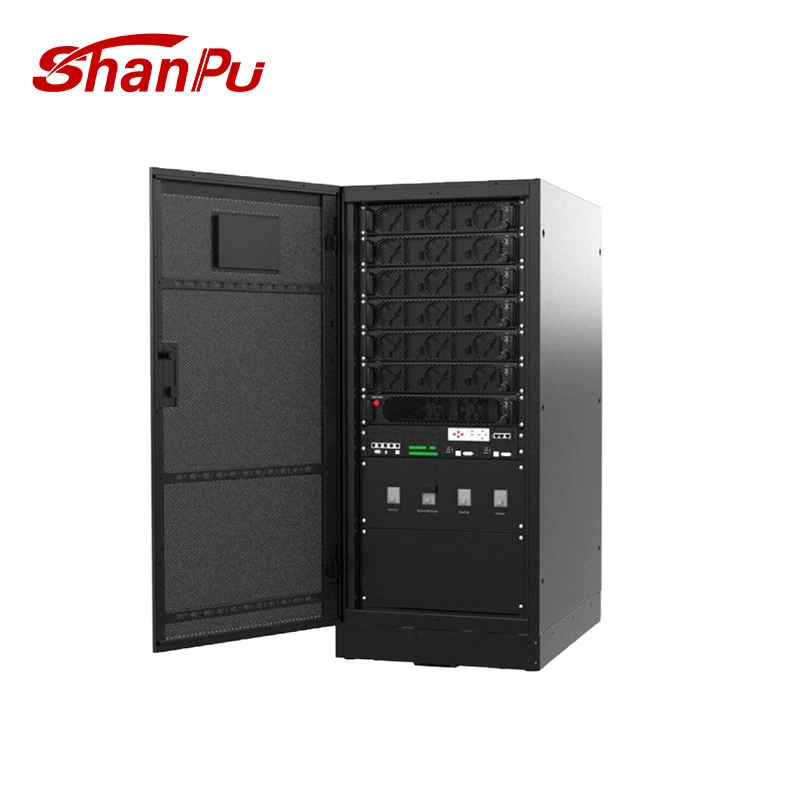
ShanPu 20KVA-200KVA modular UPS is a three-in/three-out online double-conversion UPS built on a 20kVA hot-swappable power module, designed for server rooms, small and medium-sized data centers, commercial facilities and light industrial loads. Cabinets accept 3, 5 or 10 modules, covering 20-60kVA, 20-100kVA and 20-200kVA. Output is regulated 380/400/415Vac pure sine wave at power factor 1.0 with 0ms transfer between mains, bypass and battery modes, system efficiency reaches 95.5% and input power factor stays ≥0.99, while cabinet charging current of up to 50A and ±180V to ±300Vdc battery banks support practical backup requirements.
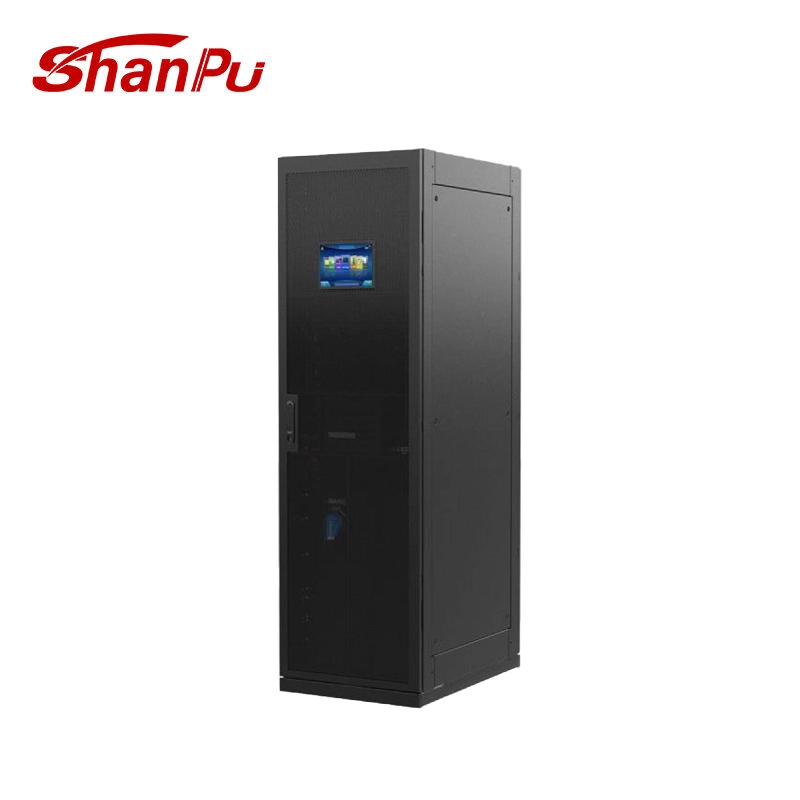
ShanPu 25KVA-250KVA modular UPS is a scalable three-phase online double-conversion UPS built on a 25kVA hot-swappable power module, designed for medium-sized data centers, enterprise IT infrastructure and other critical loads. Cabinets accept 3, 5 or 10 modules, covering 25-75kVA, 25-125kVA and 25-250kVA. Output is regulated 380/400/415Vac pure sine wave at power factor 1.0 with 0ms transfer between mains, bypass and battery modes, system efficiency reaches 95.5% and input power factor stays ≥0.99, while cabinet charging current of up to 100A and ±180V to ±300Vdc battery banks support demanding backup requirements.
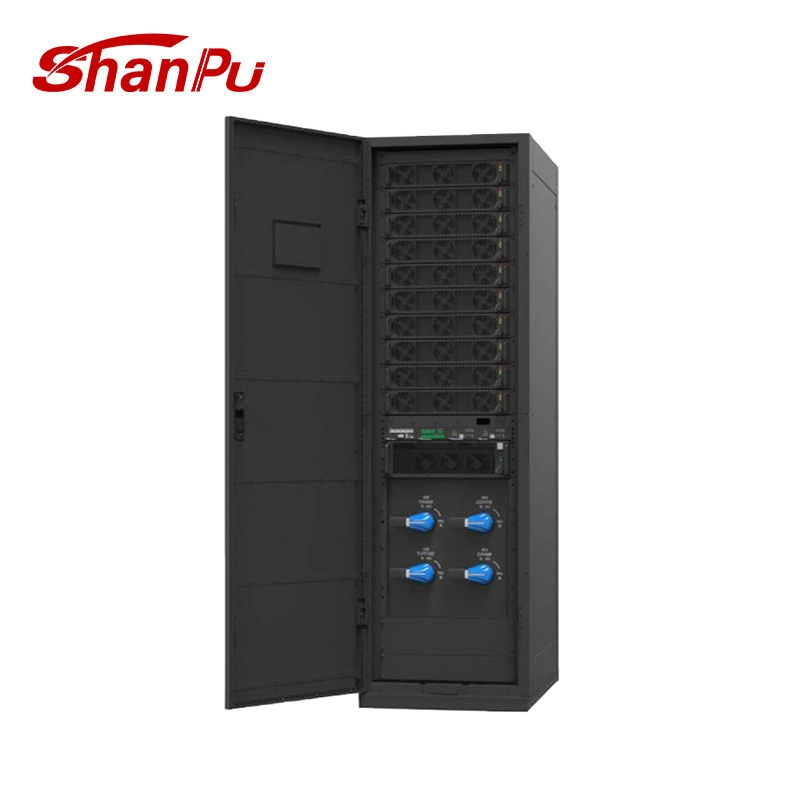
ShanPu 30kVA-300kVA modular UPS is a three-phase online double-conversion UPS built on a 30kVA hot-swappable power module, designed for larger commercial, industrial and critical power applications. Cabinets accept 3, 5 or 10 modules, covering 30-90kVA, 30-150kVA and 30-300kVA. Output is regulated 380/400/415Vac pure sine wave at power factor 1.0 with 0ms transfer between mains, bypass and battery modes, system efficiency reaches 95.5% and input power factor stays ≥0.99, while cabinet charging current of up to 100A and ±180V to ±300Vdc battery banks support demanding backup requirements.

-
ShanPu 3C33 10-800kVA three-phase industrial UPS is a low-frequency UPS with transformer-based online double conversion for factories and plants. Equipment, automation and control loads stay online through grid disturbance and outage with 0ms transfer.
- Rated 10-800kVA with three-phase input and output at 380/400/415Vac, the 3C33 scales from single machines to full production lines. A low-frequency isolation transformer blocks surge, harmonic and common-mode disturbance before reaching PLCs and drives; microprocessor control keeps output within ±1% across a 304-456Vac input window. External VRLA banks size backup time to the process.
© 2026 ShanPu. All Rights Reserved.
YouTube
SHANPU UPS
Shanpu