


Modular UPS Opportunities for Regional Distributors: Product Positioning and Market Requirements

- Why Modular UPS Architecture Is Reshaping Regional Power Distribution Markets
- Product Positioning Strategies That Win in Competitive Regional Markets
- Technical Requirements and Specification Considerations for Regional Buyers
- Expanding the Portfolio: How Energy Storage and Solar Integration Create Distributor Advantage
- Frequently Asked Questions
The modular UPS market is one of the most strategically significant segments in the power protection industry right now, and regional distributors who understand how to position these systems correctly are capturing disproportionate shares of enterprise, data center, and industrial budgets. A modular UPS architecture allows end users to scale power capacity incrementally by adding or removing power modules within a common chassis, delivering flexibility that traditional monolithic UPS systems simply cannot match. Based on my 15 years working across power electronics distribution and consulting, I can tell you that the distributors winning in this space are not just selling hardware — they are selling a total value proposition built around scalability, redundancy, and total cost of ownership. The global UPS market was valued at approximately USD 11.5 billion in 2023 and is projected to grow at a CAGR of around 6.5% through 2030, according to Grand View Research UPS market analysis. Modular configurations are driving a significant portion of that growth, particularly in Tier 2 and Tier 3 cities where infrastructure investment is accelerating. Regional distributors who align their product portfolios and sales messaging with the specific requirements of these buyers will find themselves in an exceptionally strong position over the next five years.
Why Modular UPS Architecture Is Reshaping Regional Power Distribution Markets
The Scalability Advantage That Buyers Actually Care About
When I first started advising regional distributors on UPS product selection, the conversation was almost always about upfront price. That has changed dramatically. Today, the procurement managers and facilities engineers I speak with are asking about lifecycle cost, expansion flexibility, and mean time to repair. A modular UPS answers all three questions in a way that a fixed-capacity system cannot. The ability to hot-swap a failed module without taking the entire system offline is not just a technical feature — it is a business continuity argument that resonates deeply with operations teams who have lived through a critical power failure. I have seen distributors close deals at 20% to 30% High Quality price points simply because they could demonstrate that a modular architecture reduces planned downtime during capacity upgrades. For regional markets where qualified service technicians may be hours away, the self-service maintenance aspect of modular UPS systems is a genuine differentiator that smart distributors are learning to lead with.
Understanding the Buyer Segments Driving Demand
In my experience, the demand for modular UPS systems at the regional level is coming from three distinct buyer segments, each with different priorities. The first is edge data centers and colocation facilities, which are proliferating rapidly outside major metropolitan areas as latency requirements tighten and cloud providers push infrastructure closer to end users. These buyers need systems that can start small and scale without a full infrastructure overhaul. The second segment is healthcare and manufacturing facilities, where power reliability is directly tied to operational safety and regulatory compliance. The IEEE standards for power quality and reliability are increasingly referenced in procurement specifications for these facilities, and modular UPS systems that meet IEEE 1100 and related standards carry significant credibility in these conversations. The third segment is commercial real estate and smart building developers who are integrating power protection into building management systems from the ground up. Each of these segments requires a different sales approach, and regional distributors who develop segment-specific messaging will consistently outperform those who use a generic pitch.
Market Sizing and Regional Opportunity Assessment
One of the most common mistakes I see regional distributors make is treating their territory as a homogeneous market. The reality is that modular UPS demand is highly concentrated around specific economic activity clusters — logistics hubs, technology parks, hospital campuses, and manufacturing corridors. Before investing in inventory and sales enablement for modular UPS products, I always recommend that distributors conduct a structured opportunity assessment that maps these clusters against existing power infrastructure age and reliability data. In many Tier 2 markets, aging electrical infrastructure combined with increasing digital dependency creates an urgent replacement cycle that can be accelerated with the right outreach strategy. The U.S. Department of Energy grid modernization initiatives have also created funding pathways that end users in certain sectors can leverage to offset UPS upgrade costs, which is a conversation point that sophisticated distributors are already having with their customers.
Product Positioning Strategies That Win in Competitive Regional Markets
Differentiating on Total Cost of Ownership Rather Than Unit Price
The distributors I have seen struggle with modular UPS sales are almost universally competing on unit price, which is a losing strategy when you are up against direct online channels and large national distributors with greater purchasing leverage. The distributors who consistently win are reframing the conversation around total cost of ownership over a five to ten year horizon. When you factor in the cost of a service call to replace a failed monolithic UPS, the downtime cost during replacement, the stranded capacity cost of over-provisioning a fixed system, and the energy efficiency gains from right-sized modular configurations, the economics of modular UPS become compelling even at a higher initial price point. I typically help distributors build a simple TCO calculator that they can walk through with a prospect in a 30-minute meeting. This tool alone has been responsible for shifting numerous deals from a price-based negotiation to a value-based conversation.
Building a Service and Support Wrapper Around the Product
A modular UPS system is not a commodity product, and it should not be sold like one. The most successful regional distributors I work with have built service capabilities around their UPS offerings — preventive maintenance contracts, remote monitoring integration, battery management programs, and rapid module replacement services. This service wrapper accomplishes two things simultaneously: it increases the lifetime value of each customer relationship, and it creates a switching cost that makes it much harder for competitors to displace you at renewal time. The battery management component is particularly important because battery health is the single most common point of failure in any UPS system. Distributors who can offer proactive battery monitoring and replacement programs — including options that integrate with lead acid battery and advanced lithium battery technologies — are providing genuine value that goes well beyond the initial hardware sale.
Positioning Against the Competitive Landscape
Regional distributors face competition from multiple directions in the modular UPS space: large national distributors, direct manufacturer channels, and increasingly, online marketplaces that commoditize the hardware. The sustainable competitive advantage for a regional distributor is local presence, application expertise, and the ability to integrate UPS solutions into a broader power and energy management ecosystem. This is where having a diversified product portfolio becomes strategically important. Distributors who can offer modular UPS systems alongside complementary technologies — including solar inverter solutions, energy storage systems, and outdoor power supply products — are able to position themselves as comprehensive power reliability partners rather than single-product vendors. This ecosystem approach is particularly effective with commercial and industrial buyers who are simultaneously managing grid reliability concerns, renewable energy integration, and backup power requirements.
Technical Requirements and Specification Considerations for Regional Buyers
Key Technical Specifications That Drive Purchase Decisions
After sitting through hundreds of UPS specification reviews with end users, I have identified the technical parameters that consistently drive purchase decisions in regional markets. Efficiency rating at partial load is increasingly critical — most enterprise UPS systems operate at 40% to 60% of rated capacity under normal conditions, and a system that achieves 96% efficiency at partial load versus 90% efficiency represents meaningful energy cost savings over a multi-year period. Input power factor correction, output voltage regulation under dynamic load conditions, and compatibility with generator backup systems are also frequently specified requirements. For modular UPS systems specifically, buyers want to understand the granularity of scalability — how small is the smallest power module, and what is the incremental cost of adding capacity? The following comparison table illustrates the key differences between traditional monolithic UPS and modular UPS architectures across the parameters that matter most to regional buyers.
| Evaluation Parameter | Traditional Monolithic UPS | Modular UPS Architecture |
|---|---|---|
| Initial Capital Cost | Lower upfront for fixed capacity | Higher chassis cost, lower per-kW module cost at scale |
| Scalability | Fixed capacity, full replacement required to scale | Incremental capacity addition via hot-swappable modules |
| Redundancy Options | Requires parallel systems for N+1 redundancy | Built-in module-level redundancy within single chassis |
| Mean Time to Repair (MTTR) | Hours to days depending on parts availability | Minutes with on-site spare module inventory |
| Partial Load Efficiency | Typically 88%–92% at 40%–60% load | Typically 94%–97% at 40%–60% load (module sleep mode) |
| Lifecycle Cost (10 years) | Higher due to stranded capacity and service costs | Lower due to right-sizing and reduced service complexity |
| Installation Footprint | Fixed, often requires dedicated room | Compact, scalable, suitable for edge deployments |
| Battery Integration Flexibility | Limited to factory-specified battery configuration | Compatible with multiple battery technologies and external battery cabinets |
| Remote Monitoring Capability | Basic SNMP in most models | Advanced module-level telemetry and predictive diagnostics |
| Ideal Application | Stable, predictable loads with long replacement cycles | Growing facilities, edge data centers, critical infrastructure |
Battery Technology Selection and Its Impact on System Performance
One area where I consistently see regional distributors leave money on the table is battery technology selection. The battery subsystem represents 30% to 50% of the total UPS system cost over its lifetime, yet many distributors treat it as an afterthought. For modular UPS systems, the choice between valve-regulated lead acid battery technology and lithium-ion alternatives has significant implications for system weight, footprint, cycle life, and total cost. In applications where floor loading is constrained — a common issue in older commercial buildings — lithium-ion battery modules can reduce weight by 60% to 70% compared to equivalent VRLA configurations. However, lead acid battery solutions remain cost-competitive for applications with lower cycle requirements and where upfront capital cost is the primary constraint. The Battery Council International technical resources on lead acid battery technology provide useful reference data for distributors who need to make the case for VRLA in cost-sensitive applications. Understanding when to recommend each technology — and being able to articulate the tradeoffs clearly — is a mark of genuine expertise that builds buyer confidence.
Expanding the Portfolio: How Energy Storage and Solar Integration Create Distributor Advantage
The Convergence of UPS, Energy Storage, and Renewable Integration
The most significant market shift I have observed over the past three years is the convergence of traditional UPS functionality with broader energy storage and renewable energy integration. End users who previously thought about backup power and solar energy as separate systems are increasingly demanding integrated solutions that optimize across both dimensions simultaneously. An uninterruptible power supply that can also function as part of an energy storage system — storing solar generation during off-peak periods and dispatching it during peak demand or grid outages — represents a fundamentally different value proposition than a standalone backup power device. This convergence is creating significant opportunities for distributors who have built expertise across both domains. The International Renewable Energy Agency reports on energy storage deployment consistently highlight the growing role of behind-the-meter storage in commercial and industrial applications, which is precisely the market segment that regional UPS distributors are best positioned to serve.
Building a Comprehensive Power Reliability Portfolio
In my consulting work with regional distributors, I always emphasize the importance of portfolio coherence — ensuring that every product in your lineup reinforces your core value proposition and creates natural cross-sell opportunities. For distributors who have established credibility in the modular UPS space, the logical portfolio extensions include Energy Storage Inverter solutions that enable bidirectional power flow between battery systems and the grid, Solar Energy Storage System configurations that combine photovoltaic generation with battery backup, and outdoor uninterruptible power supply products that address the growing demand for power protection in outdoor and harsh-environment applications. The outdoor power supply category is particularly interesting right now because the proliferation of outdoor edge computing infrastructure, EV charging stations, and smart city deployments is creating demand for ruggedized power protection that traditional indoor UPS products cannot address. Distributors who can offer a coherent solution across indoor modular UPS, inverter energy storage, and outdoor power supply categories are able to serve a much broader range of customer requirements with a single trusted relationship.
Practical Steps for Distributors Ready to Capitalize on These Opportunities
Based on my experience helping regional distributors build and execute growth strategies in the power protection space, I recommend a structured three-phase approach. In the first phase, conduct a rigorous portfolio audit to identify gaps between your current UPS offering and the full range of power reliability requirements your target customers have. In the second phase, invest in technical sales enablement — your sales team needs to be able to have credible conversations about modular architecture, battery technology selection, energy storage integration, and solar inverter compatibility. In the third phase, build a reference customer program that gives you documented case studies from each of your target buyer segments. Nothing accelerates the sales cycle for complex technical products like a credible peer reference from a similar organization in the same geography. These three phases, executed consistently over 12 to 18 months, will position a regional distributor to capture a meaningfully larger share of the modular UPS and energy storage opportunity in their territory.
Frequently Asked Questions
What is a modular UPS and how does it differ from a traditional UPS?
A modular UPS is a power protection system built around a common chassis that accepts individual hot-swappable power modules, allowing capacity to be added or removed incrementally. Unlike a traditional monolithic UPS with fixed capacity, a modular UPS enables end users to right-size their investment at installation and scale without replacing the entire system. This architecture also provides module-level redundancy, meaning a single module failure does not take the entire system offline, which dramatically reduces mean time to repair compared to conventional designs.
Why are regional distributors well-positioned to sell modular UPS systems?
Regional distributors have the local presence, application expertise, and customer relationships that direct manufacturer channels and online marketplaces cannot replicate. Modular UPS systems require consultative selling — buyers need help with capacity planning, battery technology selection, service program design, and integration with broader energy management systems. Regional distributors who invest in technical sales capabilities and build a service wrapper around the hardware are able to command premium pricing and create strong customer retention through switching costs.
What buyer segments drive the most modular UPS demand in regional markets?
The three primary demand drivers in regional markets are edge data centers and colocation facilities that need scalable power protection as they expand, healthcare and manufacturing facilities where power reliability is tied to operational safety and regulatory compliance, and commercial real estate and smart building developers integrating power protection into new construction. Each segment has different technical requirements and purchasing processes, so distributors benefit from developing segment-specific messaging and application expertise for each.
How does battery technology selection affect modular UPS system performance and cost?
Battery technology is one of the most consequential decisions in a modular UPS deployment. Valve-regulated lead acid battery solutions offer lower upfront cost and are well-suited for applications with low cycle requirements, while lithium-ion alternatives provide significantly lower weight, longer cycle life, and better performance in high-temperature environments. The battery subsystem represents 30% to 50% of total UPS lifecycle cost, so distributors who can guide buyers through this decision with clear TCO analysis are providing genuine value that differentiates them from competitors who treat batteries as a commodity accessory.
How can modular UPS distributors expand their portfolio to include energy storage and solar solutions?
The convergence of UPS, energy storage, and renewable energy integration is creating natural portfolio expansion opportunities. Distributors who have established UPS credibility can extend into Energy Storage Inverter products that enable bidirectional power flow, Solar Energy Storage System configurations combining photovoltaic generation with battery backup, and outdoor uninterruptible power supply products for harsh-environment applications. This portfolio coherence allows distributors to serve a broader range of customer requirements within a single trusted relationship, increasing average deal size and customer lifetime value.
What is the total cost of ownership argument for modular UPS versus monolithic systems?
Over a 10-year horizon, modular UPS systems typically deliver lower total cost of ownership despite higher initial chassis costs. The key TCO advantages include right-sized capacity that eliminates stranded investment, higher partial-load efficiency (94%–97% versus 88%–92% for monolithic systems), dramatically lower mean time to repair through hot-swap module replacement, and the ability to upgrade capacity without full system replacement. Distributors who build a simple TCO calculator and walk prospects through a 10-year cost comparison consistently find that the modular architecture wins the economic argument even against lower-priced fixed-capacity alternatives.
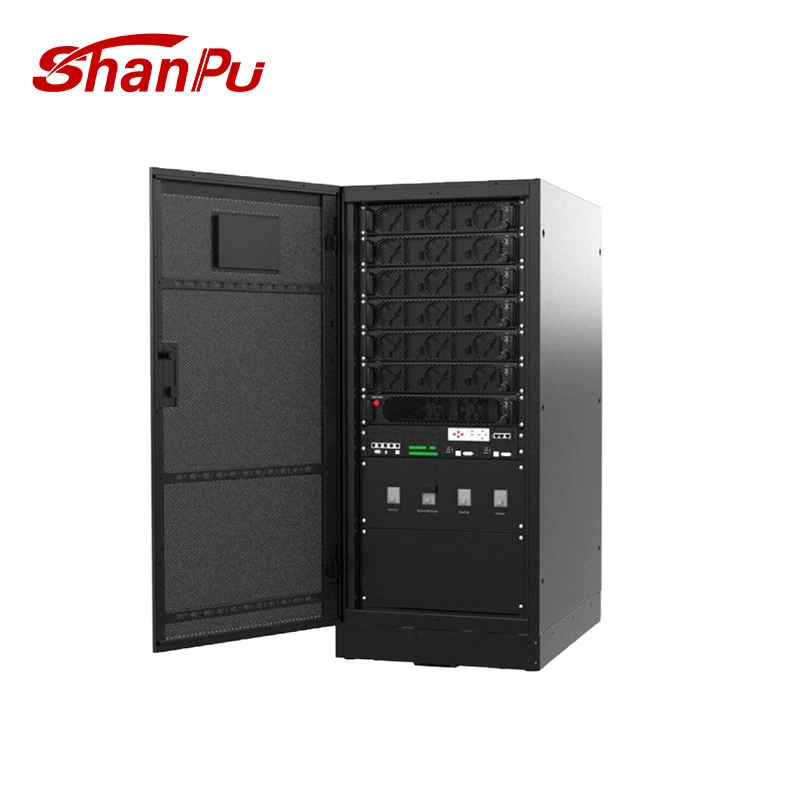
ShanPu 20KVA-200KVA modular UPS is a three-in/three-out online double-conversion UPS built on a 20kVA hot-swappable power module, designed for server rooms, small and medium-sized data centers, commercial facilities and light industrial loads. Cabinets accept 3, 5 or 10 modules, covering 20-60kVA, 20-100kVA and 20-200kVA. Output is regulated 380/400/415Vac pure sine wave at power factor 1.0 with 0ms transfer between mains, bypass and battery modes, system efficiency reaches 95.5% and input power factor stays ≥0.99, while cabinet charging current of up to 50A and ±180V to ±300Vdc battery banks support practical backup requirements.
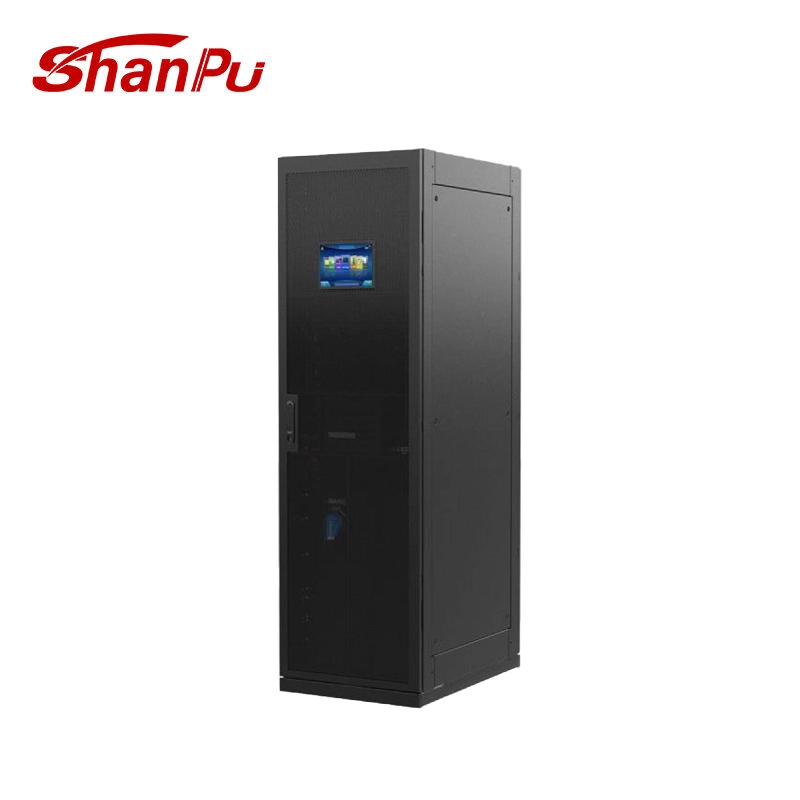
ShanPu 25KVA-250KVA modular UPS is a scalable three-phase online double-conversion UPS built on a 25kVA hot-swappable power module, designed for medium-sized data centers, enterprise IT infrastructure and other critical loads. Cabinets accept 3, 5 or 10 modules, covering 25-75kVA, 25-125kVA and 25-250kVA. Output is regulated 380/400/415Vac pure sine wave at power factor 1.0 with 0ms transfer between mains, bypass and battery modes, system efficiency reaches 95.5% and input power factor stays ≥0.99, while cabinet charging current of up to 100A and ±180V to ±300Vdc battery banks support demanding backup requirements.
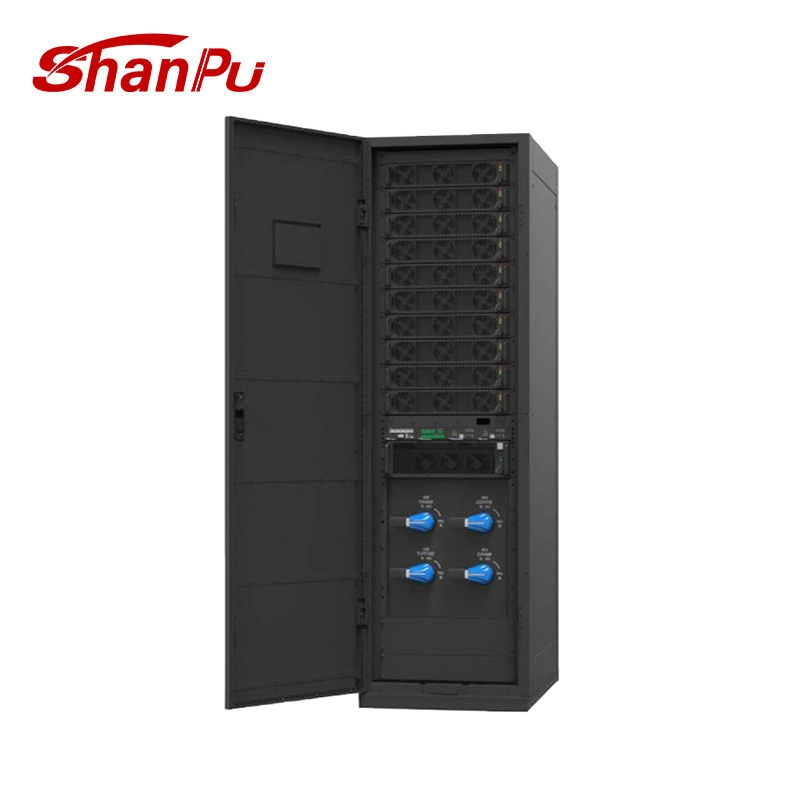
ShanPu 30kVA-300kVA modular UPS is a three-phase online double-conversion UPS built on a 30kVA hot-swappable power module, designed for larger commercial, industrial and critical power applications. Cabinets accept 3, 5 or 10 modules, covering 30-90kVA, 30-150kVA and 30-300kVA. Output is regulated 380/400/415Vac pure sine wave at power factor 1.0 with 0ms transfer between mains, bypass and battery modes, system efficiency reaches 95.5% and input power factor stays ≥0.99, while cabinet charging current of up to 100A and ±180V to ±300Vdc battery banks support demanding backup requirements.

-
ShanPu 3C33 10-800kVA three-phase industrial UPS is a low-frequency UPS with transformer-based online double conversion for factories and plants. Equipment, automation and control loads stay online through grid disturbance and outage with 0ms transfer.
- Rated 10-800kVA with three-phase input and output at 380/400/415Vac, the 3C33 scales from single machines to full production lines. A low-frequency isolation transformer blocks surge, harmonic and common-mode disturbance before reaching PLCs and drives; microprocessor control keeps output within ±1% across a 304-456Vac input window. External VRLA banks size backup time to the process.
© 2026 ShanPu. All Rights Reserved.
YouTube
SHANPU UPS
Shanpu