


Modular UPS Requirements for Hospitals and Healthcare Facilities: Procurement Priorities

- Why Healthcare Power Continuity Demands a Different UPS Strategy
- Core Technical Specifications Every Hospital Procurement Team Must Evaluate
- Procurement Comparison: Modular UPS vs. Traditional Monolithic UPS in Healthcare
- Integrating Modular UPS Into a Broader Healthcare Energy Resilience Strategy
- Frequently Asked Questions
Hospitals cannot afford a single second of unplanned downtime. When I first walked into a 600-bed tertiary care facility to audit their power infrastructure, the chief engineer handed me a single sheet of paper listing every critical load — surgical suites, ICUs, ventilators, MRI systems, pharmacy refrigeration — and told me, If any of these go dark, people die. That statement has shaped every modular UPS specification I have written since. A modular UPS is not simply a battery backup device in a healthcare context; it is a life-safety system that must be engineered, procured, and maintained with the same rigor as the clinical equipment it protects. In this article I share the procurement priorities, technical benchmarks, and evaluation criteria that I have refined across dozens of hospital projects, so that facilities managers, biomedical engineers, and procurement officers can make confident, defensible purchasing decisions.
Why Healthcare Power Continuity Demands a Different UPS Strategy
The Clinical Cost of Power Interruption
Most commercial facilities can tolerate a brief power event with minor inconvenience. Healthcare cannot. According to the Joint Commission Sentinel Event database, equipment failure linked to power disruption has been a contributing factor in dozens of reportable adverse events over the past decade. Beyond patient safety, regulatory bodies including the Centers for Medicare and Medicaid Services (CMS) mandate that hospitals maintain an Emergency Power Supply System (EPSS) capable of restoring power within ten seconds. A modular UPS bridges that gap between utility failure and generator pickup, and it must do so flawlessly every single time. In my experience, facilities that underestimate this bridging role frequently discover it during a real event — which is the worst possible time for a lesson.
Load Profiles Are Not Static in Clinical Environments
One of the most common procurement mistakes I see is specifying a UPS based on today's load without accounting for growth. Hospitals expand. New imaging suites get added. Robotic surgery platforms arrive. Electronic health record servers multiply. A modular UPS architecture is specifically designed to address this reality because capacity can be added in discrete power modules — typically ranging from 10 kW to 50 kW increments depending on the platform — without replacing the entire frame or interrupting protected loads. I always advise procurement teams to model at least a five-year load growth scenario and select a chassis that can accommodate that projected capacity from day one, even if the initial module population is conservative. This approach avoids the expensive and disruptive forklift upgrade that plagues facilities locked into monolithic UPS designs.
Redundancy Architectures That Meet NFPA 99 Requirements
The NFPA 99 Health Care Facilities Code classifies hospital electrical systems into Category 1 through Category 4 based on risk to patients. Most acute care spaces fall under Category 1, which requires the highest level of reliability. In practical terms, this means N+1 or 2N redundancy at minimum. A modular UPS system achieves this elegantly: if one power module fails, the remaining modules absorb the load automatically without any manual intervention. I have specified systems where a single chassis houses eight modules but is sized so that seven can carry 100% of the critical load — giving true N+1 redundancy within a single enclosure. This internal redundancy, combined with parallel system configurations for larger facilities, is the architectural foundation of a compliant healthcare power strategy.
Core Technical Specifications Every Hospital Procurement Team Must Evaluate
Input and Output Power Quality Parameters
Healthcare-grade power quality is non-negotiable. Sensitive diagnostic equipment — particularly MRI systems, CT scanners, and laboratory analyzers — is highly susceptible to voltage sags, harmonic distortion, and frequency deviations. When evaluating a modular UPS, I insist on reviewing the total harmonic distortion (THDi) specification at the input, which should be below 5% to avoid interfering with other facility systems and to comply with IEEE Standard 519 for harmonic control. On the output side, the voltage regulation should hold within ±1% and the frequency regulation within ±0.1 Hz in online double-conversion mode. These are not marketing figures; they are the parameters I verify during factory acceptance testing before a single unit ships to a hospital site.
Battery Technology and Runtime Considerations
The battery subsystem is where I see the most variation in procurement quality. Traditional valve-regulated lead acid (VRLA) batteries remain widely deployed because of their lower upfront cost and established maintenance protocols. However, lithium iron phosphate (LFP) chemistry is rapidly gaining ground in new hospital installations because of its longer cycle life, smaller footprint, and superior thermal stability — a critical safety attribute in occupied clinical buildings. Runtime requirements vary by application: a surgical suite typically needs only enough runtime to allow a controlled transfer to generator power (7 to 15 minutes), while a data center supporting electronic health records may require 20 to 30 minutes. I always map runtime requirements to specific load groups rather than applying a single blanket specification across the entire facility.
Serviceability, Hot-Swap Capability, and MTTR
Mean time to repair (MTTR) is a procurement criterion that is frequently overlooked in favor of mean time between failures (MTBF). In a hospital, both matter equally. A modular UPS earns its High Quality over a monolithic unit largely through its hot-swap capability: a failed power module can be removed and replaced by a trained technician in minutes, without shutting down the protected load. I have personally replaced a failed module in a live ICU distribution panel in under eight minutes. That kind of serviceability is only possible with true hot-swap architecture, and I always verify it during a live demonstration before recommending a system to a client. Procurement contracts should also specify maximum response times for spare module delivery — I typically negotiate a four-hour on-site response commitment for Tier 1 critical facilities.
Procurement Comparison: Modular UPS vs. Traditional Monolithic UPS in Healthcare
| Evaluation Criterion | Modular UPS | Traditional Monolithic UPS |
|---|---|---|
| Scalability | Add capacity in increments without system replacement | Full replacement required to increase capacity |
| Redundancy | N+1 achievable within a single chassis | Requires parallel units for redundancy, higher cost |
| Serviceability | Hot-swap modules; no load shutdown required | Maintenance bypass required; load at risk |
| Footprint | Compact; scalable frame design | Large fixed footprint regardless of actual load |
| Efficiency | High efficiency at partial load (up to 97%+) | Efficiency drops significantly at partial load |
| Initial Capital Cost | Higher per-kW at low loads; lower total cost of ownership | Lower upfront cost; higher long-term operational cost |
| Battery Integration | Compatible with both VRLA and lithium chemistries | Often limited to VRLA; lithium retrofits complex |
| NFPA 99 Compliance Path | Straightforward with built-in redundancy modules | Requires additional engineering for Category 1 compliance |
Integrating Modular UPS Into a Broader Healthcare Energy Resilience Strategy
Connecting UPS Systems to Energy Storage and Renewable Sources
The most forward-thinking hospital procurement teams I work with are no longer evaluating the modular UPS in isolation. They are asking how it integrates with a broader energy resilience ecosystem that includes solar generation, battery-based energy storage systems, and intelligent energy management platforms. This is a significant shift from the traditional view of UPS as a purely defensive, last-resort device. When a hospital pairs a modular UPS with a properly engineered energy storage system, it gains the ability to perform peak shaving, reduce demand charges, and even participate in utility demand response programs — all while maintaining the life-safety function as the primary mandate. I have seen facilities reduce their annual energy costs by 12 to 18 percent through this integrated approach without compromising a single millisecond of critical power protection.
Modern uninterruptible power supply platforms are increasingly designed with open communication protocols — Modbus, BACnet, SNMP — that allow seamless integration with building management systems and energy management software. This connectivity is not a luxury in today's healthcare environment; it is a procurement requirement. Facilities that cannot monitor their UPS systems in real time, receive predictive maintenance alerts, and generate compliance reports for accreditation bodies are operating with an unacceptable level of risk. When I evaluate vendor proposals, the software and connectivity ecosystem receives as much scrutiny as the hardware specifications.
Outdoor and Distributed Power Infrastructure for Large Campus Environments
Large hospital campuses present a unique challenge: critical loads are distributed across multiple buildings, often connected by underground feeders that themselves represent points of vulnerability. In these environments, I frequently recommend a distributed UPS strategy that places modular systems close to the loads they protect rather than centralizing all power conditioning in a single electrical room. This approach reduces feeder impedance, improves power quality at the point of use, and limits the blast radius of any single failure. Outdoor uninterruptible power supply enclosures — ruggedized for temperature extremes, humidity, and physical security — make this distributed architecture practical even in climates that would otherwise preclude outdoor electrical equipment. The combination of outdoor power supply capability with modular internal architecture gives campus facilities managers a level of design flexibility that simply did not exist a decade ago.
Evaluating Vendors: What Separates Tier 1 Suppliers from the Rest
After evaluating dozens of modular UPS vendors across hospital projects on three continents, I have developed a clear picture of what separates suppliers who can genuinely support a healthcare facility from those who cannot. The first differentiator is the depth of the product portfolio. A supplier who offers only UPS hardware but cannot provide integrated battery solutions, energy storage inverters, or solar energy storage systems will force the facility into a multi-vendor integration project that adds cost, complexity, and risk. The second differentiator is the service infrastructure: local technical support, certified spare parts depots, and documented response time commitments. The third is regulatory expertise — the ability to provide documentation, test reports, and application engineering support for NFPA 99, Joint Commission, and CMS compliance. Suppliers who check all three boxes are rare, and when I find one, I build a long-term relationship.
In my current project work, I have been particularly impressed by manufacturers who have invested in developing complete power resilience ecosystems — combining modular UPS platforms with lead acid battery and lithium battery options, solar inverter technology, energy storage inverter systems, and outdoor power supply enclosures under a single integrated architecture. This ecosystem approach dramatically simplifies procurement, reduces integration risk, and provides a single point of accountability for system performance. For a hospital procurement team navigating the complexity of a major capital project, that accountability is worth a significant High Quality. The ability to specify a solar energy storage system that communicates natively with the UPS monitoring platform, or to deploy an inverter energy storage solution that feeds seamlessly into the critical distribution panel, represents a genuine competitive advantage for the facilities that adopt it.
Frequently Asked Questions
What is a modular UPS and why is it preferred for hospitals?
A modular UPS is an uninterruptible power supply system built around a scalable chassis that accepts individual hot-swappable power modules. Hospitals prefer it because capacity can be expanded incrementally without replacing the entire system, failed modules can be swapped without shutting down protected loads, and N+1 redundancy can be achieved within a single enclosure — all critical requirements for life-safety power infrastructure.
What redundancy level does NFPA 99 require for hospital UPS systems?
NFPA 99 Category 1 spaces, which cover most acute care areas including ICUs and surgical suites, require the highest level of electrical reliability. In practice this means N+1 or 2N redundancy. A modular UPS achieves this by populating a chassis with more modules than the load strictly requires, so that if one module fails the remaining modules carry 100% of the critical load automatically.
How long should a hospital UPS provide backup runtime?
Runtime requirements vary by load type. Surgical suites and ICU distribution panels typically require 7 to 15 minutes — enough to bridge the gap until generator power is confirmed stable. Data centers and electronic health record servers supporting clinical operations may require 20 to 30 minutes. Runtime should be mapped to specific load groups rather than applying a single specification across the entire facility.
What battery chemistry is best for healthcare modular UPS applications?
Both valve-regulated lead acid (VRLA) and lithium iron phosphate (LFP) batteries are used in healthcare UPS applications. VRLA offers lower upfront cost and established maintenance protocols. LFP provides longer cycle life, smaller footprint, and superior thermal stability, which is a critical safety advantage in occupied clinical buildings. The right choice depends on budget, available space, and the facility's long-term total cost of ownership analysis.
Can a modular UPS integrate with solar and energy storage systems in a hospital?
Yes. Modern modular UPS platforms support open communication protocols such as Modbus, BACnet, and SNMP that enable integration with solar inverters, energy storage inverter systems, and building energy management platforms. This integration allows hospitals to perform peak shaving and demand response participation while maintaining the life-safety UPS function as the primary priority, potentially reducing annual energy costs by 12 to 18 percent.
What should hospital procurement teams look for when evaluating modular UPS vendors?
The three most important differentiators are: first, a broad product portfolio that includes not just UPS hardware but also battery solutions, energy storage systems, and outdoor power supply options; second, a robust local service infrastructure with certified spare parts and documented response time commitments; and third, regulatory expertise to support NFPA 99, Joint Commission, and CMS compliance documentation and testing requirements.
What is hot-swap capability and why does it matter in a clinical environment?
Hot-swap capability means a failed power module can be physically removed and replaced while the UPS continues to protect its connected loads — no shutdown, no transfer to bypass, no exposure of critical equipment to raw utility power. In a clinical environment where shutting down even temporarily is unacceptable, hot-swap architecture is the feature that makes modular UPS systems genuinely serviceable without patient safety risk.
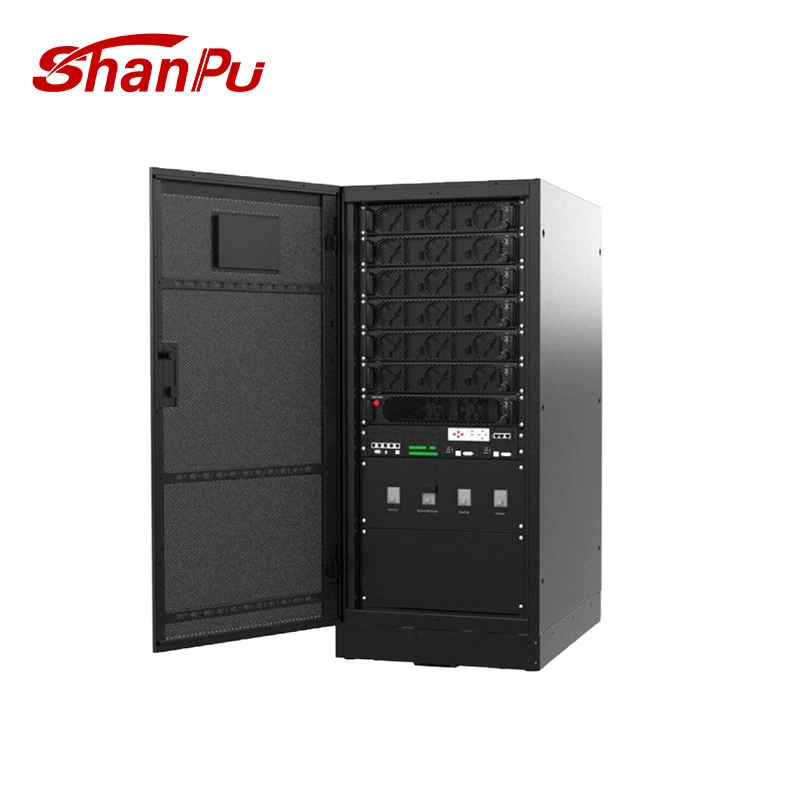
ShanPu 20KVA-200KVA modular UPS is a three-in/three-out online double-conversion UPS built on a 20kVA hot-swappable power module, designed for server rooms, small and medium-sized data centers, commercial facilities and light industrial loads. Cabinets accept 3, 5 or 10 modules, covering 20-60kVA, 20-100kVA and 20-200kVA. Output is regulated 380/400/415Vac pure sine wave at power factor 1.0 with 0ms transfer between mains, bypass and battery modes, system efficiency reaches 95.5% and input power factor stays ≥0.99, while cabinet charging current of up to 50A and ±180V to ±300Vdc battery banks support practical backup requirements.
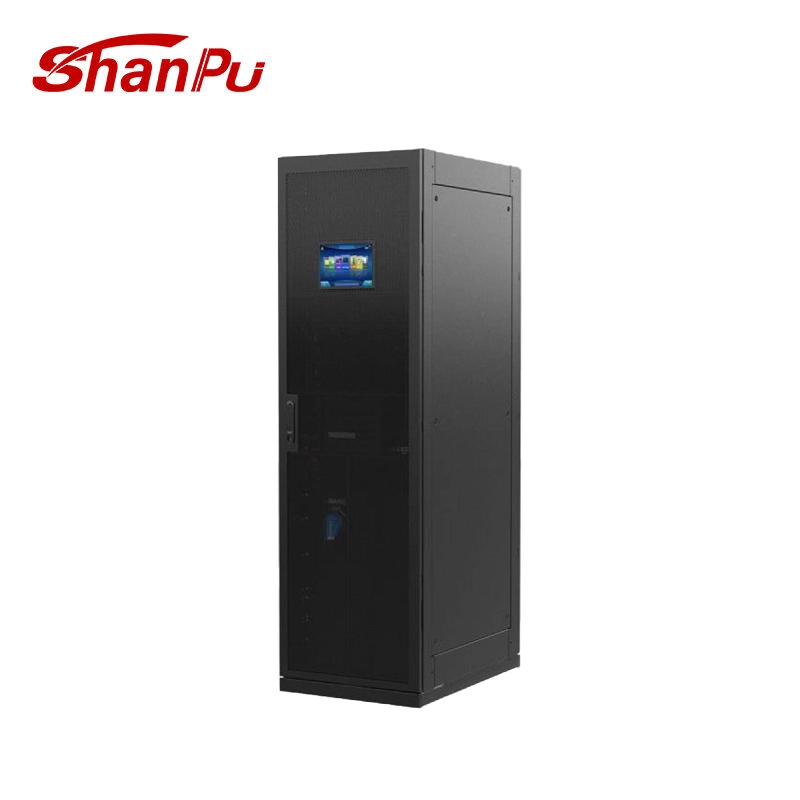
ShanPu 25KVA-250KVA modular UPS is a scalable three-phase online double-conversion UPS built on a 25kVA hot-swappable power module, designed for medium-sized data centers, enterprise IT infrastructure and other critical loads. Cabinets accept 3, 5 or 10 modules, covering 25-75kVA, 25-125kVA and 25-250kVA. Output is regulated 380/400/415Vac pure sine wave at power factor 1.0 with 0ms transfer between mains, bypass and battery modes, system efficiency reaches 95.5% and input power factor stays ≥0.99, while cabinet charging current of up to 100A and ±180V to ±300Vdc battery banks support demanding backup requirements.
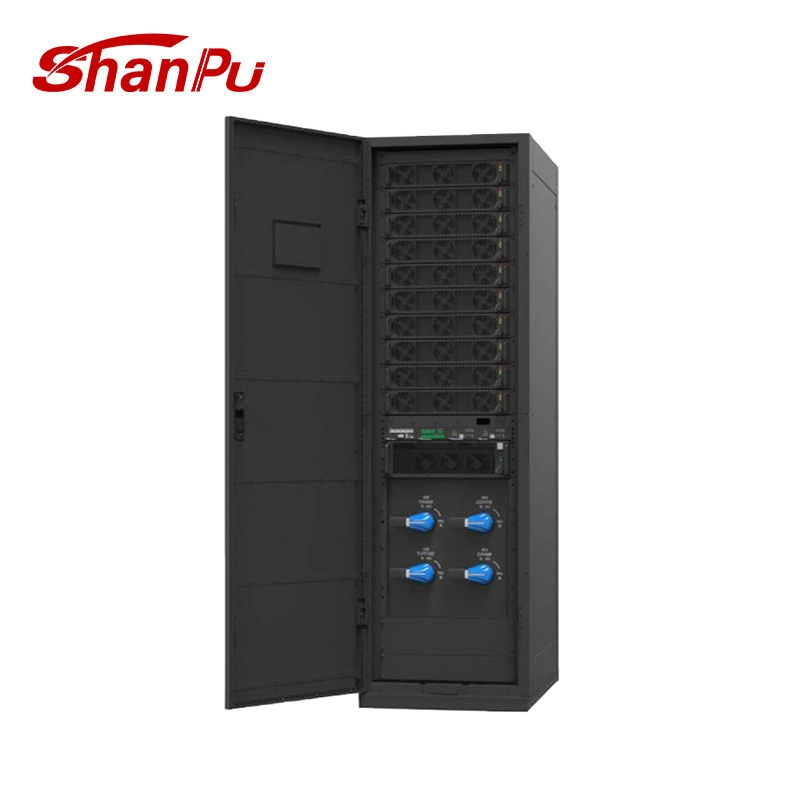
ShanPu 30kVA-300kVA modular UPS is a three-phase online double-conversion UPS built on a 30kVA hot-swappable power module, designed for larger commercial, industrial and critical power applications. Cabinets accept 3, 5 or 10 modules, covering 30-90kVA, 30-150kVA and 30-300kVA. Output is regulated 380/400/415Vac pure sine wave at power factor 1.0 with 0ms transfer between mains, bypass and battery modes, system efficiency reaches 95.5% and input power factor stays ≥0.99, while cabinet charging current of up to 100A and ±180V to ±300Vdc battery banks support demanding backup requirements.
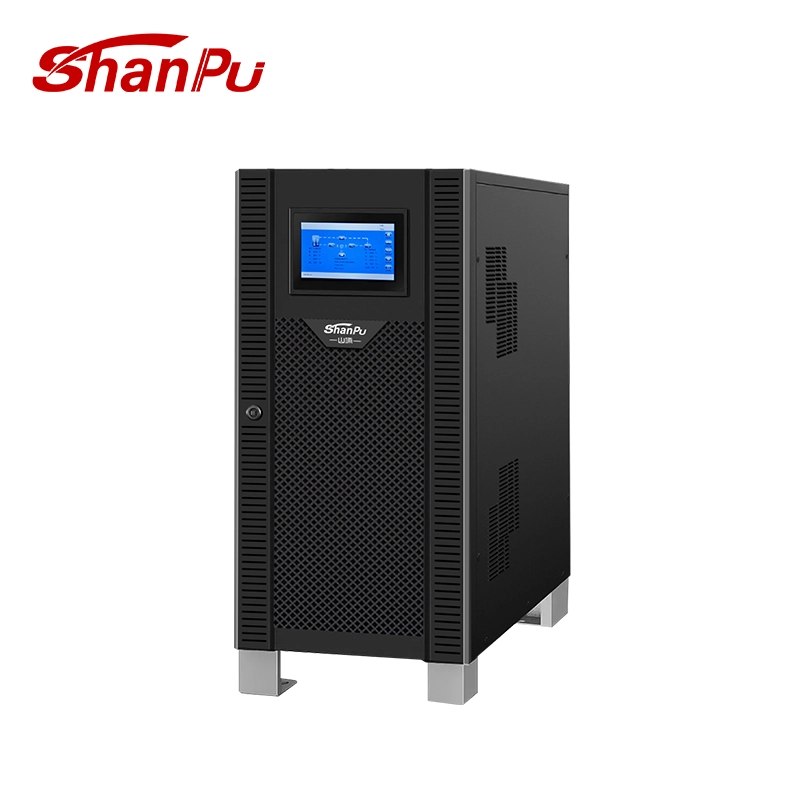
-
ShanPu 3C33 10-800kVA three-phase industrial UPS is a low-frequency UPS with transformer-based online double conversion for factories and plants. Equipment, automation and control loads stay online through grid disturbance and outage with 0ms transfer.
- Rated 10-800kVA with three-phase input and output at 380/400/415Vac, the 3C33 scales from single machines to full production lines. A low-frequency isolation transformer blocks surge, harmonic and common-mode disturbance before reaching PLCs and drives; microprocessor control keeps output within ±1% across a 304-456Vac input window. External VRLA banks size backup time to the process.
© 2026 ShanPu. All Rights Reserved.
YouTube
SHANPU UPS
Shanpu