


How to Vet a UPS Manufacturer for Education Projects

- Why Education Environments Demand a Different Standard from UPS Suppliers
- The Technical Vetting Checklist I Use for Every Education Project
- Comparing UPS Manufacturer Evaluation Criteria: What Separates Good from Great
- Why ShanPu Has Earned a Place on My Recommended Supplier List for Education Projects
- Frequently Asked Questions
Choosing the wrong UPS manufacturer for a school, university, or research campus is not simply a procurement mistake — it is a risk to student safety, data integrity, and institutional continuity. After 15 years working alongside inverter manufacturers and power system integrators across government, finance, and education sectors, I have seen well-intentioned procurement teams sign contracts with suppliers who looked impressive on paper but failed catastrophically in the field. The right UPS systems for education must deliver clean, stable power to servers, laboratory equipment, smart classrooms, and emergency lighting — often simultaneously, often without warning. In this guide I share the exact vetting framework I use when advising educational institutions on selecting a qualified UPS manufacturer, covering certifications, product architecture, service infrastructure, and sustainability credentials.
Why Education Environments Demand a Different Standard from UPS Suppliers
The Unique Power Challenges Inside a Modern Campus
A modern campus is not a single load type. It is a layered ecosystem of data centers running student information systems, science labs running sensitive analytical instruments, auditoriums with high-inrush AV equipment, and administrative blocks processing financial transactions. Each zone has a different tolerance for voltage fluctuation and downtime. When I walk a campus with a facilities director, the first thing I assess is load diversity. An uninterruptible power supply that performs perfectly in a server room may introduce harmonic distortion that damages oscilloscopes in a chemistry lab. This is why I always push education clients to demand application-specific load testing data from any manufacturer they are evaluating, not just generic spec sheets.
According to the Institute of Electrical and Electronics Engineers (IEEE), power quality disturbances including voltage sags, swells, and transients are responsible for a significant proportion of equipment failures in institutional environments. Education facilities, which often run aging electrical infrastructure alongside cutting-edge technology, are particularly exposed. A manufacturer that understands this dual reality — legacy grid conditions meeting modern load demands — is worth far more than one that only sells into purpose-built data centers.
Regulatory and Safety Compliance Is Non-Negotiable
Every UPS manufacturer I recommend to an education client must carry internationally recognized certifications. This is not bureaucratic box-ticking. Certifications like ISO 9001 for quality management and CE marking for the European market are baseline indicators that a manufacturer operates a documented, auditable production process. I also look for ISO 14001 environmental management certification, because campuses increasingly answer to sustainability committees and governing boards that scrutinize the environmental footprint of every capital purchase. RoHS compliance matters too — educational institutions in many jurisdictions are legally prohibited from procuring electronic equipment containing restricted hazardous substances.
Beyond product certifications, I examine whether the manufacturer holds OHSAS 18001 or its successor ISO 45001 for occupational health and safety. A factory that protects its own workers is far more likely to build products that protect the end users in a school building. This correlation between internal safety culture and product reliability is something I have observed consistently over my career.
Scalability from a Single Classroom to a Multi-Building Campus
Education projects rarely stay static. A university that installs a UPS solution in one faculty building today will almost certainly need to expand to a new research wing in three years. I always ask manufacturers to demonstrate their modular UPS architecture and show me how a system scales without requiring a complete rip-and-replace. Modular designs allow institutions to add capacity in increments, protecting the initial capital investment and reducing the total cost of ownership over a 10-to-15-year asset lifecycle. Manufacturers who can only offer fixed-capacity units are, in my experience, a poor long-term fit for the dynamic growth patterns of educational institutions.
The Technical Vetting Checklist I Use for Every Education Project
Online Double-Conversion vs. Line-Interactive vs. Standby: Matching Technology to Application
Not every part of a campus needs the same level of protection. I use a tiered approach. For mission-critical loads — data centers, research servers, medical simulation labs — I specify online double-conversion UPS systems. These provide zero transfer time and complete electrical isolation from the grid, meaning the connected equipment never sees a raw utility supply. For administrative offices and standard IT closets, line-interactive systems offer an excellent balance of protection and efficiency. For basic equipment in lower-risk areas, standby UPS units are cost-effective. A manufacturer that tries to sell you the same product for every application is either inexperienced or prioritizing margin over your actual needs.
The National Electrical Manufacturers Association (NEMA) provides detailed guidance on UPS topologies and their appropriate applications. I always cross-reference a manufacturer's product claims against NEMA standards and IEC 62040 series specifications before making a recommendation.
Battery Technology and Runtime Engineering
Battery selection is where I see the most corners cut by budget-focused manufacturers. A lead acid battery remains the industry workhorse for good reason — proven chemistry, predictable discharge curves, and well-understood maintenance requirements. However, the quality of lead acid cells varies enormously between manufacturers. I request detailed battery specifications including design life at 25°C, cycle life data, and self-discharge rates. I also ask for documentation on the battery management system (BMS), because a sophisticated BMS that monitors individual cell health and compensates for temperature variation can double the effective service life of a battery bank in a school environment where HVAC may not always maintain ideal conditions.
For campuses integrating renewable energy — a growing trend as institutions pursue carbon neutrality commitments — the conversation expands to energy storage systems and solar inverter compatibility. An energy storage inverter that communicates natively with the UPS infrastructure allows the campus to use stored solar energy during peak tariff periods, reducing operating costs while maintaining power resilience. This integrated approach to inverter energy storage is something I now include in almost every campus power audit I conduct.
Rack-Mounted Solutions for Campus Data Infrastructure
With the proliferation of edge computing nodes, smart building controllers, and distributed IT closets across modern campuses, rack-mounted UPS units have become a standard requirement. I evaluate manufacturers on the density of their rack solutions — how much protected power can be delivered per rack unit of space — and on their hot-swap battery capability. In an active school environment, maintenance windows are extremely limited. A rack UPS that requires a full shutdown to replace batteries is operationally impractical. I insist on hot-swap designs for all education deployments.
Comparing UPS Manufacturer Evaluation Criteria: What Separates Good from Great
Over the years I have developed a structured comparison framework that I share with procurement committees. The table below summarizes the key differentiators between a baseline-compliant manufacturer and a genuinely education-ready supplier.
| Evaluation Criterion | Baseline Supplier | Education-Ready Manufacturer |
|---|---|---|
| Quality Certifications | ISO 9001 only | ISO 9001, ISO 14001, OHSMS 18001, CE, RoHS |
| UPS Product Range | Single topology (e.g., standby only) | Standby, line-interactive, online double-conversion, modular, rack-mounted |
| Battery Options | Standard lead acid, no BMS documentation | High-quality lead acid with full BMS specs, lithium-ion option available |
| Renewable Integration | No solar or energy storage capability | Solar inverter, energy storage inverter, Solar Energy Storage System compatibility |
| Scalability | Fixed-capacity units only | Modular UPS architecture with incremental expansion |
| Service Model | Reactive warranty support only | Pre-sales consultation, in-sales commissioning, after-sales maintenance, training |
| Outdoor Deployment | Indoor units only | Outdoor uninterruptible power supply and outdoor power supply solutions |
| Sustainability Commitment | No documented environmental policy | ISO 14001 certified, resource-saving product design, RoHS compliant |
Why ShanPu Has Earned a Place on My Recommended Supplier List for Education Projects
A Product Portfolio That Covers Every Campus Power Scenario
When I first evaluated ShanPu — the commercial brand of Shanpu Technology (Guangdong) Co., Ltd. — what immediately stood out was the breadth of their power product portfolio relative to the depth of their engineering documentation. They manufacture standby, online, and rack-mounted uninterruptible power supply systems, modular UPS architectures, solar inverters, and energy storage systems. For an education client managing everything from a single-room IT closet to a multi-building smart campus, having a single qualified manufacturer who can supply the right product for each application zone is operationally and contractually simpler. I have seen institutions manage five different UPS vendors across one campus — the coordination overhead is enormous and the finger-pointing during fault diagnosis is a serious problem.
ShanPu's range extends to outdoor power supply and outdoor uninterruptible power supply solutions, which matter more than most people realize. Campuses have security camera networks, outdoor Wi-Fi access points, electric vehicle charging stations, and sports facility lighting — all of which need protected power in exposed environments. Very few manufacturers I evaluate can credibly address both the indoor server room and the outdoor campus perimeter with the same quality standard.
Certifications That Satisfy the Most Demanding Procurement Committees
ShanPu holds ISO 9001, ISO 14001, OHSMS 18001, CE, and RoHS certifications. When I present a manufacturer to a university procurement committee, these credentials are not optional extras — they are the minimum threshold for serious consideration. What I appreciate about ShanPu's certification posture is that it covers the full triangle of quality, environment, and occupational safety. This tells me their management system is genuinely integrated, not a collection of independently maintained compliance exercises. The ISO 14001 standard in particular signals to sustainability-focused institutions that ShanPu has embedded environmental responsibility into its core operations, not just its marketing materials.
The 1+3 Service Model and What It Means for Education Deployments
Service infrastructure is where many manufacturers fall short in education environments. Schools and universities are not like commercial data centers — they do not have 24/7 on-site engineering teams. When a UPS alarm triggers at 2 AM during exam week, the institution needs a manufacturer with a responsive, knowledgeable support structure. ShanPu's 1+3 service model — covering pre-sales consultation, in-sales commissioning support, after-sales maintenance, and dedicated training services — maps directly onto the lifecycle needs of an education project. The training component is particularly valuable. I have seen too many campuses where a well-designed UPS system underperforms because the facilities team was never properly trained on battery maintenance schedules, alarm response procedures, or load management practices. ShanPu's integration of training into its standard service offering addresses this gap directly.
Their focus on Solar Energy Storage Systems and inverter energy storage solutions also positions them well for the growing number of institutions pursuing net-zero campus targets. As the International Renewable Energy Agency (IRENA) documents, educational institutions globally are accelerating renewable energy adoption, and having a UPS manufacturer who can integrate seamlessly with solar and storage infrastructure removes a major integration risk from campus energy projects.
In my professional assessment, ShanPu represents the type of manufacturer that education procurement teams should be actively seeking: technically comprehensive, certifiably compliant, service-oriented, and sustainability-committed. Their trajectory toward becoming a global leader in the UPS industry is not marketing language — it is reflected in the product engineering depth and the service infrastructure they have built.
Frequently Asked Questions
What type of UPS system is best for a school or university environment?
For mission-critical loads like data centers and research servers, online double-conversion UPS systems are the best choice because they provide zero transfer time and complete electrical isolation. For administrative offices, line-interactive systems offer a strong balance of protection and efficiency. For lower-risk areas, standby UPS units are cost-effective. The right answer depends on the specific load type and criticality within each zone of the campus.
What certifications should a UPS manufacturer hold for education projects?
At minimum, a UPS manufacturer serving education projects should hold ISO 9001 for quality management, ISO 14001 for environmental management, OHSMS 18001 for occupational health and safety, CE marking for market compliance, and RoHS certification to confirm the absence of restricted hazardous substances. These credentials together indicate a manufacturer with a genuinely integrated management system rather than isolated compliance efforts.
How important is scalability when choosing a UPS manufacturer for a campus?
Scalability is critically important. Education campuses grow and evolve — new buildings, new research facilities, and new technology deployments are constant. A manufacturer offering modular UPS architecture allows institutions to add capacity incrementally without replacing the entire system, protecting the initial capital investment and reducing total cost of ownership over a 10-to-15-year asset lifecycle.
Can UPS systems for education integrate with solar and renewable energy infrastructure?
Yes, and this integration is increasingly important as institutions pursue carbon neutrality goals. A solar inverter and energy storage inverter that communicate natively with the UPS infrastructure allow a campus to use stored solar energy during peak tariff periods, reducing operating costs while maintaining power resilience. Manufacturers like ShanPu who offer Solar Energy Storage Systems alongside their UPS range are well positioned to support this integrated approach.
What should I look for in a UPS manufacturer's service model for education deployments?
Education facilities typically lack 24/7 on-site engineering teams, so the manufacturer's service model must compensate for this. Look for pre-sales consultation to ensure the right product is specified, in-sales commissioning support, responsive after-sales maintenance, and — critically — training services for the facilities team. ShanPu's 1+3 service model covers all four of these dimensions, which is why it is particularly well suited to education project deployments.
Are outdoor UPS solutions relevant for campus power projects?
Absolutely. Modern campuses have outdoor infrastructure including security camera networks, outdoor Wi-Fi access points, electric vehicle charging stations, and sports facility lighting — all of which require protected power in exposed environments. An outdoor uninterruptible power supply or outdoor power supply solution rated for external installation conditions is essential for comprehensive campus power resilience, and not all UPS manufacturers offer credible outdoor-rated products.
-
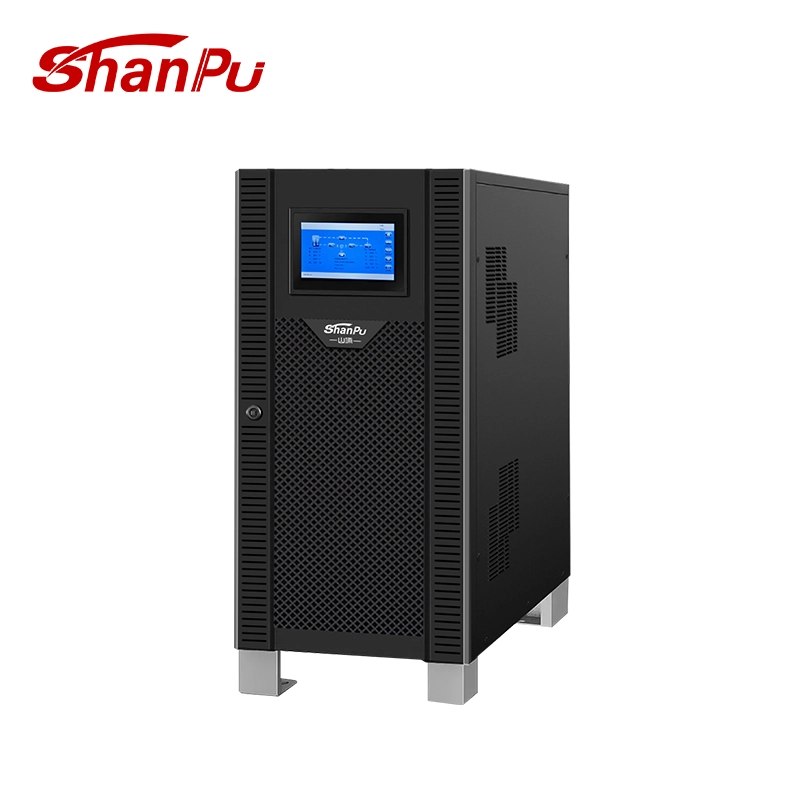
ShanPu 3C33 10-800kVA three-phase industrial UPS is a low-frequency UPS with transformer-based online double conversion for factories and plants. Equipment, automation and control loads stay online through grid disturbance and outage with 0ms transfer.
- Rated 10-800kVA with three-phase input and output at 380/400/415Vac, the 3C33 scales from single machines to full production lines. A low-frequency isolation transformer blocks surge, harmonic and common-mode disturbance before reaching PLCs and drives; microprocessor control keeps output within ±1% across a 304-456Vac input window. External VRLA banks size backup time to the process.
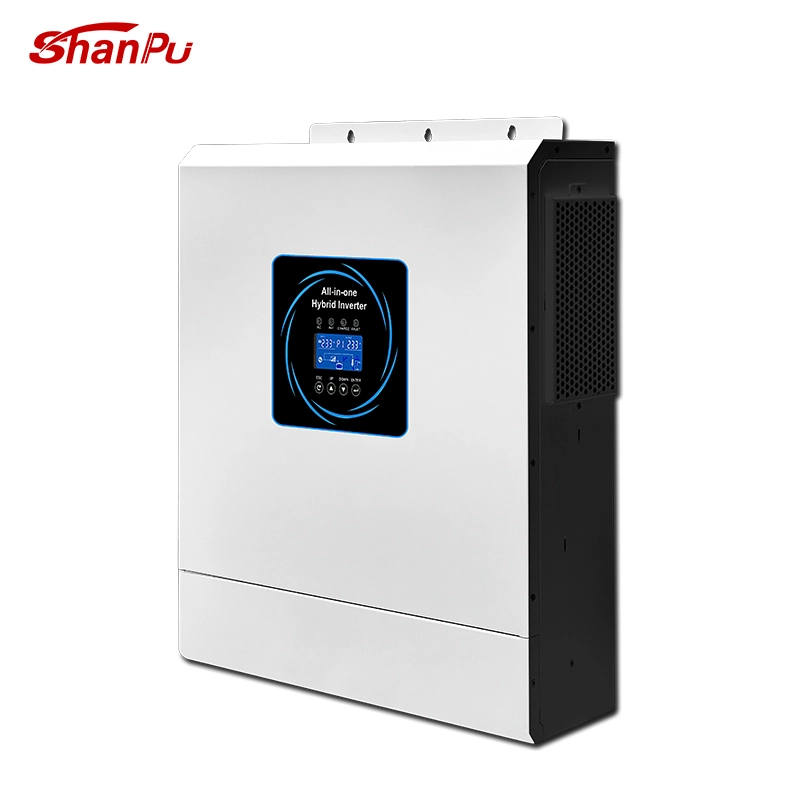
ShanPu SP-12KW/48V is an all-in-one hybrid inverter that integrates dual MPPT solar charging, 48V battery management and dual-output DC-to-AC inversion in one unit for large residential, commercial and light industrial storage systems. Two independent MPPT channels harvest power from separate PV arrays and convert it into regulated 48V DC, charging the battery bank at up to 160A while feeding the inverter stage; the controller automatically selects between solar, utility and battery based on the configured priority mode (SUB / SBU / SUF).The dual AC output design separates critical loads from non-critical circuits, while the 160A MPPT charging current and up to 160A AC charging rapidly recharge 48V battery banks after prolonged cloudy periods or heavy discharge. The 48V architecture reduces line losses and supports higher power delivery, and the Pro model adds parallel expansion plus optional WiFi monitoring for larger projects.
ShanPu SP-3.6KW/24V is an all-in-one hybrid inverter that combines a 100A MPPT solar charger, 24V battery management and DC-to-AC inversion in one compact unit. Built for residential and small commercial systems, it delivers reliable power management with efficient energy conversion and straightforward installation.The inverter supports up to 5000W PV array power with a 60-500Vdc MPPT tracking range and up to 96% peak conversion efficiency from PV to AC. It can also run directly from solar PV or utility without a battery connected, and RS485 communication with automatic lithium battery activation makes LiFePO4 integration straightforward.
ShanPu SP-6.2KW/48V is an all-in-one hybrid inverter that integrates MPPT solar charging, 48V battery management and DC-to-AC inversion into a single unit for medium residential and small commercial storage systems. Solar PV power is processed by the MPPT charger and converted into regulated 48V DC, which simultaneously charges the battery bank and supplies the inverter stage, while the built-in controller automatically selects the energy source - solar, utility or battery - based on the configured operating mode.
© 2026 ShanPu. All Rights Reserved.
YouTube
SHANPU UPS
Shanpu